The Comprehensive Guide to Understanding and Budgeting for Answer Engine Optimization Costs

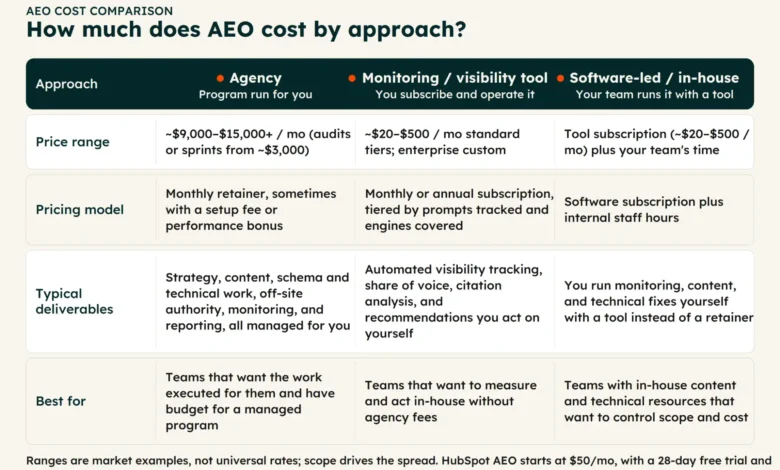
The rapid ascent of generative AI has fundamentally altered the digital landscape, shifting the paradigm from traditional search engine rankings to a new frontier known as Answer Engine Optimization (AEO). As businesses struggle to maintain visibility in a world where AI models like ChatGPT, Gemini, and Perplexity serve as the primary gateways for information, the question of cost has moved to the forefront of marketing strategy. Understanding the financial commitment required for AEO is no longer optional; it is a critical component of digital survival. Costs for AEO currently span a wide spectrum, ranging from entry-level monitoring software at roughly $30 per month to comprehensive, full-service agency retainers that can exceed $15,000 monthly.
The core of this price disparity lies in the divergence between passive observation and active intervention. A business can choose to simply monitor its brand presence within AI outputs, or it can invest in a holistic strategy that includes technical schema optimization, high-frequency content production, and aggressive off-site authority building. As the market matures, companies are increasingly forced to reconcile these costs within their existing marketing budgets, often finding that AEO functions not as a replacement for Search Engine Optimization (SEO), but as an essential, high-stakes evolution of it.
The Evolution of the AEO Marketplace
The rise of AEO corresponds directly to the explosive growth of Large Language Model (LLM) adoption. Over the past 18 months, industry analysts have noted a marked shift in consumer behavior. According to data from Search Engine Land, referral traffic originating from AI-driven search environments nearly tripled between January 2025 and December 2025. While this traffic still accounts for less than 2% of total referral volume in many datasets, the quality of these leads—often characterized by high intent and specific, query-driven interactions—has forced brands to prioritize their appearance in AI-generated summaries.
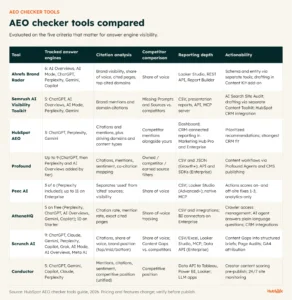
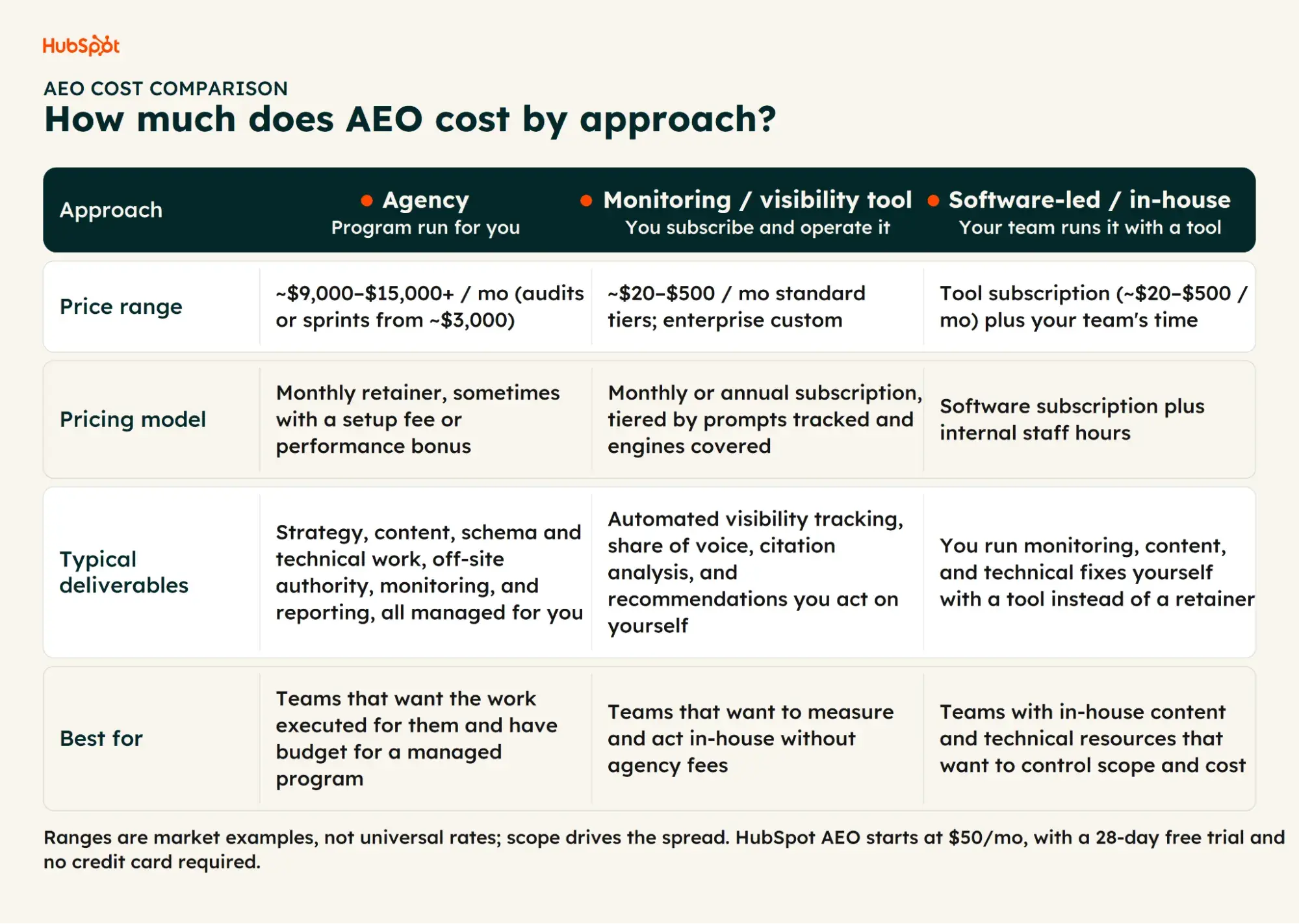
This shift has created a bifurcated market. On one side are the software-as-a-service (SaaS) providers offering diagnostic tools. These platforms, such as HubSpot AEO, Profound, and Peec AI, provide the data necessary for in-house teams to pivot their strategies. Prices for these tools typically fluctuate between $30 and $500 per month, depending on the volume of prompts tracked and the number of search engines monitored. On the other side of the market are digital agencies. These firms offer managed services, where the heavy lifting of content creation and technical entity mapping is outsourced. These high-end retainers are priced at a premium because they replace the need for specialized internal headcount.

Comparative Cost Analysis by Approach
For organizations determining their budgetary footprint, it is helpful to categorize expenditures into three distinct tiers.
The first is the Software-Led Approach, which empowers in-house teams. By utilizing a monitoring tool, a company can track how frequently its brand is cited in AI responses compared to its competitors. This model typically costs between $30 and $500 per month. The primary investment here is not the software itself, but the internal labor hours required to digest the data and execute the necessary content updates.
The second tier involves Hybrid Models, which often include a one-time audit followed by a lower-cost retainer. These setups are ideal for mid-sized enterprises that have internal resources but lack the specialized expertise required to navigate the complexities of AI indexing. Costs for these engagements often start around $3,000 for the initial audit, with ongoing support contracts ranging from $3,000 to $7,000 per month.
Finally, the Full-Service Agency Model represents the ceiling of AEO investment. These programs, which can cost upwards of $15,000 per month, provide end-to-end management. Agencies in this space handle everything from technical schema and structured data implementation to the production of high-authority, AI-friendly content that meets the stringent trust-signal requirements of models like Perplexity and Gemini.
Why Pricing Models Vary
The extreme variance in AEO pricing is driven by several operational factors. First, the size of the content library is a major cost driver. A brand with thousands of pages requires significantly more entity mapping and structured data work than a smaller, boutique operation. Second, the complexity of the industry matters; industries with high-stakes information—such as finance, healthcare, or legal services—require a higher degree of accuracy and source verification, increasing the cost of content production.

Third, the scope of "off-site authority building" is a major variable. Unlike traditional link building for SEO, AEO requires establishing the brand as a recognized entity across the web, which often involves complex digital PR strategies. Finally, the frequency of reporting and the depth of the diagnostic analysis contribute to the retainer price. A firm offering weekly, AI-driven insights with actionable recommendations will inevitably charge more than one providing a monthly, static report.
The Relationship Between AEO and Traditional SEO
A frequent point of confusion for marketing executives is the distinction between SEO and AEO. While both disciplines rely on the same fundamental building blocks—credible content, a technically sound website, and high-quality domain authority—the metrics of success are entirely different. SEO is measured by click-through rates, keyword rankings, and organic traffic volume. AEO, conversely, is measured by brand mentions, citation frequency, and share of voice within LLM responses.
Industry experts warn against the temptation to cannibalize SEO budgets to fund AEO. Because AI models often scrape top-ranking search results to construct their answers, weakening an organization’s SEO profile can lead to a direct decrease in AI visibility. The two disciplines are symbiotic; a robust SEO strategy serves as the bedrock upon which successful AEO is built. Consequently, the most effective budgets are those that integrate both, ensuring that the brand is optimized for the human reader and the AI engine simultaneously.
Identifying Red Flags in AEO Procurement
As with any nascent service category, the lack of standardized practices has invited "snake oil" solutions. Procurement teams should be wary of several red flags. First, any vendor promising "guaranteed #1 spots" in AI answers should be viewed with extreme skepticism. Because AI models are non-deterministic—meaning they produce different answers to the same query based on various factors—guarantees are functionally impossible.
Second, be cautious of agencies that attempt to rebrand standard SEO services as "AEO" without demonstrating a specific methodology for AI-model training or LLM-citation optimization. A legitimate AEO partner will have a transparent process for tracking specific AI engines and will be able to provide data on how the brand is being "hallucinated" or cited across different platforms.
Strategic Planning for a 90-Day Pilot
For firms uncertain about the long-term ROI of AEO, a 60-to-90-day pilot program is the industry-recommended path. The goal of this pilot is not to achieve total dominance, but to establish a baseline of brand presence and to determine the responsiveness of the chosen AI models to specific optimization tactics.
A successful pilot should follow this three-step structure:
- Baseline Assessment: Use a monitoring tool to capture the brand’s current share of voice across ChatGPT, Gemini, and Perplexity. Document the current number of citations and competitor mentions.
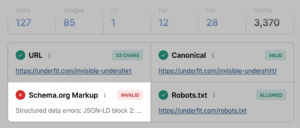
- Lean Optimization: Instead of a full-scale content overhaul, focus on "low-hanging fruit." This includes fixing technical schema issues, ensuring NAP (Name, Address, Phone) consistency across the web, and optimizing the most critical landing pages for entity-based search.
- Trend Tracking: Monitor the data for 90 days. Focus on the trend line of citations rather than daily fluctuations. By the end of the period, the data should provide a clear indicator of whether the optimization efforts are moving the needle.
The Future of AI Search Visibility
The financial implications of ignoring AEO are becoming increasingly clear. As consumers continue to adopt conversational AI as their primary research tool, the brands that fail to appear in these summaries risk being rendered invisible to a growing segment of the market. While the costs for AEO are significant and varied, they should be viewed as a necessary investment in digital infrastructure.
By starting with a clear understanding of the difference between monitoring and execution, and by carefully evaluating the three main tiers of service, businesses can build a sustainable AEO strategy. Whether a firm chooses a self-serve software route at $50 per month or a high-end, $15,000-per-month agency partnership, the objective remains the same: ensuring that when the AI engine constructs an answer, the brand is not just present, but authoritative and cited. The companies that act now to secure their place in the AI-generated future will likely define the market standards for years to come.