The rapid expansion of autonomous AI agents has brought a significant, often overlooked challenge to the forefront of machine learning operations: the "token tax." As developers build increasingly sophisticated systems capable of recursive search, deep-file retrieval, and automated reasoning, the sheer volume of data consumed by Large Language Models (LLMs) has grown exponentially. Every search result, log file, or comment block pulled into an agent’s context window represents a financial and performance cost. Recent industry data suggests that a single, seemingly simple search query—such as looking up local retail locations—can balloon into thousands of tokens due to the inclusion of nested JSON objects, tracking metadata, and redundant UI elements. This inefficiency is driving a push toward more lightweight data serialization formats, with Markdown emerging as a primary contender to replace traditional JSON in AI-centric workflows.
The Anatomy of Token Bloat in AI Systems
To understand the scale of the problem, one must examine how LLMs process information. Unlike traditional databases, which require structured, typed data to execute precise queries, LLMs function by predicting the next token in a sequence. When developers feed raw JSON responses into an LLM, the model must process not only the actual content—the "signal"—but also the structural overhead of the JSON format, such as brackets, quotes, and metadata keys.
In a typical search scenario, a standard API response might contain thousands of characters dedicated to tracking links, internal IDs, and UI-specific configuration. For an AI agent, this data is essentially "noise." It does not aid in reasoning or decision-making, yet the user is billed for every token that passes through the model’s input layer. The cumulative effect of this bloat is profound; it leads to higher API costs, increased latency as models struggle to parse massive inputs, and, perhaps most critically, the premature exhaustion of an LLM’s context window. When an agent is forced to truncate or ignore relevant information to fit within a model’s constraints, the quality of its output inevitably suffers.
Chronology of the Shift: From JSON to Markdown
For years, JSON (JavaScript Object Notation) has been the industry standard for data exchange due to its reliability and machine-readability. It is the backbone of modern web APIs, ensuring that servers and client applications can communicate without ambiguity. However, the rise of "agentic" workflows—systems where the AI is the primary consumer of data—has created a divergence in requirements.
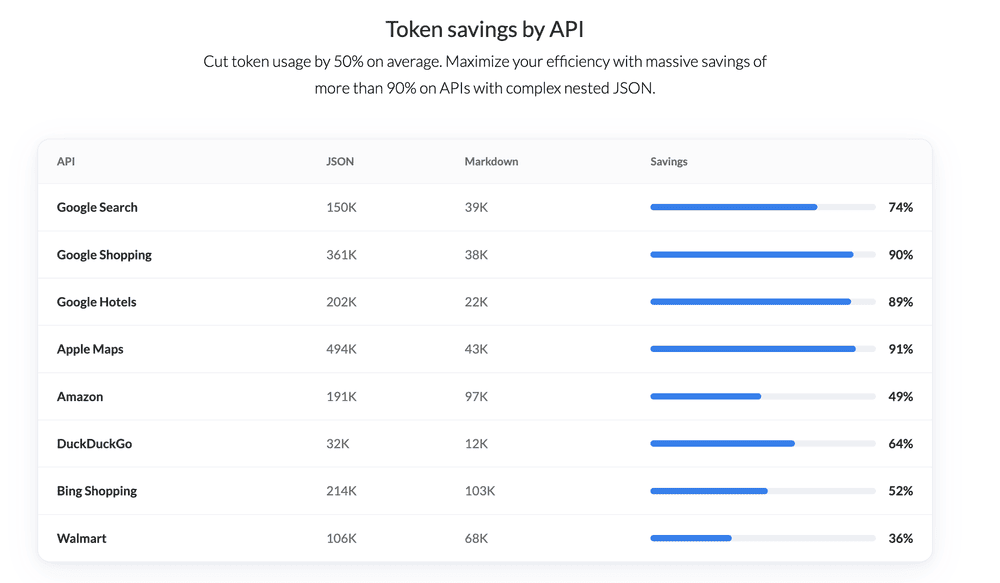
The transition toward Markdown-optimized outputs began in earnest as developers sought to minimize the cost of RAG (Retrieval-Augmented Generation) pipelines. By late 2023 and early 2024, engineers began experimenting with custom wrappers to strip JSON of its structural complexity before feeding it into models. SerpApi, a leader in search API services, formalized this trend by launching native Markdown support for its search results. This move marked a significant milestone, as it moved the responsibility of data pruning from the client-side developer to the API provider itself. By handling the transformation server-side, providers can ensure that the output is tailored specifically for the architecture of current-generation transformer models.
Empirical Analysis of Token Efficiency
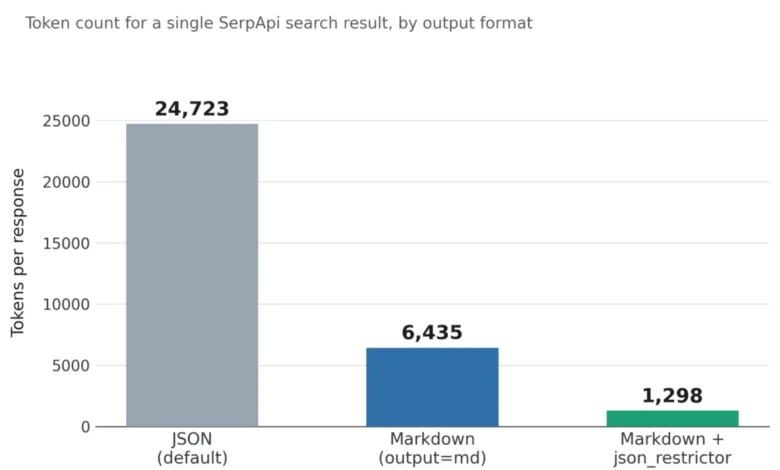
The efficiency gains of switching from JSON to Markdown are quantifiable and substantial. According to recent benchmarks, a standard search query for "coffee" that returns a rich, structured JSON object can require upwards of 24,000 tokens to process. When the same data is formatted as Markdown—retaining the critical information while stripping away the non-essential structural markup—that figure drops to roughly 6,400 tokens.
This represents a reduction of approximately 74 percent. In a production environment running thousands of queries per day, this efficiency shift is not merely a technical convenience; it is a fundamental optimization of the cost-per-inference metric. Furthermore, even more aggressive filtering—where only essential fields are returned—can drive token usage down to approximately 1,300 tokens, a nearly 95 percent reduction from the original payload. This level of optimization allows developers to pack significantly more data into the context window, effectively increasing the "intelligence" of the agent without increasing the cost of the hardware or the API subscription.
The Trade-off: When Precision Matters More than Efficiency
While Markdown offers a clear path toward reducing token costs, it is not a universal solution for all data-processing needs. The primary strength of JSON lies in its strict typing. For developers building systems that require high-precision data—such as financial engines that track fluctuating stock prices, inventory management systems relying on specific integer IDs, or analytical tools requiring floating-point coordinates—JSON remains the superior choice.
Markdown excels at presenting information for human-like consumption or general summarization tasks. However, it lacks the native schemas that allow programmatic systems to safely parse, validate, and manipulate complex data structures. The current industry consensus suggests a bifurcated strategy: use JSON for backend, machine-to-machine data pipelines where data integrity is paramount, and utilize Markdown for the "agentic" layer where the goal is to provide the AI with the context it needs to reason effectively.
Implementation and Future Implications
Implementing a move toward Markdown is increasingly straightforward. Many modern APIs now allow users to toggle the output format through simple query parameters or header configurations. For instance, by adding a specific flag to an API request, developers can force the server to output YAML frontmatter, tables, and standard headers, while simultaneously discarding internal tracking tokens and redundant field values.
Looking forward, the trend toward token-conscious data design is likely to extend beyond search APIs. We are seeing a shift in how engineers think about data transmission in the age of AI. The focus is no longer just on "what data is available," but rather "what data is useful for the model." As context windows continue to expand, there will be a temptation to continue feeding models bloated payloads. However, economic reality dictates that efficient, lean data structures will always be preferred.
The broader implication for the industry is a shift in the development lifecycle. Developers are increasingly expected to perform "token auditing"—measuring the input size of their prompts and the cost-efficiency of their data sources. Those who fail to optimize their data payloads face not only higher operational overhead but also a competitive disadvantage in an AI market where speed, cost, and efficiency define the success of an application.
Conclusion: The Future of Data Serialization
The rise of AI-driven agents has fundamentally challenged the long-standing dominance of JSON as the default format for data exchange. While JSON will continue to serve as the bedrock of traditional software architecture, Markdown has carved out a essential niche as the preferred language for machine-to-LLM communication.
By prioritizing the "signal-to-noise" ratio in every API call, developers can unlock significant cost savings and improve the performance of their AI systems. As this technology continues to mature, we expect to see more robust, model-native serialization formats emerge, further blurring the line between human-readable documentation and machine-readable data. For now, the move to Markdown stands as one of the most effective, immediate, and impactful optimizations a developer can implement to refine their AI agent’s performance and bottom-line economics. The data is clear: in the era of generative AI, the structure of your information is just as important as the information itself.