The Ultimate Guide to Social CRM in 2026: Transforming Digital Conversations Into Business Value


The landscape of customer relationship management has undergone a fundamental transformation, driven by the shift of consumer interactions from traditional phone and email channels to dynamic social media platforms. Social customer relationship management, widely known as social CRM, has emerged as a mission-critical strategy for enterprises seeking to unify unstructured social data with structured customer profiles. Rather than treating comments, direct messages, brand mentions, and sentiment signals as isolated marketing metrics, modern organizations are integrating these real-time signals directly into their core databases to empower marketing, sales, and customer service teams alike.

Historically, traditional customer relationship management systems focused heavily on reactive, historical touchpoints such as past purchases, support tickets, email logs, and structured phone records. These legacy workflows were typically managed in silos by distinct departments, offering a retroactive view of buyer behavior. However, as digital consumption patterns evolved and online platforms became primary touchpoints for brand discovery, evaluation, and customer service, the limitations of traditional databases became increasingly apparent. Modern consumers now expect brands to engage in real-time, personalized dialogues across Instagram, X, LinkedIn, and Facebook, making traditional reactive models obsolete.
The integration of social data into enterprise architectures addresses a widening expectations gap identified by recent market research. According to industry analyses, the divergence between the customer experience brands intend to deliver and the actual experiences perceived by consumers continues to widen. Social media platforms serve as public stages where this gap is prominently exposed. Consumer sentiment data underlines the urgency of this shift: studies indicate that a vast majority of consumers consider rapid responsiveness to direct questions and comments to be a brand’s most appealing social attribute, while a significant percentage will actively abandon or unfollow organizations that fail to interact with their digital communities.
To navigate this operational challenge, enterprises generally adopt one of three architectural approaches to social CRM: built-in extensions, standalone platforms, and hybrid social operating systems. Built-in solutions append social tools directly to legacy CRM applications, maintaining centralized data storage while sometimes sacrificing depth on the social engagement side. Standalone platforms specialize in high-volume social media management and feed data back into primary databases through application programming interfaces. Meanwhile, hybrid operating systems act as sophisticated bridges—handling publishing, listening, and engagement natively, enriching those streams with artificial intelligence, and seamlessly synchronizing the resulting intelligence with enterprise-grade solutions such as Salesforce and Microsoft Dynamics 365.
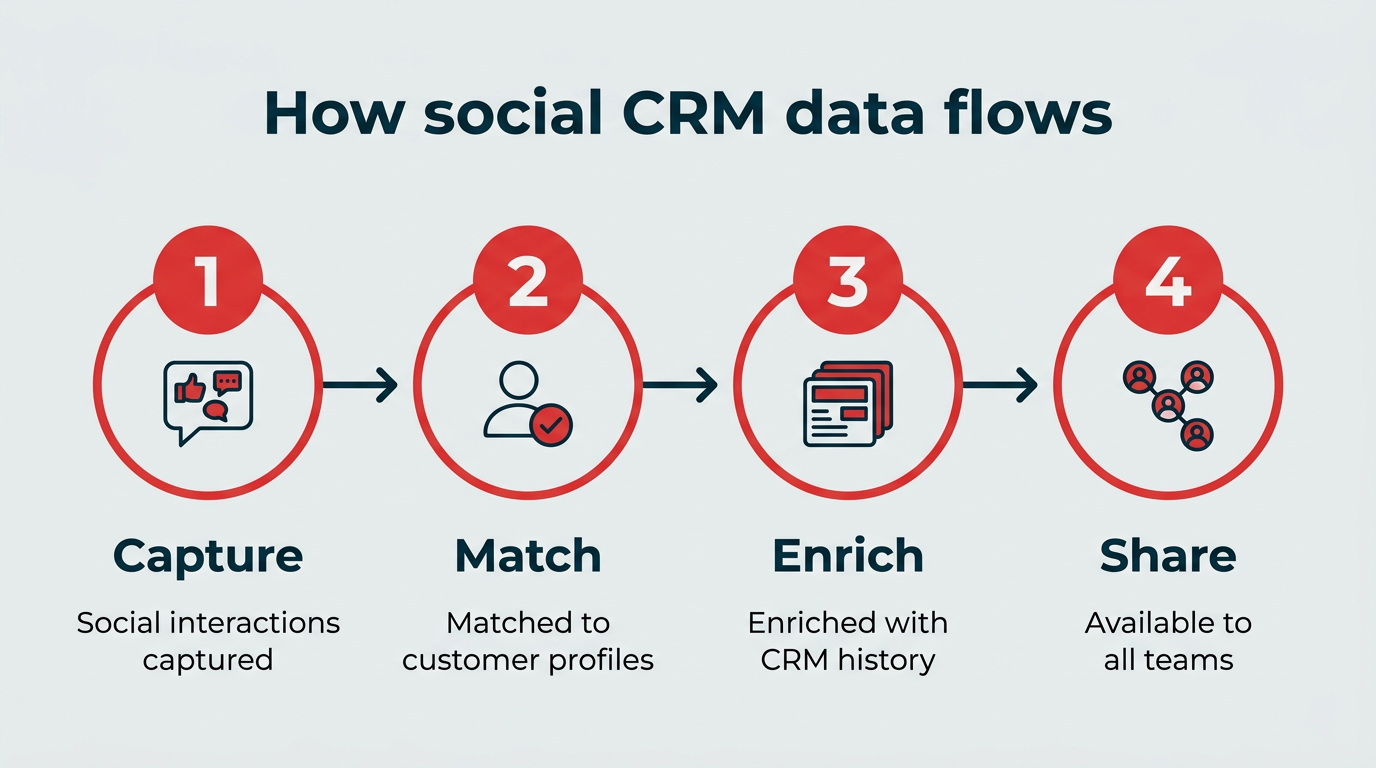
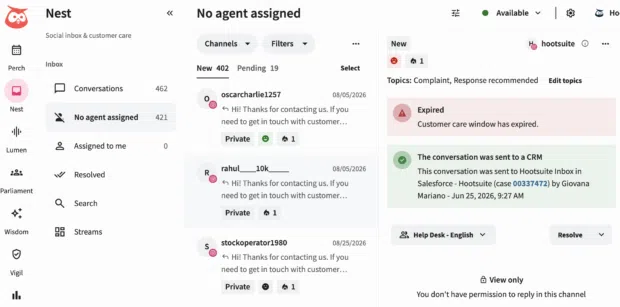
The mechanics of a robust social CRM workflow follow a continuous four-step pipeline: capturing interactions across connected digital channels, matching those interactions to existing customer records or instantiating new profiles, enriching those profiles with historical transactional context, and distributing that unified view across all customer-facing departments. For example, when a consumer submits a product inquiry via an Instagram direct message, support and sales representatives are immediately presented with a comprehensive profile that details previous purchases, open tickets, and prior brand interactions. This contextual awareness eliminates redundant questioning and empowers teams to deliver consistent, accelerated service.
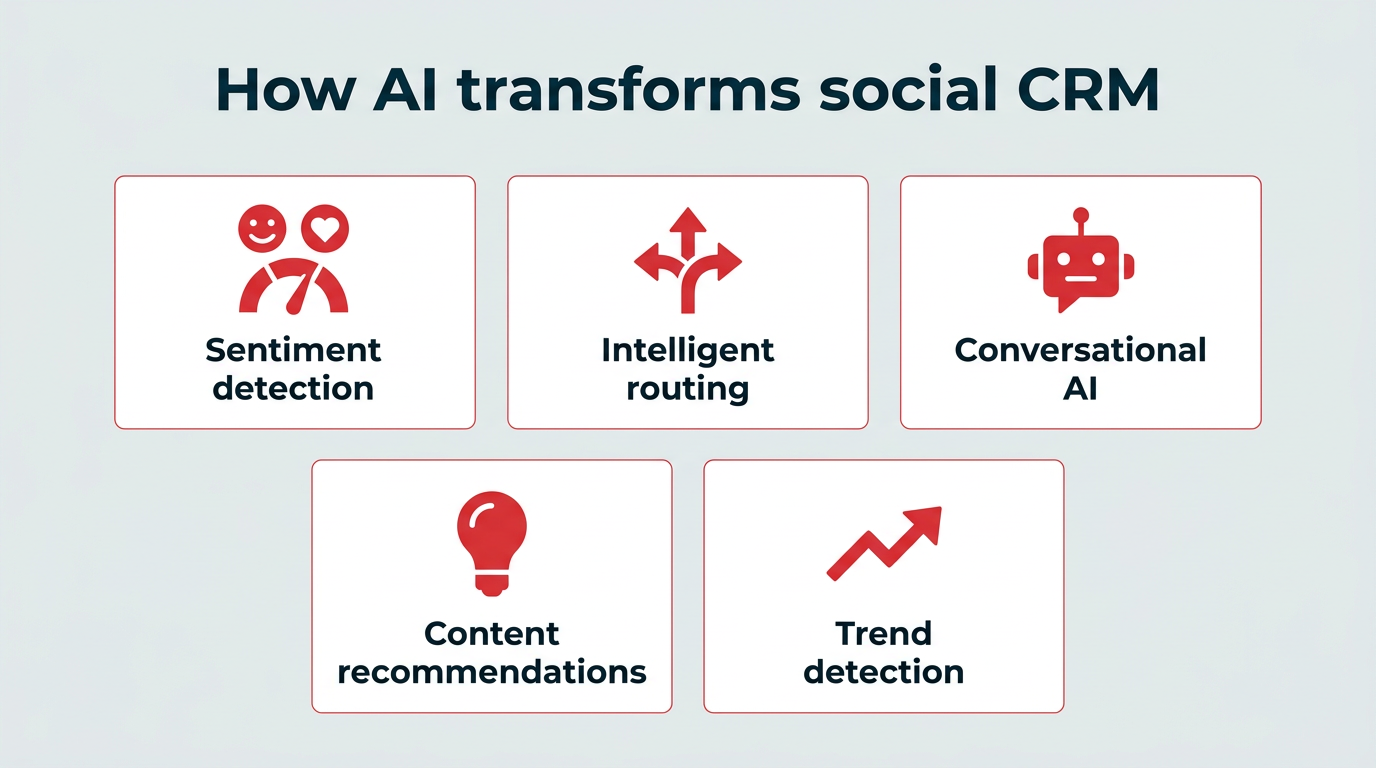
Artificial intelligence has become the primary catalyst for scaling social CRM operations. As global social mention volumes surge past manual processing capacities, AI-driven automation handles the heavy lifting of sorting, sentiment analysis, and message prioritization. Modern platforms employ advanced natural language processing to categorize incoming inquiries, detect emotional drivers and sarcasm across multiple languages, and route urgent complaints to the top of enterprise service queues. This triage capability ensures that high-priority issues are addressed swiftly, mitigating public relations risks and protecting customer lifetime value.

Furthermore, AI-powered social listening elevates social CRM from a reactive support mechanism to a proactive strategic intelligence tool. Rather than relying on manual keyword searches, machine learning models continuously monitor global conversations, tracking emerging topic clusters and sudden shifts in market sentiment. This intelligence feeds directly back into audience segmentation and content planning, allowing marketing teams to design targeted campaigns based on authentic consumer needs rather than guesswork.
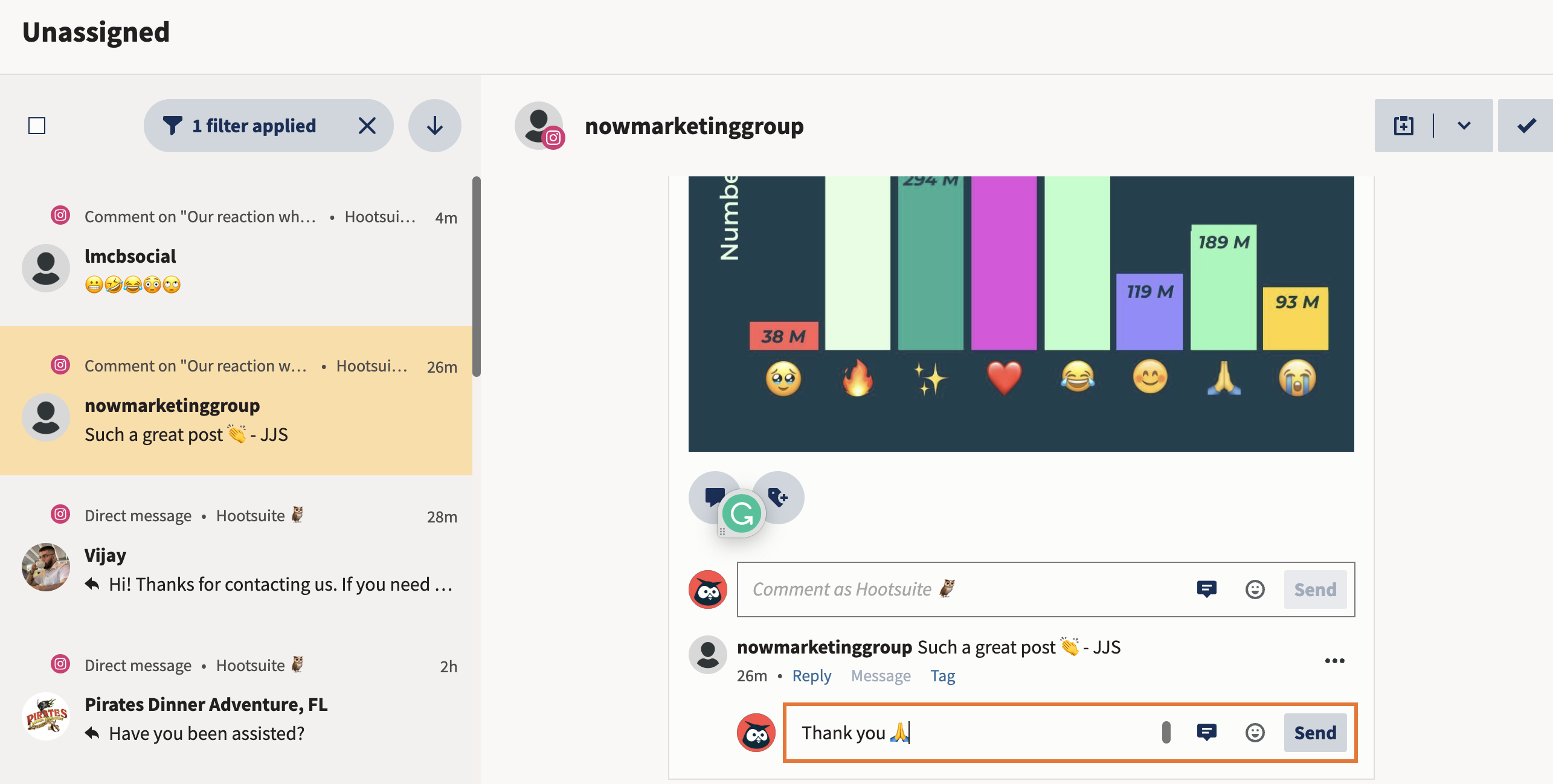
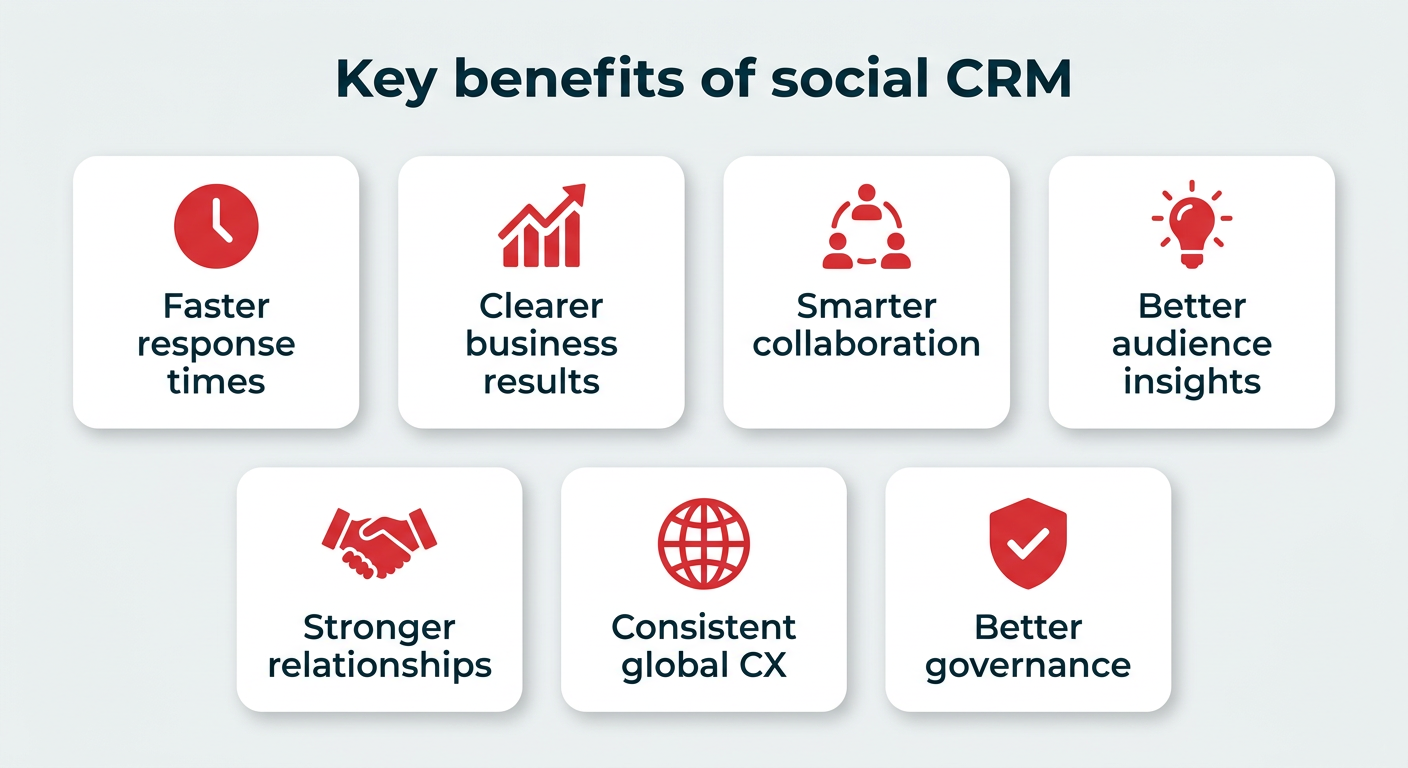
The practical benefits of this integrated approach extend deeply into customer service, sales enablement, and targeted marketing. Within customer support environments, unified inboxes and automated routing dramatically reduce resolution times, a crucial metric given that a substantial portion of consumers expects same-day responses to digital inquiries. By maintaining a single source of truth across channels, organizations prevent duplicate outreach and ensure that every customer interaction reflects a comprehensive understanding of the individual’s history.

For sales divisions, social CRM redefines lead generation and qualification. Rather than treating initial social engagements as superficial interactions, sales professionals can leverage intent signals—such as repeated post comments, saved product reels, and direct messages regarding pricing—to prioritize outreach. AI lead-scoring models analyze these behavioral patterns, enabling representatives to focus their efforts on prospects exhibiting high purchase intent. Consequently, social-sourced leads can be seamlessly tagged and incorporated into standard pipeline reporting, allowing executive leadership to accurately measure social return on investment and optimize advertising budgets.
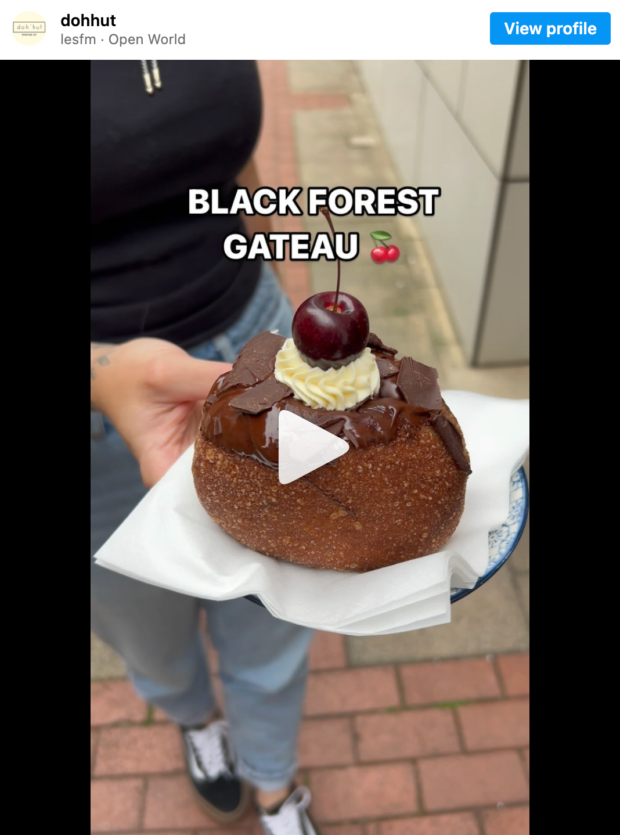
Marketing teams similarly benefit from the rich feedback loop established by social CRM integrations. By correlating social activity with downstream business outcomes such as subscriptions and completed purchases, marketers gain undeniable proof of campaign effectiveness. This data-driven clarity facilitates the creation of hyper-targeted content, precise lookalike audiences for social advertising, and agile strategy pivots in response to real-time market feedback.
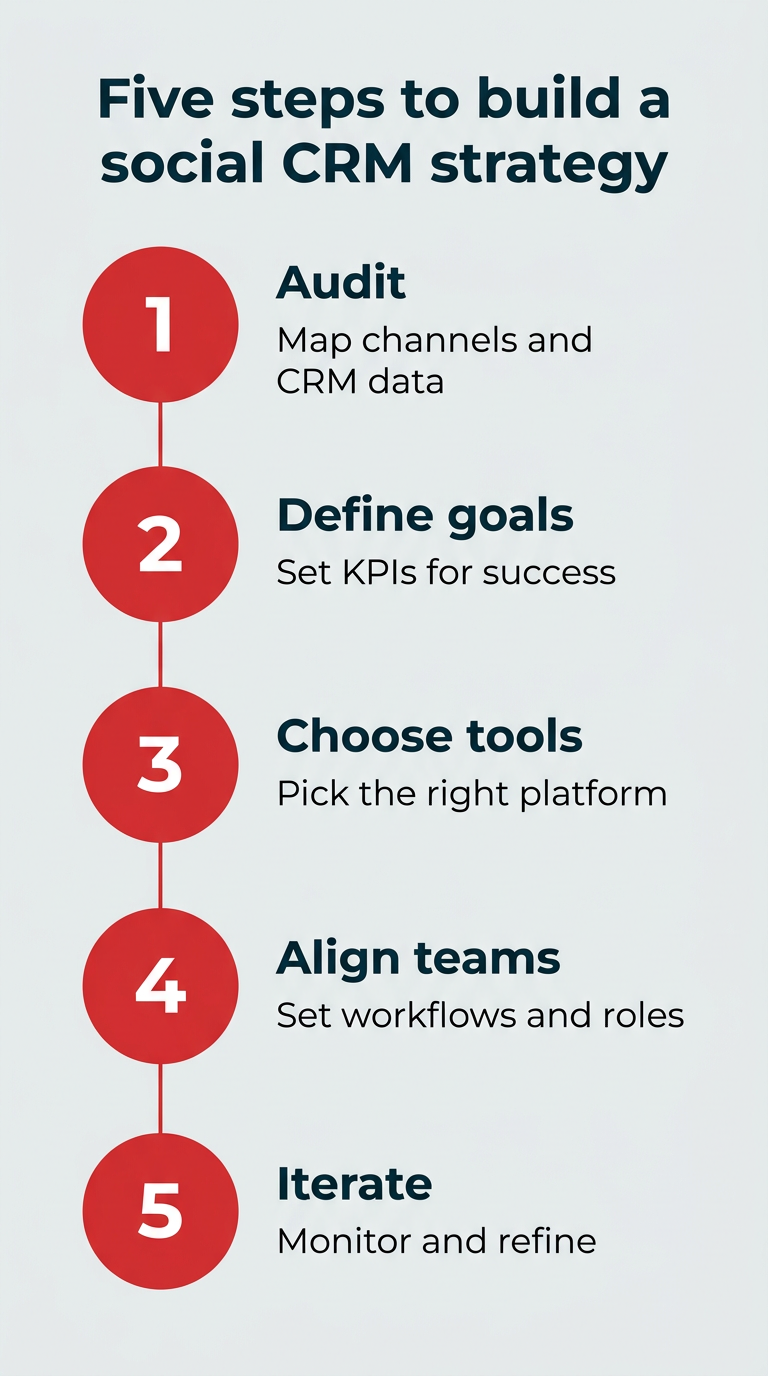
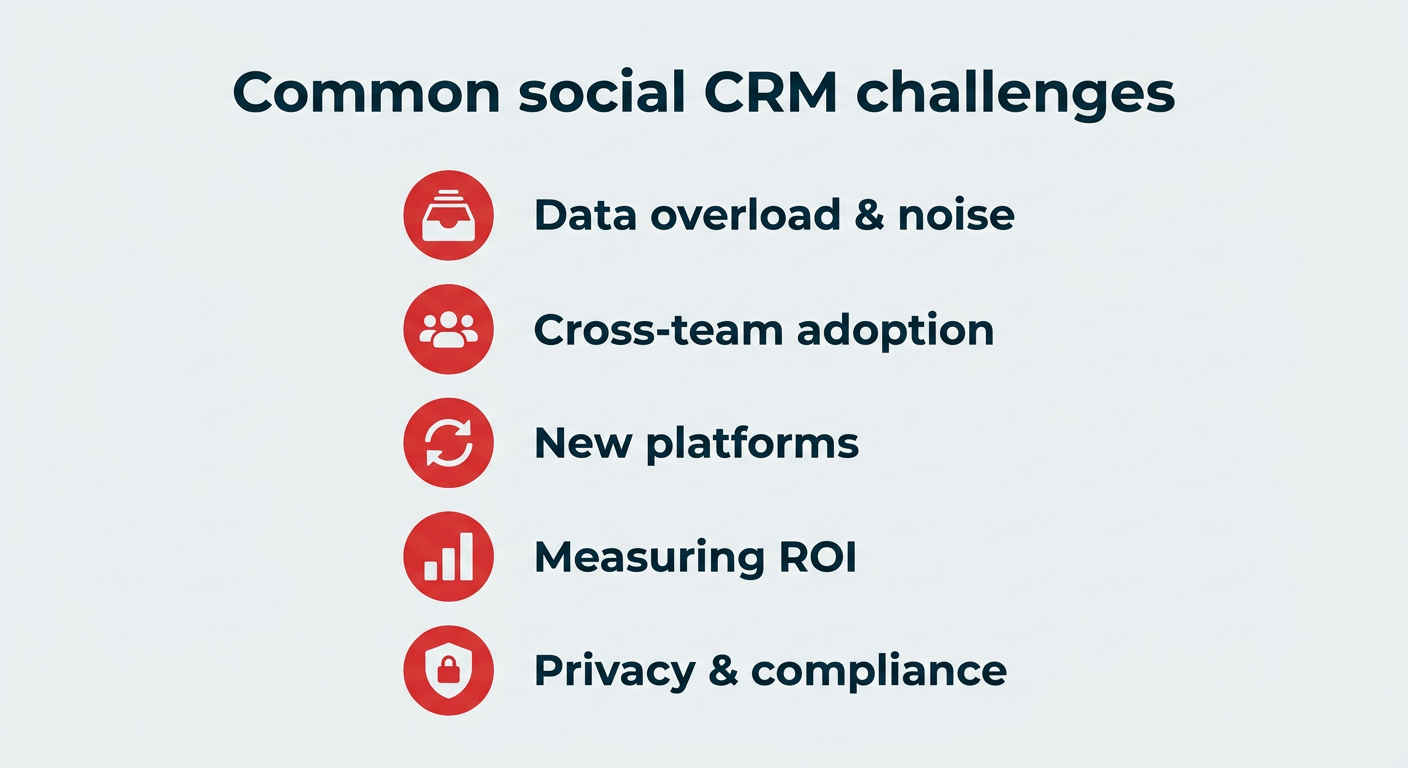
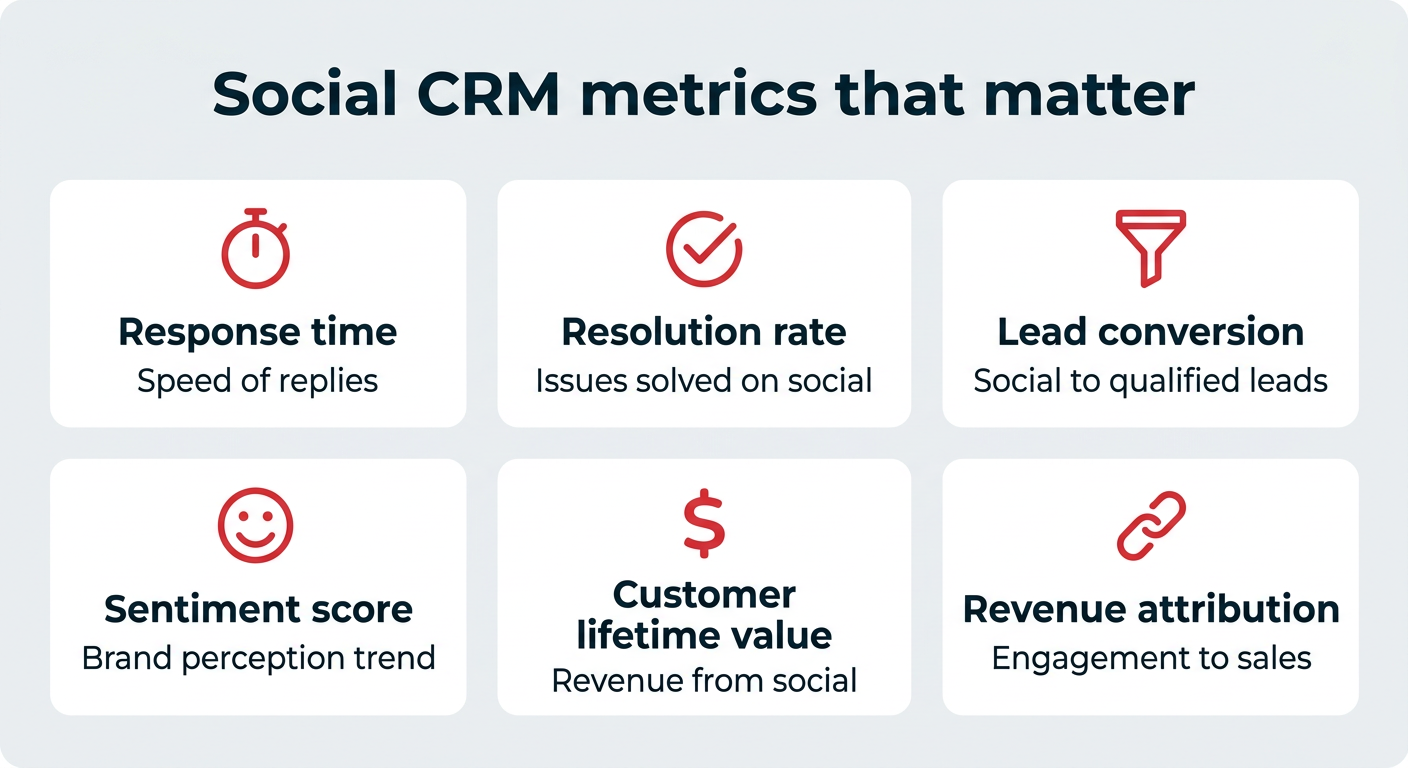
Implementing a successful social CRM framework requires a structured, multi-phase organizational strategy. Enterprises typically begin by conducting a comprehensive audit of their existing social channels and CRM data infrastructure to identify integration gaps. Following this assessment, leadership must define clear goals and key performance indicators—such as average response time, resolution rate, lead conversion percentage, and net sentiment score—aligned with broader business objectives. Selecting the appropriate software ecosystem that bridges social management with legacy databases is the next critical milestone, followed by rigorous cross-team alignment to establish standardized routing rules and response guidelines across marketing, sales, and support departments.
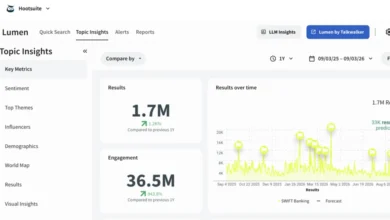
The market for social CRM software features several prominent solutions tailored to varying organizational needs and scales. Hootsuite offers an all-in-one social media management, listening, and engagement infrastructure designed to centralize high-volume interactions and sync smoothly with enterprise systems. HubSpot provides an integrated customer platform combining marketing, sales, and service hubs around a centralized Smart CRM. Salesforce leverages advanced artificial intelligence and conversational assistants to guide enterprise sales pipelines and deliver deep predictive insights. Meanwhile, Microsoft Dynamics 365 delivers modular, highly customizable CRM environments underpinned by robust customer insight engines, and SugarCRM offers flexible, customizable architectures tailored to specific team requirements.
Ultimately, the deployment of a comprehensive social CRM strategy represents a vital evolution in how modern enterprises manage customer relationships. By breaking down departmental silos and synthesizing real-time social conversations with historical transactional data, organizations can bridge the widening expectations gap, drive measurable revenue growth, and deliver consistently exceptional customer experiences across every digital touchpoint.