Volt Typhoon Leverages Sophisticated Silent Train Botnet for Strategic U.S. Critical Infrastructure Espionage

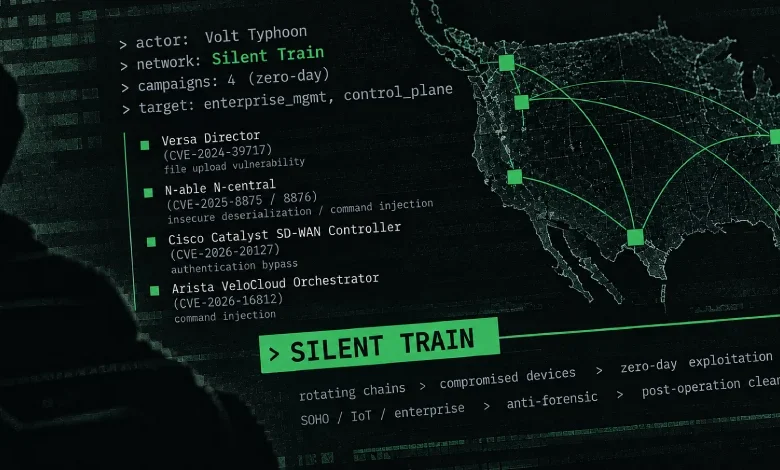
The notorious China-nexus state-sponsored cyber espionage group widely known as Volt Typhoon has been definitively linked to a sophisticated, highly disciplined covert access network designated as Silent Train. First identified by security researchers in late 2023, the infrastructure has been actively weaponized to conduct zero-day exploits, secure strategic footholds, and facilitate broad cyber espionage operations. According to an extensive threat intelligence report published by Lumen Technologies’ Black Lotus Labs, Silent Train relies heavily on rapidly rotating, multi-hop chains of compromised Small Office/Home Office (SOHO) devices, Internet of Things (IoT) hardware, and enterprise infrastructure.
The operational framework of Silent Train represents a significant evolution in state-sponsored cyber tradecraft. Designed specifically to maximize operational security (OpSec) while minimizing detection, attribution, and disruption, the framework employs strict anti-forensic protocols, compartmentalized command-and-control methodologies, and meticulous post-operation cleanup routines. The discovery underscores an ongoing, aggressive campaign by foreign threat actors targeting foundational American infrastructure, raising profound concerns among federal cybersecurity agencies and private-sector defenders alike.
Anatomy and Evolution of the Silent Train Framework
Silent Train operates as a layered, multi-hop relay network that obfuscates the true origin of malicious traffic. When executing operations against targeted networks, Volt Typhoon operators route their traffic through a sequence of compromised devices before it ultimately reaches the victim’s environment. Each individual node within the chain is assigned a specific, rigid operational role. For instance, specific hardware models, such as Intelbras modems, have been observed exclusively serving as low-level relay nodes, whereas high-capacity enterprise appliances like Netgear Orbi routers and Fortinet FortiGate firewalls function as domestic intermediary and exit points designed to interface directly with target networks.

This rigorous compartmentalization ensures that even if a segment of the infrastructure is compromised or blocked by network defenders, the broader architecture remains resilient and masked. The framework’s lifecycle has undergone notable maturation since its inception. Initially, Silent Train functioned as an entirely ephemeral network. Operators would rapidly provision a chain of compromised devices, execute their intrusion or data exfiltration tasks, and subsequently dismantle the infrastructure—often within a matter of hours or even minutes. Sessions lasted approximately four hours on average, leaving minimal forensic traces behind.
However, by early 2025, threat intelligence analysts noted a structural shift toward a hybrid architecture. While retaining ephemeral elements, Volt Typhoon began integrating select enterprise-grade devices into the framework for extended durations, keeping them active as persistent nodes for one to three months. Furthermore, the operational capability evolved to incorporate advanced reverse-tunneling variants, leveraging open-source utility tools such as Chisel and FRP to seamlessly tunnel traffic from infected nodes straight into upstream command-and-control infrastructure.
A Chronology of Disruption and Adaptation
The genesis of Silent Train closely mirrors international law enforcement and private industry efforts to dismantle previous state-backed botnets. The covert access capability began taking shape around November 2023. This timeline is particularly significant, as it directly preceded the first coordinated multinational wave of disruptions targeting the KV-botnet—another notorious IoT botnet linked to China-nexus state-sponsored groups, including Volt Typhoon.
As U.S. federal authorities and cybersecurity firms intensified pressure on the threat actor’s infrastructure, culminating in a secondary wave of disruptions against the KV-botnet in late January 2024, Volt Typhoon’s reliance on Silent Train surged dramatically. Recognizing the fragility of persistent command-and-control servers, the cyber espionage group pivoted hard toward a transient, highly modular framework. By abandoning traditional, long-lived infrastructure in favor of on-demand, one-time-use device chains, the group successfully established a resilient mechanism capable of absorbing tactical setbacks without compromising its core operational access.

Zero-Day Exploitations and Targeted Sectors
Throughout its active campaigns, Silent Train has served as the underlying delivery and exploitation vehicle for multiple high-profile zero-day vulnerabilities. Among the confirmed campaigns is the exploitation of a critical file upload vulnerability tracked as CVE-2024-39717 within Versa Director. Volt Typhoon leveraged this zero-day flaw to deploy a bespoke, stealthy web shell known as VersaMem, which was engineered specifically to harvest user credentials and establish persistent access channels into downstream customer networks.
In addition to the Versa Director campaign, threat hunters have identified at least three other confirmed zero-day exploits orchestrated through the Silent Train network. Furthermore, intelligence suggests the threat group successfully exploited a probable zero-day vulnerability affecting Quest KACE management software prior to its official vendor patch in October 2025. That specific campaign is estimated to have impacted more than 30 high-value organizations.
The breadth of Silent Train’s victimology is vast, encompassing hundreds of entities across critical sectors. Targeted organizations include major telecommunications providers, government agencies, defense contractors, satellite and mission-critical communication services, higher education institutions, IT firms, and vital operational sectors such as water, energy, transportation, maritime, rail, aviation, and emergency response services.
Geographically, the vast majority of these targeted operations within the United States have concentrated heavily on specific regions, most notably California, Texas, and Hawaii. Analysts point out that these specific states house vital military installations, key defense manufacturing hubs, core telecommunications backbones, and critical logistics nodes essential for both civil continuity and military deployment.

Strategic Implications and National Security Concerns
The discovery and analysis of Silent Train provide a clear window into the methodical, long-term strategic objectives of state-sponsored actors targeting Western infrastructure. Unlike financially motivated cybercrime syndicates driven by ransomware or immediate monetary extortion, Volt Typhoon’s operations are characterized by patience, stealth, and a focus on pre-positioning.
By repeatedly targeting centralized management platforms, networking hardware, and control-plane technologies, the group ensures deep visibility and enduring control over consequential networks. Government officials and cybersecurity experts have repeatedly warned that such pre-positioning campaigns are designed to establish covert leverage, potentially enabling disruption or espionage during times of heightened geopolitical tension or international crisis, particularly within the Indo-Pacific region.
The transformation of Silent Train into a resilient, hybrid, and compartmentalized framework demonstrates the adaptability of advanced persistent threat (APT) groups in the face of heightened defensive scrutiny. As public and private sectors continue to collaborate on threat intelligence sharing and network hardening, the mitigation of risks posed by compromised SOHO and IoT devices remains a paramount challenge for global cybersecurity defense.
Related posts: