Mastering Post-Production Efficiency with Adobe Premiere Pro Hover Scrub Technology

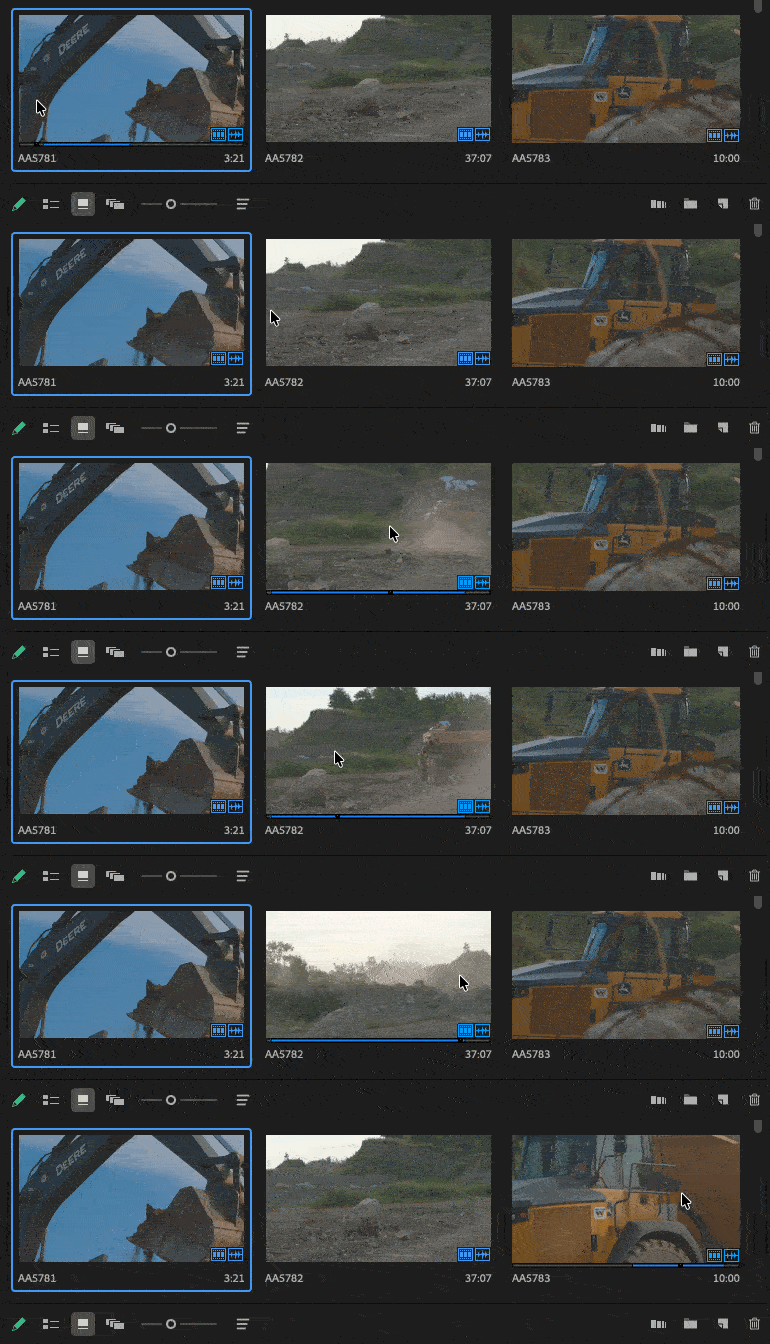
The evolution of non-linear editing (NLE) software has been defined by a constant pursuit of reducing the friction between a creator’s intent and the final output. Among the most enduring and transformative features within Adobe Premiere Pro is Hover Scrub, a visual skimming technology that allows editors to preview footage with unprecedented speed. Initially introduced in 2012 as a cornerstone of the Adobe Premiere Pro CS6 update, Hover Scrub fundamentally altered the way editors interact with their project bins. Despite being a staple of the software for over a decade, the feature remains a hidden gem for many newcomers and even some seasoned professionals who rely on traditional, click-heavy workflows. By allowing users to traverse the contents of a video clip simply by moving the cursor across its thumbnail, Hover Scrub eliminates the need for constant loading into the Source Monitor, streamlining the organization and auditioning phases of the post-production process.
The Technical Mechanics of Hover Scrub
Hover Scrub functions through a dynamic thumbnail interface within the Project panel. When a bin is set to Icon View or the more modern Freeform View, the software generates a real-time preview of the media. As the user’s pointer hovers over a specific clip, the thumbnail acts as a miniature monitor. Moving the mouse from the left edge to the right edge of the thumbnail corresponds to the playhead moving from the start to the end of the clip.
For the feature to be active, it must be toggled within the bin’s settings. This is found in the "hamburger" menu (the three horizontal lines) located next to the bin’s name in the Project panel. While Hover Scrub is typically enabled by default in modern versions of Premiere Pro, certain workspace configurations or performance-saving settings may result in it being disabled. Ensuring this feature is active is the first step toward a high-speed logging workflow.
The responsiveness of Hover Scrub is tied to the software’s ability to generate and cache "peak files" and "media cache" data. In high-resolution workflows involving 4K or 8K footage, the smoothness of the scrub depends on the speed of the storage media and the processing power of the workstation. However, Adobe’s optimization of the Mercury Playback Engine has ensured that Hover Scrub remains functional even on mid-range hardware by utilizing proxy files or lower-resolution preview renders when necessary.

Chronology of Development: From CS6 to the Creative Cloud Era
The introduction of Hover Scrub in 2012 was not an isolated update but part of a strategic overhaul of Premiere Pro. At the time, the professional editing landscape was in a state of flux. Apple’s release of Final Cut Pro X in 2011 had polarized the industry, leading many editors to seek a more traditional yet modernized alternative. Adobe responded with Premiere Pro CS6, which introduced a "sleek, redesigned user interface" that focused on the footage rather than the buttons.
- May 2012 (CS6 Launch): Hover Scrub is introduced as a headline feature. It was designed to mimic the fluid "skimming" found in other modern databases, bringing a more tactile feel to digital asset management.
- 2013-2017 (Creative Cloud Expansion): Adobe integrated Hover Scrub more deeply with the Source Monitor and introduced improved gesture support for trackpads, allowing for a more natural feel on mobile workstations like the MacBook Pro.
- 2019 (Introduction of Freeform View): The release of the Freeform View in the Project panel expanded the utility of Hover Scrub. Editors could now arrange clips in a non-linear, storyboard-style layout and use Hover Scrub to quickly check continuity between adjacent thumbnails without ever touching the timeline.
- 2022-2024 (Performance and AI Integration): Recent updates have focused on underlying performance, ensuring that Hover Scrub remains lag-free when working with modern codecs like H.265 (HEVC) and ProRes RAW.
Workflow Optimization and Advanced Applications
While the basic utility of Hover Scrub is clear, its advanced applications can significantly reduce the "time to first cut." Professional editors utilize several techniques to maximize the effectiveness of this tool.
Thumbnail Scaling for Precision
The Project panel includes a zoom slider that allows users to increase the size of the thumbnails. By scaling a thumbnail to a larger size, the editor effectively creates a secondary preview monitor within the bin. This is particularly useful for identifying specific facial expressions, focus accuracy, or subtle movements that might be missed on a smaller icon. When combined with a high-resolution 4K monitor, these thumbnails provide enough detail to make critical "selects" without the overhead of loading each clip.
Direct-to-Timeline Editing
One of the most powerful aspects of Hover Scrub is its integration with keyboard shortcuts. As an editor hovers over a clip, they can use the "I" and "O" keys to set In and Out points directly on the thumbnail. Once the desired segment is marked, the editor does not need to open the Source Monitor. By simply clicking the clip and using the "Insert" (comma) or "Overwrite" (period) keys, the marked segment is immediately placed into the active sequence. This "three-point editing" from the bin is a hallmark of high-efficiency news and documentary editing.
The Seamless Handoff to the Source Monitor
In scenarios where a more detailed inspection is required—such as checking audio waveforms or applying effects—Hover Scrub offers a seamless transition to the Source Monitor. If an editor finds a specific frame while scrubbing and decides they need a closer look, double-clicking the clip will open it in the Source Monitor with the playhead positioned at the exact frame where the cursor was hovering. This eliminates the need to "re-find" the moment, maintaining the editor’s creative momentum.

Supporting Data: The Impact on Production Timelines
The efficiency gains provided by Hover Scrub are supported by industry trends toward faster turnaround times. In the modern media landscape, where social media content, breaking news, and daily vlogs require rapid delivery, every second saved in the logging phase is vital.
According to general industry benchmarks for post-production, logging and organizing footage can account for up to 30% to 50% of the total editing time, depending on the shooting ratio. For a project with 10 hours of raw footage, a traditional workflow of double-clicking and loading every clip might take several hours just for initial review. Hover Scrub allows for a "first pass" review at roughly 2x to 4x the speed of real-time playback. By skimming through footage at high speed, an editor can identify "dead air" or unusable takes in seconds, effectively cutting the initial logging time by nearly half.
Furthermore, the rise of "Freeform View" storyboarding has enabled directors and editors to collaborate more effectively during the assembly phase. By visually arranging clips and scrubbing through them to check for visual flow, teams can settle on a narrative structure before a single clip is moved to the timeline.
Industry Perspectives and Official Responses
Adobe has consistently framed Hover Scrub as part of their "Frictionless Creativity" initiative. In various white papers and product showcases, Adobe product managers have emphasized that the goal of the Premiere Pro interface is to "get out of the way of the editor."
Professional organizations, such as the American Cinema Editors (ACE), have noted that while high-end narrative features still rely heavily on assistant editors to log footage using detailed metadata and list views, the "visual-first" approach of Hover Scrub is indispensable for unscripted content. Documentary editors, in particular, have praised the feature for its ability to help them find "needle in a haystack" moments in hundreds of hours of observational footage.

Critics of the feature occasionally point to the hardware resources required to maintain a smooth scrub in complex projects. However, the consensus among tech analysts is that the benefits of visual skimming far outweigh the localized processing costs, especially as GPU acceleration becomes more prevalent in NLE workflows.
Broader Implications for the Future of Editing
The legacy of Hover Scrub extends beyond Premiere Pro. Its success influenced other software developers to implement similar "skimming" or "live preview" features. DaVinci Resolve’s "Source Tape" view and Avid Media Composer’s "Frame View" improvements reflect a broader industry shift toward visual asset management.
Looking forward, the integration of Artificial Intelligence (AI) and Machine Learning (ML) via Adobe Sensei is expected to enhance Hover Scrub further. Future iterations may include "Smart Scrubbing," where the playhead automatically slows down when it detects a human face, a change in scene, or a specific action, making the hover-based search even more intelligent.
Moreover, as cloud-based editing becomes the standard through platforms like Frame.io (now an Adobe company), the principles of Hover Scrub are being applied to web-based review tools. This allows clients and producers to skim through high-resolution dailies in a web browser with the same fluidity that editors enjoy in the desktop application.
Conclusion
Hover Scrub represents a pivotal moment in the history of Adobe Premiere Pro, marking the transition from a button-heavy interface to a fluid, footage-centric workflow. By empowering editors to see their media without the barriers of traditional loading and playback, it has become an essential component of the modern editing toolkit. Whether used for a quick glance at a bin’s contents or as a high-speed tool for marking in-and-out points, Hover Scrub remains a testament to the power of intuitive design in professional software. As the volume of digital media continues to grow, tools that facilitate rapid auditioning and organization will remain at the heart of the creative process, ensuring that editors spend less time searching for footage and more time telling stories.