The Complete Guide to Answer Engine Optimization and Selecting the Right AEO Checker for Your Brand

The fundamental nature of search is undergoing its most significant transformation since the inception of the World Wide Web. As consumers increasingly shift their behavior from clicking through lists of traditional search engine results to engaging in conversational dialogues with AI platforms like ChatGPT, Perplexity, and Gemini, the digital landscape has shifted toward a "zero-click" paradigm. In this environment, visibility is no longer guaranteed by high search rankings; instead, it is determined by whether an AI model chooses to mention your brand or cite your content within a synthesized, conversational answer. This evolution has birthed the practice of Answer Engine Optimization (AEO), a critical discipline for businesses aiming to maintain authority in the era of generative AI.
The Emergence of the Answer Engine Era
The shift toward generative AI in search was solidified in May 2024, when Google officially launched AI Overviews (AIOs) to the broader public. This rollout marked a departure from the classic "ten blue links" model that had defined the internet for decades. Before this, companies invested heavily in Search Engine Optimization (SEO) to ensure their domains appeared in the top positions of search results. Today, that strategy is merely the foundation. While strong SEO—characterized by crawlability, topical authority, and high-quality backlinks—remains essential, it is no longer sufficient. Answer engines now curate information, reading across hundreds of sources to synthesize a single, authoritative response. If your brand is not integrated into the underlying data models or cited as a primary source, you effectively disappear from the conversation entirely.
![AEO checker tools that measure answer engine visibility [2026]](https://53.fs1.hubspotusercontent-na1.net/hubfs/53/aeo-checker-1-20260903-3858273.webp)
This transition has created a clear distinction between SEO and AEO. While SEO focuses on the mechanics of ranking in a list, AEO focuses on the linguistics of being cited. AEO requires brands to provide clearly structured data, answer specific user queries with precision, and offer claims backed by verifiable primary sources that AI models find trustworthy.
The Role and Mechanics of an AEO Checker
As the reliance on these platforms grows, manual monitoring becomes impossible. An AEO checker is a specialized software tool designed to measure brand visibility across generative engines. Unlike traditional rank trackers, which provide a static list of positions, an AEO checker operates on a continuous, multi-dimensional loop: measuring, diagnosing, prioritizing, and reporting.
These tools perform several vital functions:
![AEO checker tools that measure answer engine visibility [2026]](https://no-cache.hubspot.com/cta/default/53/9dd5e54b-fbef-4dd0-bc44-1689feb1ea18.png)
- Citation Tracking: They monitor whether your domain is included as an inline source or a cited link within an AI-generated response.
- Brand Mention Analysis: They track whether your brand name appears in the text of an answer, even if a direct link is absent.
- Competitive Intelligence: They identify which competitors are winning the "answer share" for your high-priority keywords, allowing you to identify content gaps.
- Sentiment and Accuracy Auditing: They flag instances where an AI engine might misrepresent your brand or provide outdated information, enabling rapid correction.
Manual Verification: A Baseline Approach
While enterprise-grade software is necessary for scale, understanding the manual process is essential for those just beginning their AEO journey. To perform a manual check for Google AI Overviews, marketers must execute priority queries in an incognito or logged-out session to ensure the results are not biased by personal history.
- Query Selection: Curate a list of high-intent keywords, including your brand name, core product categories, and the specific questions your target audience asks during the buying process.
- Sample Size: Because AI responses are dynamic and vary between sessions, a single search is insufficient. Perform multiple searches across different times and browsers to establish a pattern of consistency.
- Documentation: Log whether an AIO appears, whether your brand is cited, and exactly what claim is being made. This provides a baseline for future improvements.
It is important to note that search engines are inconsistent; an AI Overview may trigger for one user but not another. Consequently, relying on Search Console data can be misleading. While Google introduced a generative AI performance report in June 2026, it currently provides limited data, often aggregating impressions rather than providing the granular, query-specific detail needed for strategic optimization.
Evaluating AEO Software: A Buyer’s Guide
As the market matures, the criteria for selecting an AEO checker have become more stringent. Organizations should prioritize tools that offer the following capabilities:
![AEO checker tools that measure answer engine visibility [2026]](https://53.fs1.hubspotusercontent-na1.net/hubfs/53/aeo-checker-2-20260903-852936.webp)
- Multi-Engine Integration: The tool must track across diverse ecosystems, including ChatGPT (OpenAI), Perplexity, and Gemini (Google), as each engine uses different retrieval mechanisms.
- Automated Frequency: Manual sampling is prone to error and fatigue. The software should provide automated, scheduled tracking to capture the volatility of AI responses.
- Actionable Insights: Raw data is insufficient. The best tools provide prioritized recommendations—such as "update schema," "revise answer text," or "address missing entity"—to guide the content team on exactly how to increase citation frequency.
- CRM Integration: For advanced marketers, connecting AEO data to business outcomes is the "holy grail." Being able to track an AI-referred visit to a closed-won deal transforms AEO from a marketing metric into a revenue-driving activity.
Market Landscape and Tool Comparison
The current landscape of AEO software is segmented into three primary categories: those that track AI Overviews, those that focus on chat-based citations, and those that focus on technical readiness.
Tools with AI Overview Tracking
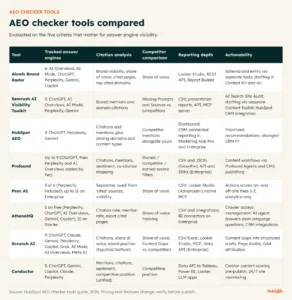
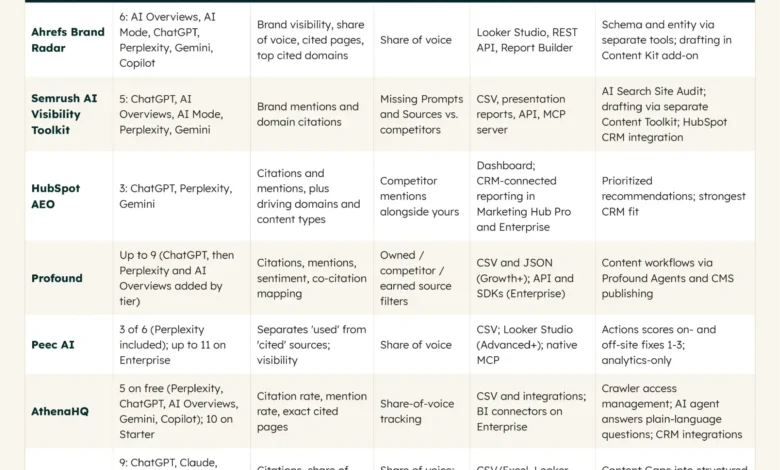
Ahrefs Brand Radar stands out for its reliance on real-world search queries rather than synthetic prompts, providing a high-fidelity view of the Google ecosystem. Similarly, the Semrush AI Visibility Toolkit allows users to flag which existing organic keywords are triggering AIOs, helping teams pivot their resources toward high-impact areas.
Tools for Citation and Chat Detection
HubSpot AEO offers a comprehensive approach, tracking both citations and mentions across major platforms while integrating these insights directly into the CRM. Profound takes this a step further by providing sentiment analysis and a breakdown of citations by source type, allowing brands to understand if they are being cited as a primary authority or merely an secondary reference.
![AEO checker tools that measure answer engine visibility [2026]](https://53.fs1.hubspotusercontent-na1.net/hubfs/53/aeo-checker-3-20260903-8904553.webp)
Specialized Monitoring
For organizations heavily reliant on specific platforms, dedicated tools like Peec AI and AthenaHQ provide specialized, high-frequency monitoring for Perplexity, which has gained significant traction as a research-oriented answer engine. For those focusing on technical SEO, platforms like Scrunch AI and Conductor focus on the "crawlability" aspect, ensuring that AI agents can effectively parse and render the content on your site.
The Strategic Implications for Modern Marketing
The rise of AEO represents a fundamental shift in the power dynamic between content creators and search engines. Historically, SEO was about "driving traffic." AEO is about "shaping authority." The implications for business strategy are profound:
- Content Strategy: Long-form content remains valuable, but it must now be punctuated by concise, data-rich snippets that satisfy the "direct answer" requirement of AI models.
- Brand Entity Management: Ensuring that your brand is clearly defined as an entity in your structured data is no longer optional; it is the primary way AI models identify and attribute information to you.
- Conversion Funnels: Since many users will never leave the AI interface, brands must optimize for "zero-click" influence. This involves ensuring that the brand value proposition is clearly communicated within the AI response itself.
The Path Forward
The "new era of search" is not a temporary trend; it is a permanent structural change in how human beings interface with the sum of human knowledge. While the transition from link-based search to answer-based search presents challenges for traditional web traffic models, it also provides an unprecedented opportunity for brands to establish themselves as trusted authorities.
![AEO checker tools that measure answer engine visibility [2026]](https://53.fs1.hubspotusercontent-na1.net/hubfs/53/aeo-checker-4-20260903-6212698.webp)
By implementing an AEO checker, businesses move away from reactive, guesswork-based strategies and toward a data-driven, continuous improvement cycle. Whether you start with manual spot-checks to establish a baseline or invest in enterprise-level tools that integrate directly with your CRM, the goal remains the same: ensuring that when a customer asks a question, your brand is the definitive answer they receive. The future of digital visibility belongs to those who adapt to this new conversational reality, ensuring their expertise is not just available, but prominently cited in the very fabric of the internet’s newest search interfaces.