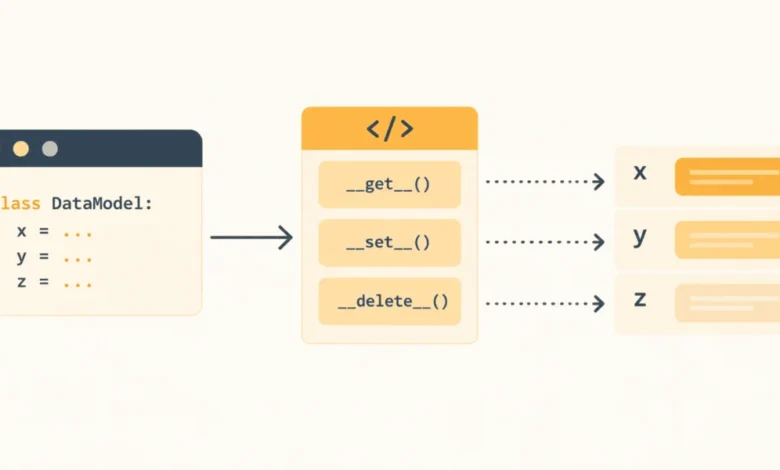
Python developers frequently encounter the challenge of managing object state, data integrity, and resource efficiency as applications scale. While standard practices like the @property decorator serve basic needs, they often lead to code duplication when applied across multiple classes. Python descriptors offer a more sophisticated, reusable, and elegant architectural solution. By implementing the descriptor protocol—specifically the __get__, __set__, and __delete__ methods—developers can exert granular control over how attributes are accessed, assigned, and processed. This article explores the mechanics of descriptors and demonstrates how they facilitate the creation of validated, computed, and lazily loaded attributes in a professional development context.
The Evolution of Attribute Access in Python
At its core, the descriptor protocol is the engine room of the Python object model. It is the underlying mechanism that powers methods, class methods, static methods, and properties themselves. When an attribute is accessed on an object, Python does not simply return a value; it initiates a lookup chain that checks the instance dictionary, the class dictionary, and eventually the descriptor protocol.
Historically, managing complex state in Python required repetitive boilerplate. If a developer needed to ensure a value remained within a specific range, they would write a property with a setter that performed manual checks. In large-scale applications, such as a travel management system requiring consistent validation for thousands of data points, this approach quickly leads to "spaghetti code." Descriptors resolve this by abstracting the logic into a standalone class, allowing the validation rules to be defined once and reused across any number of attributes.
Building Validated Attributes: Ensuring Data Integrity
Data integrity is a cornerstone of robust software architecture. In any enterprise-grade application, such as a simulated tourism booking system, ensuring that user-provided inputs—like ratings—adhere to strict boundaries is critical to preventing downstream errors.
A validated descriptor acts as a guardian. By leveraging the __set_name__ method, introduced in Python 3.6, a descriptor can automatically identify the name of the attribute it is bound to. This eliminates the need for manual configuration.
class ValidatedRating:
    def __init__(self, min_val=1.0, max_val=5.0):
        self.min_val = min_val
        self.max_val = max_val

    def __set_name__(self, owner, name):
        self.public_name = name
        self.private_name = f"_name"

    def __get__(self, obj, objtype=None):
        if obj is None:
            return self
        return getattr(obj, self.private_name)

    def __set__(self, obj, value):
        if not isinstance(value, (int, float)):
            raise TypeError(f"self.public_name must be a number.")
        if not (self.min_val <= value <= self.max_val):
            raise ValueError(f"self.public_name must be between self.min_val and self.max_val.")
        setattr(obj, self.private_name, float(value))
By centralizing validation, developers reduce the surface area for bugs. In a production environment, this pattern ensures that if a range requirement changes—for instance, shifting from a 5-star to a 10-star rating system—the modification occurs in one location rather than across dozens of model files.
Computed Attributes: Dynamic Data Transformation
In modern software, data is rarely static. It is frequently derived from other existing states. A common scenario involves currency conversion. If a system stores financial data in a base currency (like Japanese Yen) but must frequently report it in another (like US Dollars), calculating this value on every update is inefficient and error-prone.
Computed attributes allow for read-only access to derived data. By implementing only the __get__ method and raising an AttributeError in __set__, developers can create "virtual" attributes that are always accurate to the current state of the object.
class ComputedUSDPrice:
    def __init__(self, exchange_rate=0.0067):
        self.exchange_rate = exchange_rate

    def __set_name__(self, owner, name):
        self.name = name

    def __get__(self, obj, objtype=None):
        if obj is None:
            return self
        jpy_price = getattr(obj, 'price_jpy', 0)
        return round(jpy_price * self.exchange_rate, 2)

    def __set__(self, obj, value):
        raise AttributeError(f"self.name is a computed read-only attribute.")
This approach maintains a "single source of truth." By calculating the USD price on-demand, the application avoids synchronization issues where the base price and the converted price might diverge if the developer forgets to update both during a transaction.
Lazily Loaded Attributes: Optimizing Resource Utilization
Resource management is the final pillar of efficient attribute handling. In high-performance computing or large-scale data processing, loading heavy payloads—such as historical itinerary data, complex JSON configurations, or database query results—at initialization can significantly increase latency.
Lazy loading solves this by deferring the computation until the moment the attribute is accessed. Once computed, the result is cached in the instance’s __dict__, ensuring that subsequent access is near-instantaneous.
import time

class LazyItinerary:
    def __set_name__(self, owner, name):
        self.name = name

    def __get__(self, obj, objtype=None):
        if obj is None:
            return self
        print(f"[System] Querying database for obj.destination...")
        time.sleep(1) # Simulated latency
        itinerary = f"Itinerary for obj.destination: Arrival, sightseeing, departure."
        obj.__dict__[self.name] = itinerary
        return itinerary
This pattern is essential for microservices and API-driven architectures where responsiveness is paramount. By only fetching data when needed, the system remains lightweight and responsive, providing a superior user experience.
Practical Integration: The Unified Model
When these three patterns are integrated into a single class, the power of descriptors becomes evident. A JapanTour object can handle complex validation, dynamic calculations, and deferred data loading simultaneously, resulting in a clean, readable, and highly maintainable codebase.
In the context of the JapanTour class, the rating attribute ensures that only valid data is stored; the price_usd attribute provides accurate real-time currency conversion; and the itinerary attribute preserves system performance by waiting until the exact moment of request to retrieve the heavy travel data.
Broader Implications and Industry Impact
The adoption of the descriptor protocol represents a shift toward more "Pythonic" and declarative programming. Industry-standard frameworks like Django and SQLAlchemy rely heavily on this pattern to map database columns to Python attributes. By mastering these techniques, engineers move beyond basic object-oriented programming into advanced meta-programming, enabling them to build libraries and systems that are not only easier to debug but also significantly more flexible in the face of changing requirements.
While descriptors require a deeper understanding of the Python interpreter, the trade-off is a substantial reduction in technical debt. As software systems continue to grow in complexity, the ability to abstract attribute logic will remain a hallmark of senior-level development. By treating attributes as managed entities rather than mere data containers, developers can enforce business rules at the lowest possible level of the code, creating more resilient and reliable software ecosystems.
Ultimately, whether you are building a specialized tourism application or a distributed data processing engine, descriptors provide the tools necessary to enforce order, ensure accuracy, and optimize performance. Through the thoughtful application of the descriptor protocol, the code becomes less about managing state and more about defining the architecture of the system itself.