Anker MagGo Pro 2 Power Bank Review: Active Cooling, 25W MagSafe, and Fast Charging Bring New Standards to Mobile Power

The consumer electronics accessories market has witnessed a significant technological shift with the introduction of advanced thermal management systems in portable power solutions. Leading this wave of innovation, Anker has officially launched its flagship portable charger, the MagGo Pro 2. Billed by the manufacturer as the fastest and most thermally efficient wireless power bank currently available on the commercial market, the device combines a robust 10,000mAh capacity with 25W MagSafe fast-charging capabilities, active cooling architecture, and a comprehensive smart information display. Debuting amid the competitive retail landscape of the Black Friday shopping weekend, the MagGo Pro 2 has immediately captured the attention of mobile device users, particularly owners of contemporary Apple iPhone hardware, seeking high-performance charging accessories without the traditional pitfalls of overheating and subsequent power throttling.
Main Facts and Core Specifications
The Anker MagGo Pro 2 arrives with a comprehensive suite of hardware specifications designed to push the boundaries of portable power delivery. At its core, the device houses a 10,000mAh battery cell capacity, striking a balance between substantial energy reserves and everyday portability. What sets this iteration apart from its predecessors and competitive offerings is the integration of an active cooling mechanism. Traditional wireless power banks frequently suffer from thermal degradation; as energy transfers inductively, internal temperatures rise, forcing the charging speed to drop significantly to protect the battery and the connected smartphone. By incorporating active cooling fans and advanced heat dissipation pathways within the chassis, Anker ensures that the MagGo Pro 2 maintains optimal operating temperatures during extended high-wattage charging sessions.
Wireless performance is anchored by a 25W MagSafe-compatible output, representing a substantial leap forward for magnetic wireless charging speeds. For users who prefer a wired connection, the power bank delivers up to 45W of maximum output through its integrated USB-C port. This dual-capability allows the unit to function not only as a convenient wireless desktop stand but also as a high-speed wired power source capable of rapid-charging tablets, smaller laptops, and modern smartphones. According to official performance metrics provided by early testing and manufacturer data, the combination of active cooling and high-wattage output enables the unit to charge an iPhone 17 Pro from zero to fifty percent capacity in just 25 minutes.

Chronology and Market Launch Strategy
The development and subsequent release of the MagGo Pro 2 represent the culmination of years of iterative engineering in portable thermal management. As smartphone manufacturers continue to push the boundaries of fast wireless charging—necessitated by ever-increasing battery capacities and power-hungry mobile processors—accessory makers have faced the continuous challenge of managing heat. Excessive heat not only slows down charging speeds but also degrades the long-term chemical health of lithium-ion battery cells in both the power bank and the host smartphone.
Anker’s development timeline for the MagGo series transitioned from passive aluminum heat sinks to active thermal regulation following consumer demand for sustained peak charging speeds. The official rollout of the MagGo Pro 2 was strategically timed to coincide with the late-November holiday shopping period, specifically Black Friday weekend. By introducing the product to the market with an introductory promotional discount of 22 percent—lowering the standard retail price from $109.99 down to $85.99 on major e-commerce platforms like Amazon—the company positioned the device as an aggressive holiday offering for early adopters of newly released flagship smartphones.
Design, Ergonomics, and Smart Display Features
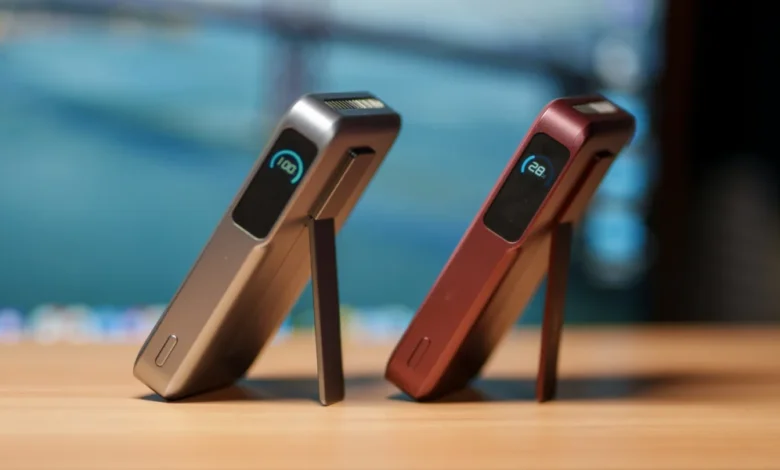
Beyond its raw performance metrics, the industrial design of the MagGo Pro 2 incorporates several notable ergonomic enhancements tailored to modern mobile workflows. One of the most prominent additions is the integration of a smart digital display situated on the side of the chassis. Unlike basic LED indicator lights that offer only vague approximations of remaining power, this high-contrast display provides real-time telemetry. Users can cycle through various operational metrics by pressing the physical power button, including precise battery percentage levels, live charging speeds for both wireless and USB-C connections, the internal operating temperature of the power bank, and the overall projected health of the internal battery cells.
Furthermore, the hardware design includes a built-in folding kickstand. This feature has become increasingly popular within the premium MagSafe accessory sector, allowing users to prop their smartphones horizontally or vertically while drawing power. This structural addition transforms the portable battery into a functional desktop charging dock or media viewing stand suitable for travel, office environments, or domestic use.

Compatibility considerations have also been carefully engineered. While the magnetic alignment is precisely calibrated for standard Pro-tier and base iPhone models, users handling larger device configurations—such as specialized dual-screen or extended handset models—may notice the power bank extending slightly past the lower boundary of the device housing. However, the inclusion of the articulated kickstand completely mitigates any stability concerns, ensuring the phone remains securely propped and continuously charged regardless of minor dimensional overhangs.
To complement the aesthetic preferences of modern smartphone owners, Anker has made the MagGo Pro 2 available in a diverse palette of finishes. Alongside traditional silver, blue, and gray options, the manufacturer introduced a specialized burgundy colorway designed to match the specific metallic hues of the latest iPhone 18 Pro series, ensuring a cohesive visual pairing for consumers invested in the Apple ecosystem.
Supporting Data and Technical Performance Analysis
An analytical evaluation of the MagGo Pro 2 reveals significant advancements in how portable power banks manage energy conversion efficiency. Standard Qi2 and MagSafe wireless chargers typically operate at lower wattage thresholds due to thermal constraints governed by safety regulatory bodies. By maintaining a lower internal delta-T (change in temperature over time) via active airflow, the MagGo Pro 2 circumvents the standard thermal throttling curve.
Data compiled from early user evaluations and technical testing underscores the practical implications of this technology. When charging a compatible flagship device, older-generation 15W MagSafe power banks frequently reduce their output to 5W or 7.5W within ten minutes of continuous operation as heat accumulates. The MagGo Pro 2, conversely, sustains higher amperage and voltage delivery for much longer durations, accounting for the dramatic reduction in charge times observed in benchmark tests.

Moreover, the inclusion of 45W USB-C Power Delivery (PD) input and output ensures that the power bank itself can be replenished rapidly. Utilizing an appropriate high-wattage wall adapter, the 10,000mAh internal cell capacity can be recharged from empty to full in a fraction of the time required by standard 10W or 18W portable chargers, minimizing downtime for users constantly on the move.
Industry Implications and Broader Market Impact
The introduction of active cooling to consumer-grade portable power banks marks a turning point for the mobile accessory industry. As thermal management transitions from a feature exclusive to high-performance gaming laptops and specialized photographic equipment down to pocket-sized accessories, consumer expectations regarding device performance are shifting.
Competitors in the mobile accessory space are now under increased pressure to develop similar active thermal regulation systems to match the sustained charging speeds and telemetry transparency established by Anker’s latest hardware. For consumers, the proliferation of such devices signals an era where portable charging no longer requires a compromise between speed, safety, and thermal comfort.
The promotional pricing strategy employed during its initial market release—dropping the price point from $109.99 to $85.99—further indicates an aggressive push to capture market share among holiday shoppers. As the technology matures and manufacturing costs for miniature cooling components stabilize, features such as real-time diagnostic displays and active temperature regulation are anticipated to transition from premium luxury additions to baseline expectations for high-end mobile power solutions.