The landscape of enterprise artificial intelligence is shifting rapidly away from open-ended text generation toward structured, deterministic control planes. Addressing this operational demand, Google DeepMind has officially announced the launch of the Gemini Decisions API alongside its specialized underlying model, Gemini Decision 1. Designed specifically for closed-set decision-making tasks—such as automated agent routing, policy enforcement, contextual grading, and tool selection—the new API allows developers to evaluate up to 1,000 independent questions in a single, high-speed forward pass. By eliminating the traditional token-by-token text generation loop, the system aims to solve persistent industry challenges surrounding latency, cost efficiency, and predictability in multimodal application development.
Background Context and Evolution of AI Workflows
For years, developers building automated workflows, customer service agents, and moderation systems have relied on standard large language models to make categorical choices. This approach typically involved prompting a generative model to output specific strings like "yes," "no," or a designated category code, followed by parsing the response on the client side. While functional, this methodology introduced significant inefficiencies. Generative text decoding is inherently sequential, which drives up latency and consumes valuable computing cycles. Furthermore, forcing a probabilistic, open-ended text generator to reliably output constrained classification metrics often required rigid output schemas and post-processing safeguards.
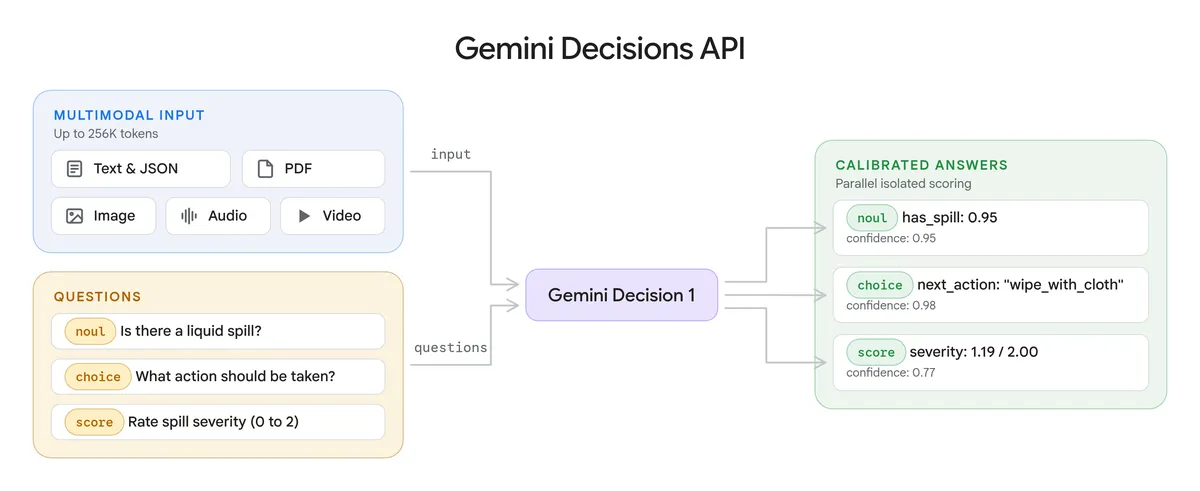
Google DeepMind’s product team, led by Product Manager Min Choi and Principal Scientist Felix Yu, approached this architectural bottleneck from a fundamentally different angle. Instead of generating conversational text, Gemini Decision 1 evaluates candidate options concurrently. By scoring possibilities mathematically in a single forward pass, the model returns precise probabilities and calibration metrics directly. This structural pivot transforms how applications handle routine operational decisions, streamlining workloads that previously required cumbersome chains of generative prompts.

Technical Architecture and Multimodal Capabilities
At the core of the new offering is its native multimodal architecture. Unlike traditional classifiers restricted solely to textual data, Gemini Decision 1 can ingest and process text, high-resolution images, complex audio recordings, video streams, and extensive PDF documents within a single unified context window of up to 256K tokens. This capability allows systems to combine disparate information sources—such as cross-referencing an incoming audio customer support recording with account logs or evaluating a scanned physical invoice alongside visual proof of delivery—without requiring separate transcription or optical character recognition pipelines.
The API supports three primary operational question types: binary yes/no checks, categorical multiple-choice selections, and rubric-based scoring systems. Crucially, every evaluation returns a granular confidence score ranging from 0 to 1. This continuous calibration metric empowers enterprise software engineers to programmatically route ambiguous cases to human reviewers or fallback protocols, substantially mitigating the risk of silent automation failures.
Performance Benchmarks, Latency, and Cost Structure
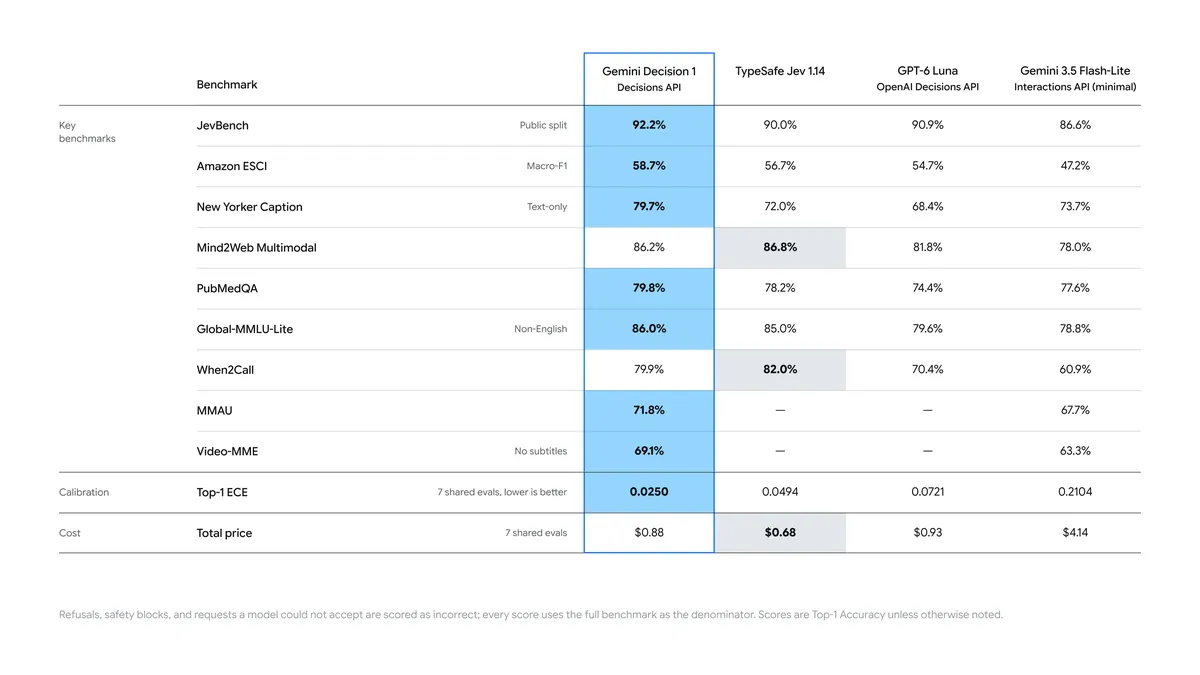
In comparative benchmark evaluations spanning agent routing, structural reasoning, option ranking, and complex multimodal comprehension, Gemini Decision 1 has demonstrated leading performance metrics coupled with exceptionally low calibration error. Because the model bypasses token-by-token decoding for its decision outputs, median compute latency remains constrained to between 50 and 100 milliseconds, translating to an end-to-end response time of 150 to 250 milliseconds. Notably, this latency profile remains virtually flat even when scaling from a single inquiry to 100 concurrent questions within a single request.
The economic model introduced with the Decisions API also marks a notable departure from conventional generative pricing. Priced at $0.10 per million input tokens, the system bills zero output tokens. Because the core input context is transmitted and billed only once per request—with subsequent questions adding only minimal instruction and criteria overhead—the API achieves cost efficiencies reported to be nearly five times lower than comparable traditional multimodal endpoint configurations. Additionally, developers avoid hidden expenses typically associated with auxiliary transcription services or multi-step reasoning models.
Early Industry Adoption and Ecosystem Integration
Ahead of its wider commercial rollout, several internal and external engineering teams have begun incorporating the Decisions API into low-latency control planes and interactive design tools. Early adopters have utilized the endpoint to power real-time UI generation platforms, automated quality assurance workflows, and complex safety filters. By replacing custom-trained classification models with dynamic, prompt-driven decision criteria, these teams have accelerated product development cycles while maintaining strict performance standards.
Ecosystem support is expanding concurrently with the launch. Major development frameworks and infrastructure providers have announced native integrations for Gemini Decision 1, including OpenRouter, LangChain, Vercel, LiteLLM, Pydantic AI, Pipecat, LiveKit, and OpenCode. Developers can immediately access the service utilizing official Google GenAI software development kits. While the Decisions API is currently accessible via Google AI Studio—featuring a zero-cost tier tailored for prototyping—Google has confirmed that broader enterprise availability through Gemini in Google Cloud is scheduled to roll out in the near future.
Broader Industry Implications and Future Outlook
The introduction of specialized decision-making endpoints reflects a mature phase in the commercialization of artificial intelligence. As enterprises move beyond experimental generative chatbots and focus on robust, production-grade automation, the demand for predictable, auditable, and economically viable tooling has intensified. By providing a high-throughput, calibrated alternative to generative text models, Google’s new architecture signals a broader industry trend toward purpose-built AI primitives.
As organizations increasingly deploy autonomous agents capable of interacting with complex physical and digital environments, the ability to execute rapid, multi-faceted evaluations with transparent confidence scoring will likely become a foundational requirement. The success of the Gemini Decisions API may well set a new benchmark for how machine learning infrastructure balances speed, cost, and analytical reliability in mission-critical enterprise applications.