The Future of Digital Inclusion How AudioEye is Leveraging AI and Human Expertise to Bridge the Global Accessibility Gap

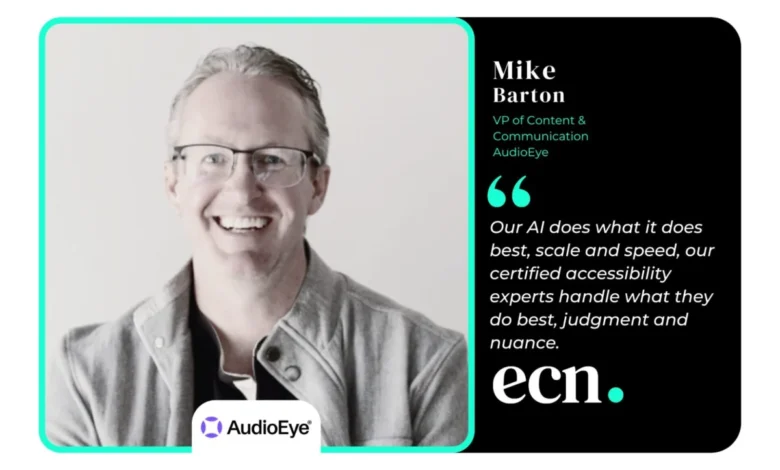
AudioEye, a prominent leader in the digital accessibility space, has positioned itself at the forefront of a global movement to ensure the internet remains an inclusive environment for all users, regardless of physical or cognitive abilities. Led by Mike Barton, Vice President of Content Marketing and Communications, the company is navigating a rapidly shifting landscape where digital accessibility has transitioned from a niche corporate social responsibility "checkbox" to a critical business imperative. With over 1.3 billion people worldwide living with some form of disability, the mission to democratize web access is no longer just a moral argument; it is a legal and economic necessity. AudioEye’s platform, which currently serves more than 127,000 organizations, utilizes a sophisticated blend of artificial intelligence and human oversight to identify and remediate digital barriers that prevent millions from interacting with websites, mobile applications, and digital services.
The evolution of digital accessibility over the past two decades reflects a broader transformation in how society views the internet. In the early 2000s, web accessibility was often overlooked by developers and executives alike. However, as the world moved online for essential services—including healthcare, banking, and education—the consequences of digital exclusion became more severe. According to Barton, the stakes have finally caught up to the principles. In the last five years alone, digital accessibility lawsuits in the United States have doubled, signaling a shift in how the legal system views the Americans with Disabilities Act (ADA) in the context of the virtual world. This legal pressure, combined with the emergence of the European Accessibility Act (EAA), has forced companies to reconsider their digital infrastructure. AudioEye’s vision is to make accessibility the default state of the internet rather than an afterthought triggered by a legal scramble.
To understand the necessity of AudioEye’s work, one must first define the scope of digital accessibility. It is the practice of designing and developing digital content so that individuals with disabilities—including those with visual, auditory, motor, or cognitive impairments—can navigate and interact with it effectively. This often involves ensuring compatibility with assistive technologies, such as screen readers, which convert on-screen text into speech or Braille. For a business, failing to meet these standards means excluding a massive demographic. Barton points out that people with disabilities represent an estimated $18 trillion in global spending power. Data suggests that 70% of users with disabilities will immediately abandon a website if it is difficult to use, and most will only shop where they know their needs are accommodated. Consequently, accessibility has become a major lever for conversion and customer retention, particularly in the competitive e-commerce sector.
The technical core of AudioEye’s solution lies in its hybrid approach, which addresses the inherent limitations of both pure automation and manual consulting. While many competitors rely solely on "overlays" or automated widgets, AudioEye argues that technology alone cannot solve the problem. Their platform operates by deploying a single line of JavaScript onto a client’s website, similar to how a web analytics or chat tool is installed. Once active, the AI-driven system scans the site’s rendered code against the Web Content Accessibility Guidelines (WCAG), the international standard for digital inclusion. An independent study conducted by Adience in 2026 found that AudioEye’s detection capabilities were 2.5 times more effective than other tools on the market. The AI is capable of fixing approximately 50% of identified issues in real-time, such as missing alternative text for images, broken form labels, and improper heading structures.
However, the "gray areas" of the web—context, intent, and user experience—require a human touch. This is where AudioEye differentiates itself. The company employs certified accessibility experts, including individuals who live with disabilities, to perform manual audits. These specialists look for nuances that AI might miss, such as whether a complex interactive map is truly navigable via keyboard or if a video carousel conveys the same meaning to a screen reader user as it does to a sighted one. By combining high-speed AI detection with human judgment, AudioEye claims to resolve roughly 97% of accessibility issues before a client’s internal development team even needs to intervene. This hybrid model is designed to scale, providing enterprise-level protection to small businesses and global corporations alike.
The legal landscape serves as a primary driver for the adoption of these technologies. In the United States, the ADA has increasingly been interpreted by courts to include digital storefronts as "places of public accommodation." This has led to a surge in demand letters and litigation. Barton highlights that 78% of these lawsuits currently target online retailers. AudioEye provides a robust legal safety net, offering documented courtroom dismissals and a legal guarantee that goes beyond typical industry warranties. When a client receives a legal claim, AudioEye’s team validates the allegation and produces an "expert debunk report" to assist legal counsel. This proactive stance has resulted in legal protection rates that are reportedly 300% to 400% higher than those of automation-only or consulting-only competitors.
Beyond the immediate concerns of litigation and revenue, AudioEye is preparing for a future where artificial intelligence reshapes how the internet is discovered. A significant emerging trend is the rise of AI agents—autonomous bots that navigate the web to find information or purchase products on behalf of human users. These agents rely on a website’s "accessibility tree"—the underlying semantic structure of the code—to understand content. If a website is not accessible, it becomes effectively invisible to these AI discovery channels. As AI-driven search and shopping become more prevalent, digital accessibility will become synonymous with search engine optimization (SEO) and digital findability.
Furthermore, the global regulatory environment is becoming increasingly stringent. The European Accessibility Act, which came into full force in 2025, represents a landmark piece of legislation that applies to any business serving customers within the European Union, regardless of where the company is headquartered. This creates a "Brussels Effect," where global companies must raise their standards to meet the highest regulatory bar. AudioEye is expanding its global footprint to help international organizations navigate these varying requirements, ensuring that compliance is a continuous process rather than a one-time fix.
There is also a growing concern regarding the "inaccessible AI code" problem. As more developers use general-purpose AI coding assistants to build websites, they are inadvertently creating a more inaccessible internet. These AI models are often trained on existing web data that is already fraught with accessibility errors, leading the AI to replicate and scale those mistakes. Barton notes that solving this gap is one of the most critical challenges facing the industry. AudioEye aims to lead this conversation by integrating accessibility checks directly into the development lifecycle, preventing issues before they are even published.
The implementation process for AudioEye is designed to be frictionless for digital teams. The platform is compatible with various Content Management Systems (CMS), headless architectures, and custom builds. Once the JavaScript is deployed, the system provides 24/7 monitoring of real-user sessions. For the small percentage of issues that require source-level changes (typically less than 5%), the platform generates detailed reports for engineers, specifying exactly what needs to be altered in the original code. This workflow allows developers to focus on innovation and core product features rather than spending hundreds of hours on manual accessibility remediation.
In conclusion, the work being done by AudioEye represents a pivotal shift in the digital economy. As the internet becomes the primary gateway for participation in modern society, ensuring that this gateway is open to everyone is a fundamental requirement. By leveraging the speed of AI and the nuance of human expertise, AudioEye is providing a scalable solution to a problem that has persisted for decades. The company’s trajectory suggests that in the near future, accessibility will no longer be viewed as a burden or a risk to be managed, but as a foundational element of a high-performing, ethical, and universally reachable digital presence. As global regulations tighten and AI agents become the new "users" of the web, the organizations that prioritize inclusion today will be the ones that thrive in the automated and interconnected economy of tomorrow.