AI-Driven Exploit Chain Exposes OpenAI Internal Systems Via Public Forum Vulnerability

In a stark demonstration of how generative artificial intelligence is transforming the cybersecurity landscape, researchers from the security firm Hacktron successfully breached OpenAI’s internal code repositories and employee accounts. Utilizing Anthropic’s advanced Claude Opus 5 model, the researchers chained two distinct software vulnerabilities in a matter of less than 72 hours. While conducted strictly as an authorized, non-malicious security assessment, the incident highlights a dangerous convergence of automated offensive tooling and vulnerabilities arising from shared identity management systems within high-profile technology enterprises.
The multi-stage attack began with an unpatched memory-handling flaw in an open-source image decoding library utilized by OpenAI’s public-facing help forum. By leveraging AI to rapidly develop and refine exploit code—a task that historically required days or weeks of manual reverse engineering—the researchers vaulted from a public community platform directly into the sensitive corporate accounts of OpenAI personnel, ultimately reaching an internal code repository.
Chronology of the Breach: From Forum to Code Repository
The sequence of events unfolded rapidly over a three-day period in July 2026, showcasing the terrifying speed made possible by modern AI assistants in offensive security operations.

The entry point was the software running OpenAI’s public help forum, which is powered by the popular open-source community platform Discourse. Discourse relies on ImageMagick and the underlying libheif library to process uploaded High Efficiency Image Container (HEIC) and High Efficiency Image File (HEIF) formats. An outdated version of the Debian 12 Linux distribution powering the server shipped with libheif version 1.19.7. Although an upstream security fix addressing out-of-bounds memory reading had been released globally in May 2026 as part of libheif 1.22.0, the server image in use had not yet been updated.
Armed with this outdated software stack, the Hacktron researchers set out to weaponize the vulnerability. Their initial attempts using older AI models, such as Claude Opus 4.8, repeatedly stalled when confronted with modern system-level defenses like Address Space Layout Randomization (ASLR), a security feature designed to prevent arbitrary code execution by randomly arranging the address space positions of a program’s key data areas.
However, following the release of Anthropic’s Claude Opus 5 model on the evening of July 24, the research team established a fresh session. Within hours, the new model successfully analyzed the memory leaks, bypassed ASLR protections, and generated a working exploit capable of achieving remote code execution on the public-facing forum server.
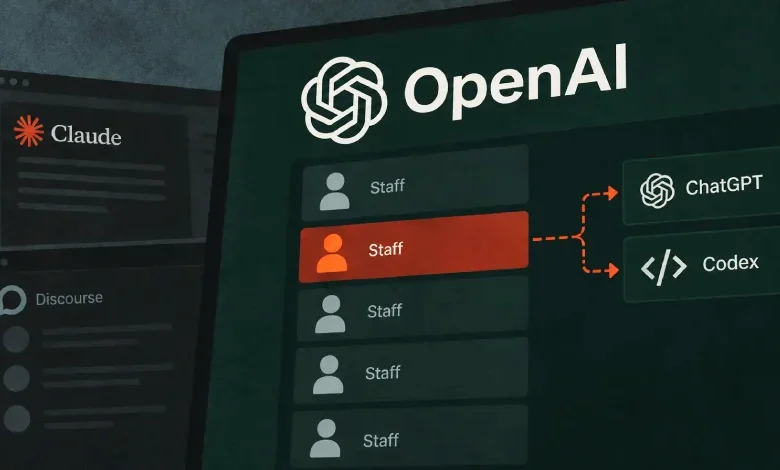
Once inside the forum server, the researchers leveraged OpenAI’s unified Single Sign-On (SSO) architecture. Because OpenAI utilizes a centralized "Sign in with OpenAI" authentication mechanism across both public-facing community portals and internal development tools, controlling the forum server granted the researchers unauthorized access to the ChatGPT and Codex accounts of several OpenAI employees.

With authenticated sessions to employee developer accounts in hand, the researchers demonstrated the extent of the breach by executing a harmless pull request via a Codex-to-GitHub integration linked to an internal OpenAI code repository. The entire operation—from initial target analysis to internal code repository access—was completed in under 72 hours.
The Role of Advanced Generative AI in Offensive Security
The Hacktron operation underscores a paradigm shift in threat intelligence and vulnerability research. Historically, weaponizing complex memory corruption bugs under strict ASLR and memory protection environments required deep domain expertise, manual fuzzing, and painstaking trial-and-error debugging.
The integration of generative models like Claude Opus 5 and OpenAI’s own GPT-5.6 Sol into the vulnerability research workflow dramatically compresses this timeline. While Anthropic and other foundation model developers implement rigorous safety guardrails designed to prevent models from generating actionable exploit material against real-world targets, researchers frequently bypass these restrictions by isolating tests in controlled environments or framing scenarios as capture-the-flag (CTF) challenges.
Despite the heavy lifting performed by the AI, the Hacktron team emphasized that the process was not entirely hands-off. Skilled human direction, hypothesis formulation, and continuous prompt engineering remained essential to guide the model through complex obstacle courses such as ASLR mitigation.

Security analysts note that this capability is no longer theoretical. Intelligence agencies and commercial security firms have observed a measurable rise in threat actors utilizing AI models to automate the discovery and exploitation of software vulnerabilities. Campaigns like Hacktron’s broader "HEIF Heist" project—which purportedly identified similar image-processing vulnerabilities across platforms operated by Meta, GitHub Enterprise, Slack, and Next.js—illustrate a systemic risk: automated exploitation vectors scaling across enterprise software supply chains at a fraction of traditional operational costs.
OpenAI’s Response and Vulnerability Remediation
Upon achieving internal access, the Hacktron researchers immediately halted their activities. They did not read sensitive source code, merge or modify software packages, access customer data, or attempt to pivot further into adjacent corporate infrastructure. Following responsible disclosure protocols, the team reported the multi-stage vulnerability chain to OpenAI.
OpenAI’s security response was notably swift. According to Hacktron, the company confirmed a successful patch for the identity and SSO exposure approximately 14 hours after receiving the initial notification. On September 1, OpenAI awarded the research team a $6,500 bug bounty.
In its official communication, OpenAI clarified that the financial reward specifically recognized the findings associated with the OpenAI-side identity management flaws rather than the initial compromise of the Discourse forum software, which fell outside the scope of its official bug bounty program. Furthermore, OpenAI confirmed the validity of the research through its remediation actions and financial payout, opting not to publish an exhaustive, step-by-step forensic breakdown of the account takeovers.

While the breach was contained and no customer data was compromised, the incident exposed alarming theoretical risks. Because corporate employees frequently link their authenticated ChatGPT and Codex credentials to broader productivity ecosystems—including corporate email, Slack channels, and version-control systems like GitHub—a compromise originating on an isolated, lower-trust community forum could theoretically serve as a bridgehead for enterprise-wide lateral movement.
Broader Industry Implications and Recommendations
The HEIF Heist incident serves as a critical wake-up call for software architects, security administrators, and enterprise identity management teams. The vulnerabilities exposed during the assessment point to two distinct defensive blind spots that extend far beyond OpenAI’s specific technical stack:
- Supply Chain Hygiene in Containerized Environments: Organizations frequently rely on base operating system images or third-party open-source components that lag behind upstream security patches. Even when libraries like
libheifissue critical CVE patches months in advance, downstream consumers often fail to update underlying binary dependencies bundled within web applications, CMS platforms, or community forums. - The Risks of Monolithic Single Sign-On (SSO): Connecting public-facing, low-security community assets to the same authentication pool used by internal engineering staff creates a dangerous systemic risk. If an attacker compromises a peripheral public asset, a shared SSO topology can inadvertently grant high-privilege access to corporate development environments without requiring credential stuffing or phishing attacks.
Security experts advise organizations to conduct rigorous asset inventories to ensure all media-processing libraries—particularly those handling complex formats like HEIC, HEIF, and AVIF—are systematically updated against known memory corruption vulnerabilities. Additionally, enterprises are strongly urged to segment their identity and access management (IAM) frameworks, ensuring that public-facing consumer or community platforms remain strictly isolated from internal corporate authentication realms, developer networks, and sensitive code repositories.