The Rise of Local Large Language Models in Machine Learning Workflows Through Scikit-Ollama Integration

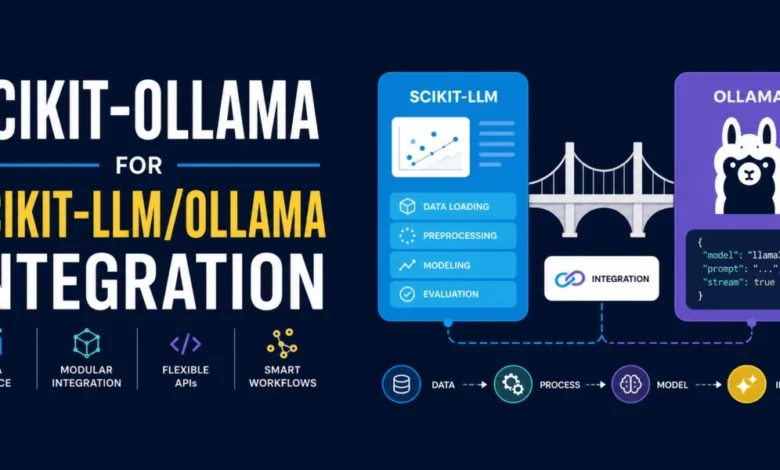
The landscape of artificial intelligence is currently undergoing a seismic shift as developers and enterprises move away from centralized, cloud-dependent architectures toward localized, privacy-centric solutions. At the forefront of this movement is the integration of Large Language Models (LLMs) into established machine learning frameworks, a feat recently simplified by the emergence of scikit-ollama. This library serves as a critical bridge between the industry-standard scikit-learn interface and Ollama, a platform that allows users to run powerful LLMs entirely on local hardware. By enabling zero-shot text classification without the need for external API calls, scikit-ollama addresses the dual challenges of data privacy and escalating operational costs that have historically hindered the adoption of generative AI in sensitive sectors.
The Evolution of Local Inference and Scikit-Ollama
For nearly a decade, scikit-learn has been the cornerstone of the Python machine learning ecosystem, providing a consistent and intuitive "fit-predict" syntax that has defined how practitioners build predictive models. However, as the industry transitioned from classical statistical methods to transformer-based language models, a gap emerged. Early LLM implementations required complex prompt engineering and specialized libraries that diverged significantly from the scikit-learn workflow.
The introduction of Scikit-LLM began to bridge this gap by wrapping cloud-based models like GPT-4 in scikit-learn-compatible estimators. While revolutionary, this approach still tethered users to third-party providers, raising concerns regarding data sovereignty and subscription-based overhead. Scikit-ollama represents the next logical step in this evolution. Built upon the foundations of Scikit-LLM, it removes the cloud dependency by leveraging Ollama’s ability to serve models like Llama 3, Mistral, and Phi-3 locally. This allows data scientists to treat a multi-billion parameter language model as if it were a local Support Vector Machine (SVM) or Random Forest classifier.
Technical Foundations and Environment Preparation
The implementation of a local LLM-driven classification system requires a specific convergence of software environments. Industry analysts note that the shift to local execution is largely supported by the democratization of high-performance hardware, such as Apple’s M-series silicon and NVIDIA’s RTX consumer GPUs, which provide the VRAM necessary to host quantified model weights.
To utilize scikit-ollama, the technical requirements begin with a modern Python environment, specifically version 3.9 or higher. This requirement is driven by the library’s reliance on advanced type hinting and asynchronous processing capabilities found in later Python iterations. The installation process is streamlined through standard package managers, yet the underlying infrastructure—Ollama—must be installed as a standalone service on the host operating system. This architectural choice ensures that the model weights are managed efficiently outside of the Python runtime, allowing for better memory management and faster inference speeds.
Once the environment is prepared, the workflow mirrors that of a traditional data science project. Using datasets provided by the Scikit-LLM ecosystem, such as movie review repositories for sentiment analysis, practitioners can load raw text and labels into memory. The distinction in this modern workflow lies in the absence of a "training" phase in the traditional sense. Instead of adjusting millions of weights over multiple epochs, the system utilizes "zero-shot" learning, where the pre-trained knowledge of a model like Llama 3 is harnessed to categorize text based on context and semantic understanding.
The Mechanics of Zero-Shot Classification via Ollama
The core innovation of scikit-ollama is the ZeroShotOllamaClassifier. In a traditional machine learning pipeline, a classifier must be exposed to thousands of labeled examples to learn the statistical boundaries between "positive" and "negative" sentiment. In contrast, the zero-shot approach leverages the LLM’s inherent understanding of language.
When a user calls the fit() method in scikit-ollama, they are not initiating a gradient descent process. Instead, they are defining the "label space." By providing a list of candidate labels—such as "positive," "negative," and "neutral"—the library configures the internal prompting logic. Under the hood, scikit-ollama reformulates the classification task into a constrained text-generation prompt. When the predict() method is invoked, the local Ollama instance receives the text input along with instructions to output only one of the predefined labels.
This process transforms a general-purpose generative model into a specialized discriminative tool. The "intelligence" of the model allows it to handle nuances, sarcasm, and complex linguistic structures that often baffle classical N-gram or TF-IDF based models. For instance, in movie review analysis, a model like Llama 3 can distinguish between a "spectacular failure" (negative) and a "spectacular achievement" (positive) with high accuracy, despite both phrases containing the word "spectacular."
Comparative Analysis: Local vs. Cloud-Based AI
The transition to local models via scikit-ollama is driven by several critical factors identified by IT infrastructure experts:
- Data Sovereignty and Security: For industries such as healthcare, finance, and legal services, sending sensitive text data to a cloud provider is often a violation of internal policy or government regulations like GDPR and HIPAA. Local inference ensures that the data never leaves the workstation or the corporate intranet.
- Cost Predictability: Cloud APIs typically charge per token. For high-volume applications, these costs can become prohibitive and difficult to forecast. Local models, once the hardware is acquired, have a marginal cost of zero.
- Latency and Reliability: While cloud APIs are subject to network fluctuations and rate-limiting, a local Ollama instance provides consistent performance tailored to the host’s hardware capabilities.
- Customization: Local deployment allows developers to swap models instantly—moving from a lightweight 3-billion parameter model for speed to a 70-billion parameter model for maximum accuracy—without changing a single line of API integration code.
Performance Metrics and Hardware Considerations
While the benefits of local integration are clear, the performance of scikit-ollama is inherently tied to the host machine’s specifications. During benchmark tests, a standard Llama 3 (8B) model running on an Apple M2 Max chip demonstrated the ability to classify movie reviews at a rate of approximately 20 to 50 iterations per minute, depending on the length of the input text.
For enterprise-grade applications, the "bottleneck" is often the initial model loading time. Scikit-ollama manages this by keeping the Ollama service warm, ensuring that subsequent calls to the predict() method do not suffer from the overhead of re-initializing the model weights. Furthermore, the use of 4-bit and 8-bit quantization—techniques that reduce the precision of model weights to save memory—has allowed these sophisticated workflows to run on machines with as little as 16GB of RAM, a threshold that was unthinkable just two years ago.
Strategic Implications for the Future of Data Science
The integration of tools like scikit-ollama signals a broader democratization of natural language processing. By lowering the barrier to entry, small-to-medium enterprises (SMEs) can now deploy state-of-the-art sentiment analysis, intent detection, and document categorization systems that were previously the exclusive domain of tech giants with massive R&D budgets.
Furthermore, this shift encourages a hybrid approach to AI. Data scientists can use scikit-ollama for rapid prototyping and local testing before deciding whether to scale to a cluster of local GPUs or a private cloud environment. The adherence to the scikit-learn API ensures that these models can be easily integrated into existing pipelines, including those involving automated feature engineering and cross-validation.
Industry analysts suggest that the next frontier for this integration will be "few-shot" learning and local fine-tuning. As libraries like scikit-ollama mature, we can expect the introduction of estimators that allow for "Parameter-Efficient Fine-Tuning" (PEFT), where a local model is slightly adjusted based on a small set of domain-specific data, all while maintaining the familiar scikit-learn syntax.
Conclusion
The emergence of scikit-ollama represents a pivotal moment in the convergence of classical machine learning and modern generative AI. By providing a seamless, local, and cost-effective method for text classification, it empowers developers to build sophisticated applications that respect user privacy and operational constraints. As the AI ecosystem continues to move toward the "edge," the ability to bridge powerful local models with the simplicity of the scikit-learn interface will remain an essential skill for the modern data practitioner. The era of "AI-on-the-desk" has arrived, and with it comes a new standard for secure, efficient, and accessible machine learning.