Google Unveils Five New AI-Powered Features in Search to Transform Student Learning and Academic Organization

The landscape of digital education is undergoing a profound transformation as artificial intelligence becomes more deeply integrated into everyday research and study workflows. In an announcement timed for the upcoming academic term, Google has introduced five new artificial intelligence capabilities within its core Search engine and associated platforms. Designed to help students master complex subjects, prepare for high-stakes standardized tests, and manage sprawling academic workloads, these tools represent a major step forward in the practical application of generative AI for educational purposes. According to Awaneesh Verma, Distinguished Product Manager for Search, the new offerings are built to be safe by design and aim to bridge the gap between static textbook learning and interactive, personalized instruction.
The introduction of these features comes at a critical juncture in the evolution of educational technology. Over the past several years, students and educators have increasingly turned to digital platforms for supplementary instruction, remote collaboration, and homework assistance. However, many early generative AI tools operated in isolation, requiring users to switch between separate applications for note-taking, quiz generation, and conceptual research. Google’s latest update seeks to consolidate these functions directly inside the Search interface and AI Mode, creating a unified ecosystem where learners can transition seamlessly from exploratory research to rigorous practice and organization.
Interactive Visuals and Generative User Interfaces
One of the primary hurdles students face when encountering advanced subjects—such as organic chemistry, advanced physics, or macroeconomics—is the limitation of static textbook graphics. To address this, Google Search is now rolling out generative user interface (UI) capabilities that allow the system to create custom visual tools and simulations on the fly.
When a user searches for a fundamental scientific concept, such as the pH scale, the AI Overview can generate an interactive visual element rather than a simple block of text. Students can manipulate variables, observe real-time changes, and issue specialized follow-up queries, such as plotting specific citrus fruits along the continuum. This capability, which launched globally in English within AI Mode and is expanding to standard AI Overviews, transforms passive reading into an active, exploratory experience. Industry analysts note that visual simulations significantly enhance cognitive retention, particularly for visual and kinesthetic learners who struggle to conceptualize abstract scientific principles.
Standardized Test Preparation and Expert Partnerships
Testing knowledge retention is a vital component of academic success, yet access to personalized practice materials has traditionally required expensive tutoring services or specialized test-prep manuals. Google’s second major update introduces customized practice quizzes directly within Search, covering a vast spectrum of disciplines ranging from foreign languages to advanced mathematics and the humanities.
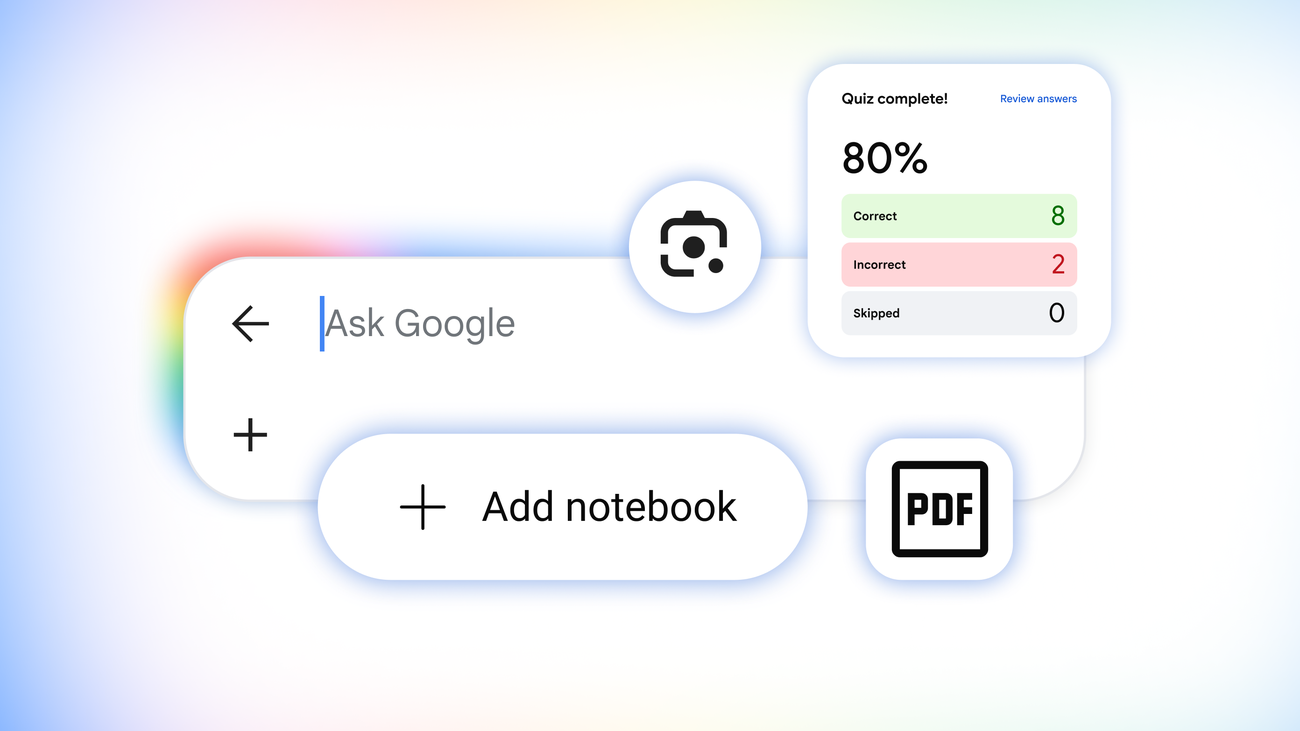
Crucially, these diagnostic tools are not built solely on generic language model training data. Through strategic partnerships with leading educational and test-prep organizations—including The Princeton Review, Careers360, PhysicsWallah, and Akira Enem—Google has integrated authoritative, curriculum-aligned content into the quiz generation engine. Consequently, students preparing for prominent global examinations can request targeted practice sets. The supported examinations now comprise a diverse international roster:
- ACT and SAT (United States)
- Advanced Placement (AP) exams
- ENEM (Brazil)
- Graduate Record Examination (GRE)
- Joint Entrance Examination (JEE) (India)
- Law School Admission Test (LSAT)
- Medical College Admission Test (MCAT)
- National Eligibility cum Entrance Test (NEET) (India)
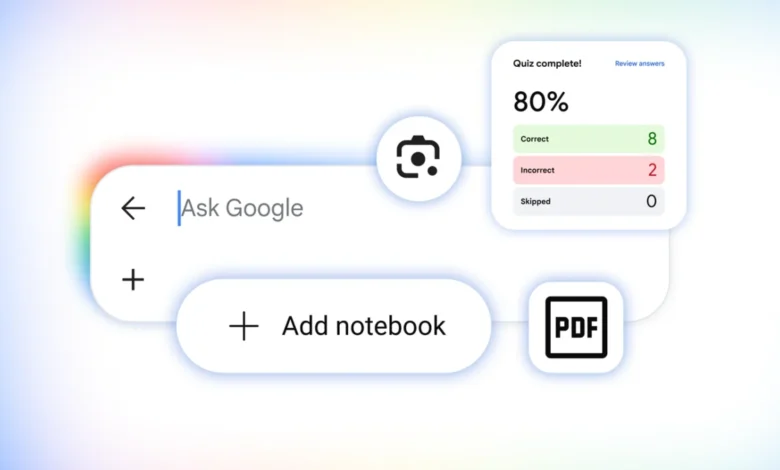
When a student queries the system for commonly tested vocabulary words or physics problem sets, Search generates an interactive quiz complete with detailed rationale for each answer choice and direct links to further reading materials. These practice quizzes are currently available free of charge in English globally across AI Overviews and AI Mode.
Step-by-Step Problem Solving with Google Lens
Mathematical and analytical problem-solving often halts when a student makes an early calculation error, leaving them uncertain of where their methodology went off course. To mitigate this friction, Google is expanding the functionality of Lens in Search to offer an interactive, diagnostic learning assistant.
In the coming weeks, users utilizing the Google app on Android and iOS will be able to tap the Lens camera icon and capture an image of handwritten equations, geometry proofs, or complex word problems. Instead of merely providing a final solution, the resulting AI Overview acts as a virtual tutor. It pinpoints the precise step where a mistake may have occurred, offers structured hints, and guides the student toward the correct deduction. If the explanation requires further depth, students can seamlessly transition their query into AI Mode to continue the dialogue while simultaneously cross-referencing authoritative web resources.
Unified Study Management Through Integrated Notebooks
Information fragmentation is a persistent challenge for modern students, who frequently accumulate dozens of open browser tabs, scattered PDF syllabi, lecture slides, and disparate digital notes. To solve this organizational bottleneck, Google is integrating its popular Gemini Notebook functionality (formerly known as NotebookLM) directly into AI Mode.
Starting this week, users can establish dedicated digital notebooks tailored to individual classes, research projects, or study groups. By ingesting diverse reference materials—ranging from official course syllabi and lecture slides to web articles and previous AI Mode chat transcripts—the system creates a centralized repository of knowledge. Students can then query their custom notebook to synthesize insights, cross-reference source documents, and track their intellectual progress over time.
Furthermore, to ensure a cohesive user experience across the Google product family, pre-existing notebooks created within Gemini Notebook or the standalone Gemini application will automatically sync with Search. This feature is rolling out across more than 180 countries in English, with additional regional language support scheduled for release in the subsequent weeks.
Automated File Generation and Document Synthesis
The final pillar of Google’s back-to-school initiative focuses on streamlining administrative and preparatory tasks. Students often spend valuable study hours manually condensing lengthy lecture recordings, scanned handwritten notes, and textbook chapters into cohesive study guides.
Google Search now enables users to request ready-to-use study documents derived directly from uploaded files or active AI Mode conversation threads. By uploading a combination of handwritten lecture notes and digital slide decks, a student can prompt the system to generate a structured, one-page summary or a comprehensive review document. This custom file creation capability has been deployed globally in English for AI Mode and is slated for imminent integration into AI Overviews. Initially supporting standard document types, slide presentations, spreadsheets, and plain text formats, the feature significantly reduces the logistical overhead of exam preparation.
Broader Implications for Educational Technology
The rollout of these five educational capabilities highlights a broader shift in how technology companies approach artificial intelligence in academia. Rather than positioning AI solely as an automated answer engine—which has historically raised concerns regarding academic integrity and critical thinking—major technology providers are increasingly emphasizing pedagogical scaffolding. By focusing on diagnostic coaching through Google Lens, verified practice materials through publisher partnerships, and personalized synthesis through Gemini Notebooks, Google is attempting to align its utility with active learning methodologies.
Education sector analysts point out that while these tools offer unprecedented access to personalized tutoring and organizational efficiency, their long-term efficacy will depend heavily on digital literacy and institutional guidance. Educators will need to adapt curricula to incorporate generative research tools responsibly, ensuring that students utilize AI for conceptual mastery and critical evaluation rather than mere shortcut-taking.
As these features roll out globally across English-speaking markets and expand into new languages, they mark a definitive milestone in the consumerization of advanced educational technology. By embedding complex machine learning architectures directly into the everyday search habit, Google is attempting to redefine the foundational tool of modern internet research into a comprehensive, personalized academic companion.