The Evolution of Retrieval-Augmented Generation
The concept of RAG, which combines a retrieval mechanism with a Large Language Model (LLM), has historically focused on text-based chunking. By breaking documents into smaller semantic units and storing them in vector databases, developers enabled systems to answer questions grounded in specific source material. However, this paradigm was designed for prose. When a system encounters a PDF containing a financial performance chart or a scientific schema, text-based chunking typically strips away the structural context. The result is often an incomplete or hallucinated response that ignores the very visual evidence that conveys the most critical information.
Recent industry reports indicate that nearly 80% of enterprise data is trapped in unstructured formats, with a substantial portion of that value embedded in non-textual elements. The shift toward multi-modal RAG—the ability for an AI system to process and correlate text, tables, and images simultaneously—marks a maturation in how AI interacts with business intelligence. This methodology aligns with the broader push toward "vision-language" integration, where models like OpenAI’s GPT-4o are capable of "seeing" and interpreting visual data with the same depth as they process natural language.
Core Architecture and Methodology
Building a robust multi-modal pipeline requires a multi-stage approach: parsing, summarization, vector indexing, and multimodal reasoning. This architecture moves away from the "flat" retrieval approach, utilizing a multi-vector system to ensure that visual data is searchable even if the user provides only a text-based query.
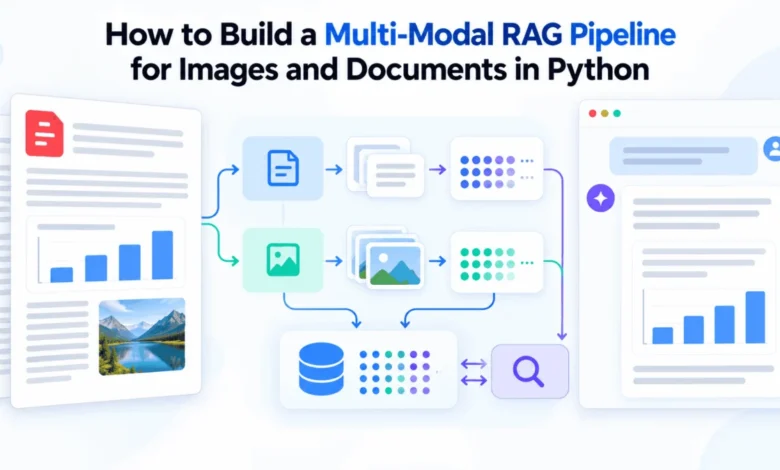
The process begins with the extraction phase using tools like the unstructured library, which is capable of distinguishing between disparate elements of a PDF. By identifying and separating paragraphs, tables, and images, the pipeline preserves the original document’s layout logic. Once extracted, images are not simply stored; they are passed to a vision-enabled LLM to generate dense, descriptive textual summaries. These summaries are then embedded and indexed in a vector store, effectively acting as a "searchable proxy" for the image.
When a query is issued, the system performs a similarity search across both the original text chunks and the image summaries. If a relevant image is identified, the system retrieves the original file, converts it into a base64-encoded format, and provides it to the LLM alongside the relevant text. This creates a context-rich environment for the model to generate a synthesis of the information, ensuring the final output is grounded in both the document’s narrative and its visual data.
Technical Implementation and Prerequisites
Implementing this system requires a specialized stack, typically involving Python, LangChain for orchestration, and a vector database like ChromaDB.
Prerequisites:
- API Infrastructure: A valid OpenAI API key is essential, as the intelligence layer relies on GPT-4o for both image summarization and the final reasoning task.
- Environment Setup: Developers must install
langchain,langchain-openai,unstructured,chromadb, andpillow. - System Dependencies: The
poppler-utilspackage is a critical requirement forunstructuredto perform low-level rendering of PDF pages into image elements.
The implementation flow involves four distinct phases:
- Parsing: Using
partition_pdf()to decompose the source document into distinctCompositeElementandImageobjects. - Summarization: Automating the description of images to allow for vector space indexing.
- Storage: Utilizing a
MultiVectorRetrieverto map textual search terms to both raw text documents and their corresponding visual counterparts. - Inference: Constructing a multimodal prompt that combines text and image input for the final answer.
Implications and Strategic Impact
The ability to process multi-modal documents has immediate implications for highly regulated and data-intensive industries. In finance, for example, an analyst can query a massive folder of quarterly reports, asking for a comparison of revenue growth across specific regions. The system will not only pull the textual justification for these figures but will also present the actual charts from the reports as supporting evidence, significantly reducing the risk of data misinterpretation.
Similarly, in the manufacturing and healthcare sectors, where technical manuals and medical records are densely populated with diagrams and scans, this technology allows for instantaneous access to accurate, context-aware information. By enabling the AI to "see" the document, developers are moving beyond simple keyword search toward genuine machine comprehension of complex human artifacts.
Challenges and Future Considerations
While this pipeline solves the issue of visual blindness in RAG, it introduces new challenges, particularly regarding cost and latency. Every image extraction and subsequent summary generation incurs a cost and processing time. As companies scale these pipelines to thousands or millions of documents, they must implement filtering logic—such as excluding images below a certain pixel threshold or those deemed "decorative"—to manage API costs.
Furthermore, the field is evolving toward more sophisticated models. While the current API-driven approach is ideal for standard business use cases, emerging research into models like ColPali suggests a future where documents might be embedded directly as images without the need for traditional parsing or OCR. This would eliminate the "parsing step" entirely, potentially increasing accuracy by preserving the global structure of a page.
Conclusion
The construction of a multi-modal RAG pipeline is a foundational step for any organization looking to move beyond simple text automation. By bridging the gap between disparate content types, developers can build systems that truly mirror how humans read: taking in the text, cross-referencing it with the visuals, and forming a coherent, evidence-based conclusion. As the technology matures, we can expect these systems to become the standard for any application requiring high-fidelity document interaction, marking a definitive shift toward more intuitive and capable AI architectures. The tools are now available for developers to start building these systems today, turning previously unreadable archives into active, intelligence-rich assets.