Unlocking the Value of Digital Engagement: A Comprehensive Guide to Calculating and Maximizing Social Media ROI


Social media ROI, or Return on Investment, represents the quantifiable value a business gains from its social media marketing and advertising efforts, contrasting the resources invested against the tangible and intangible returns. In an increasingly digital-first economy, understanding this metric is paramount for businesses to validate their marketing spend, optimize strategies, and demonstrate genuine impact on the bottom line. This crucial calculation extends beyond mere revenue attribution, encompassing both direct monetary gains and significant non-monetary values such as enhanced brand awareness, improved customer sentiment, and increased engagement, all of which contribute to long-term business health and growth.
The Evolving Landscape of Social Media Investment

The perception and utility of social media for businesses have undergone a profound transformation. What once began as a peripheral channel for informal brand presence has evolved into a central pillar of comprehensive marketing strategies, demanding substantial investment in terms of budget, time, and human resources. This elevated status, however, brings with it a heightened demand for accountability. Data from a recent Hootsuite study reveals that a significant 68% of marketers express concern over their ability to definitively prove ROI from their social media endeavors. This apprehension persists despite overwhelming evidence of social media’s commercial power. Projections from Statista indicate that the global social commerce market is poised to reach an impressive $908.5 billion in 2026, marking a robust 10.7% year-over-year growth, with forecasts suggesting it will surpass the $1 trillion mark by 2028. With nearly 5.75 billion social media users expected worldwide by 2026, the sheer scale of potential reach underscores the imperative for precise ROI measurement.
Defining and Demystifying Social Media ROI

At its core, the classic ROI formula is straightforward: ((Value Generated – Costs) / Costs) x 100. However, applying this to social media introduces complexities. The "value generated" in a social context is multifaceted, encompassing direct sales and lead conversions, as well as less tangible benefits that are nonetheless vital. Monetary value typically includes direct sales, lead conversions, website traffic leading to purchases, and cost savings (e.g., from using social media for customer service). Non-monetary value, while harder to quantify, includes brand awareness, positive sentiment, increased brand loyalty, improved customer satisfaction, and a stronger share of voice within the industry. To integrate these non-monetary outcomes into the ROI calculation, businesses must assign estimated financial values to them, often using proxies like customer lifetime value (CLV) for new followers or an estimated value per lead, click, or engagement based on historical conversion data. This holistic approach ensures a more accurate reflection of social media’s total contribution.
Navigating the Hurdles: Why Social ROI is Challenging to Measure

Despite its critical importance, measuring social media ROI is fraught with challenges that often leave marketers struggling to present a clear picture to stakeholders.
- Multi-Touch Attribution Across Channels: The customer journey is rarely linear. A potential customer might encounter a brand’s Instagram post, receive an email a week later, and finally convert via a paid search advertisement. In such multi-touch scenarios, traditional single-touch attribution models frequently overlook or undercredit social media’s initial influence. Implementing sophisticated multi-touch attribution models and assisted conversion tracking is essential to accurately apportion credit to social media’s role at various stages of the customer’s path to purchase.
- Delayed Conversions and Long Sales Cycles: The impact of social media often manifests weeks or even months after the initial interaction. This is particularly true for B2B and enterprise sales, where a LinkedIn post might plant the seed for a deal that materializes much later. Limiting measurement to immediate, same-day results can significantly understate social media’s true contribution to long-term sales pipelines.
- Quantifying Non-Monetary Value: Metrics like brand awareness, positive sentiment, and share of voice are undeniably valuable but resist easy translation into dollar figures. Overcoming this requires strategic estimation, often by linking these metrics to established business outcomes. For instance, increased brand awareness might be valued based on the cost of achieving similar reach through traditional advertising, or positive sentiment could be linked to customer retention rates and CLV.
- Data Silos Across Platforms: Each social media platform provides its own analytics dashboard, creating fragmented data landscapes. Manually consolidating this information is time-consuming and prone to errors. This challenge was highlighted in Nielsen’s 2025 Marketing Report as a top barrier to calculating ROI, emphasizing the need for unified analytics platforms that aggregate data from all social channels, web analytics, and CRM systems into a single, cohesive view.
A Systematic Approach: Five Steps to Calculate Social Media ROI
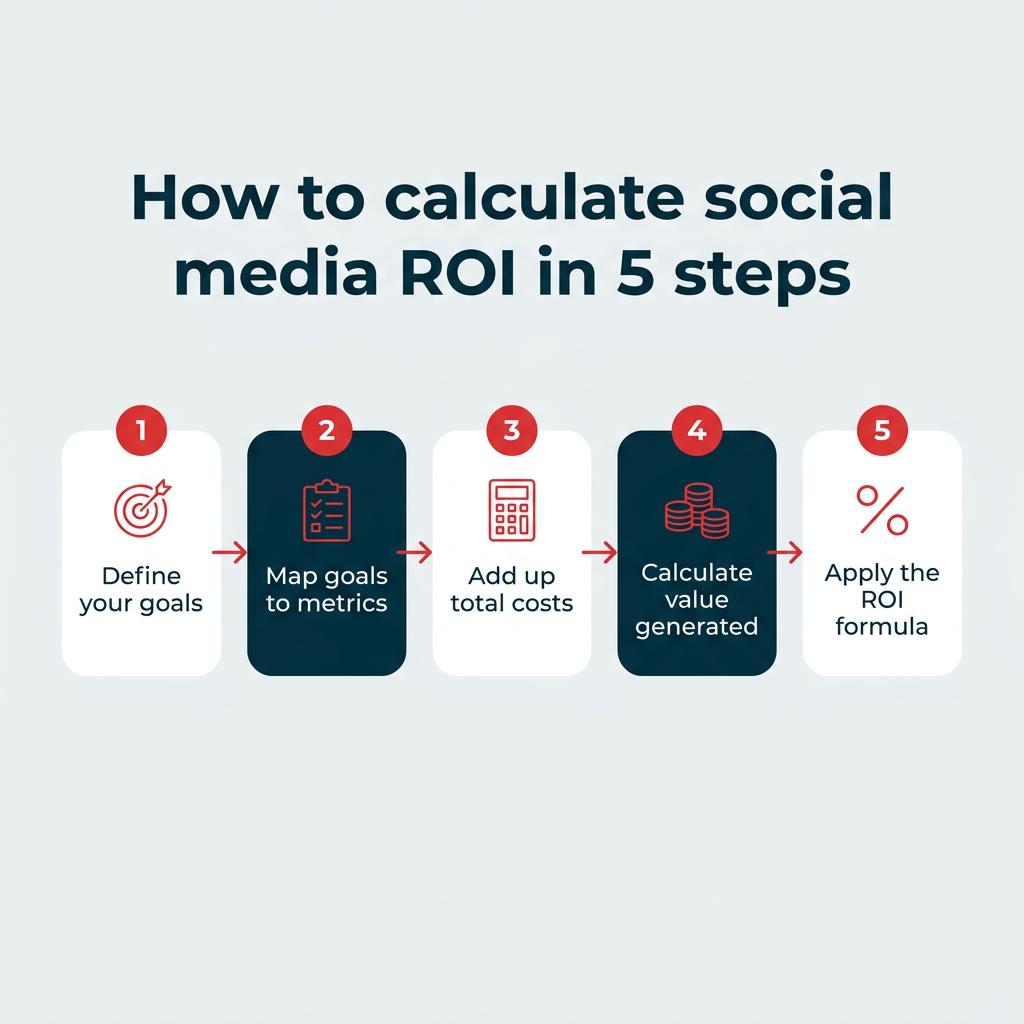
To accurately measure social media ROI, a structured methodology is indispensable:
- Define Your Social Media Goals: The first step is to establish clear, measurable, and business-aligned goals. Whether the focus is on increasing sales, generating leads, boosting brand awareness, or enhancing customer service, each objective will dictate different metrics and measurement strategies. Campaign-specific goals, such as increasing website traffic by X% or generating Y leads within a quarter, provide actionable benchmarks for performance evaluation. As Eileen Kwok, former Social & Influencer Marketing Strategist at Hootsuite, advises, "The goals you have set for at the start of the year, could have already changed. Depending on the shifts your organization is making, or the changing social landscape, make sure you are revisiting your goals every quarter to see if any updates need to be made."
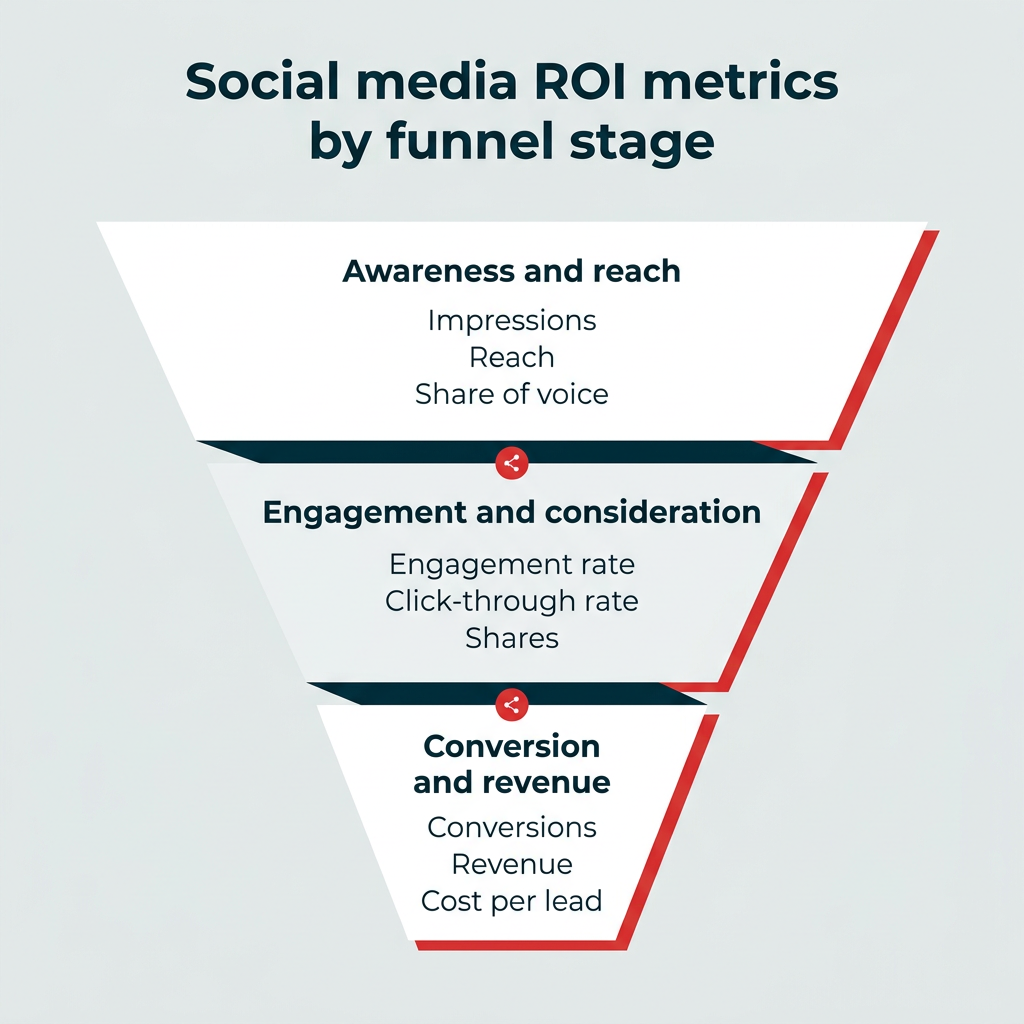
- Map Goals to the Right Metrics: Once goals are defined, select the most relevant social media metrics that demonstrate progress toward those objectives. For instance, if the goal is brand awareness, metrics like impressions, reach, brand mentions, and follower growth rate are key. For engagement, focus on engagement rate, click-through rate (CTR), shares, comments, and video views. For conversion and revenue, track actual conversions, revenue attributed to social, cost per lead (CPL), cost per acquisition (CPA), and return on ad spend (ROAS).
- Add Up Your Total Social Media Costs: A comprehensive calculation of investment is critical. This includes all expenditures related to social media activities over a defined period. Common costs include social media advertising spend, content creation expenses (design, video production, copywriting), social media management tools and software, employee salaries (social media managers, strategists), influencer marketing budgets, training costs, and any other overhead directly attributable to social efforts. Granularity here ensures an accurate cost base for the ROI formula.
- Calculate the Value Generated: This step involves summing up both monetary and the estimated non-monetary value generated. Monetary value is straightforward: direct sales, lead values, subscription revenues, or website conversions. For non-monetary value, assign a proxy dollar value. For example, if a new follower typically translates to a certain CLV over their lifecycle, or if an engagement leads to a measurable increase in brand affinity that correlates with future purchases, these can be monetized for the calculation. This proactive assignment of value is essential for a holistic ROI assessment.
- Apply the ROI Formula: With total value generated and total costs calculated, plug these figures into the formula:
((Value Generated – Costs) / Costs) x 100. The result, expressed as a percentage, indicates the return on investment. A positive percentage signifies that social media efforts are yielding more value than they cost, while a negative percentage signals a need for strategic adjustments.
Real-World Illustrations of Social Media ROI Calculation
To clarify these steps, consider practical examples:
- E-commerce Business Campaign: An online retailer launches a social media campaign to boost sales. Their costs include $5,000 for ad spend and $2,000 for content creation, totaling $7,000. The campaign directly generates $19,500 in sales revenue and, through engagement, contributes to a $3,000 increase in average customer lifetime value for new followers. The total value generated is $22,500. Applying the formula: (($22,500 – $7,000) / $7,000) x 100 = 221.4%. This indicates a substantial return, generating over double the investment.
- B2B Lead Generation on LinkedIn: A B2B company invests $10,000 in a LinkedIn lead generation campaign (including ad spend, content, and staff time). This campaign results in 50 qualified leads, each estimated to be worth $1,000 based on historical conversion rates and deal sizes. The total value generated is $50,000. ROI = (($50,000 – $10,000) / $10,000) x 100 = 400%. This high return underscores the effectiveness of targeted B2B social strategies.
- Brand Awareness Campaign: A brand runs a three-month awareness campaign with a total cost of $15,000. While direct sales are not the primary goal, the campaign significantly increases brand mentions, website traffic (non-converting), and follower count. The company estimates that the increased brand visibility and engagement translate to an equivalent value of $25,000 (based on comparative ad spend for similar reach and the estimated CLV of new followers). ROI = (($25,000 – $15,000) / $15,000) x 100 = 66.7%. This demonstrates how even non-sales-focused campaigns can show a positive financial return when value is appropriately estimated.
What Constitutes "Good" Social Media ROI?
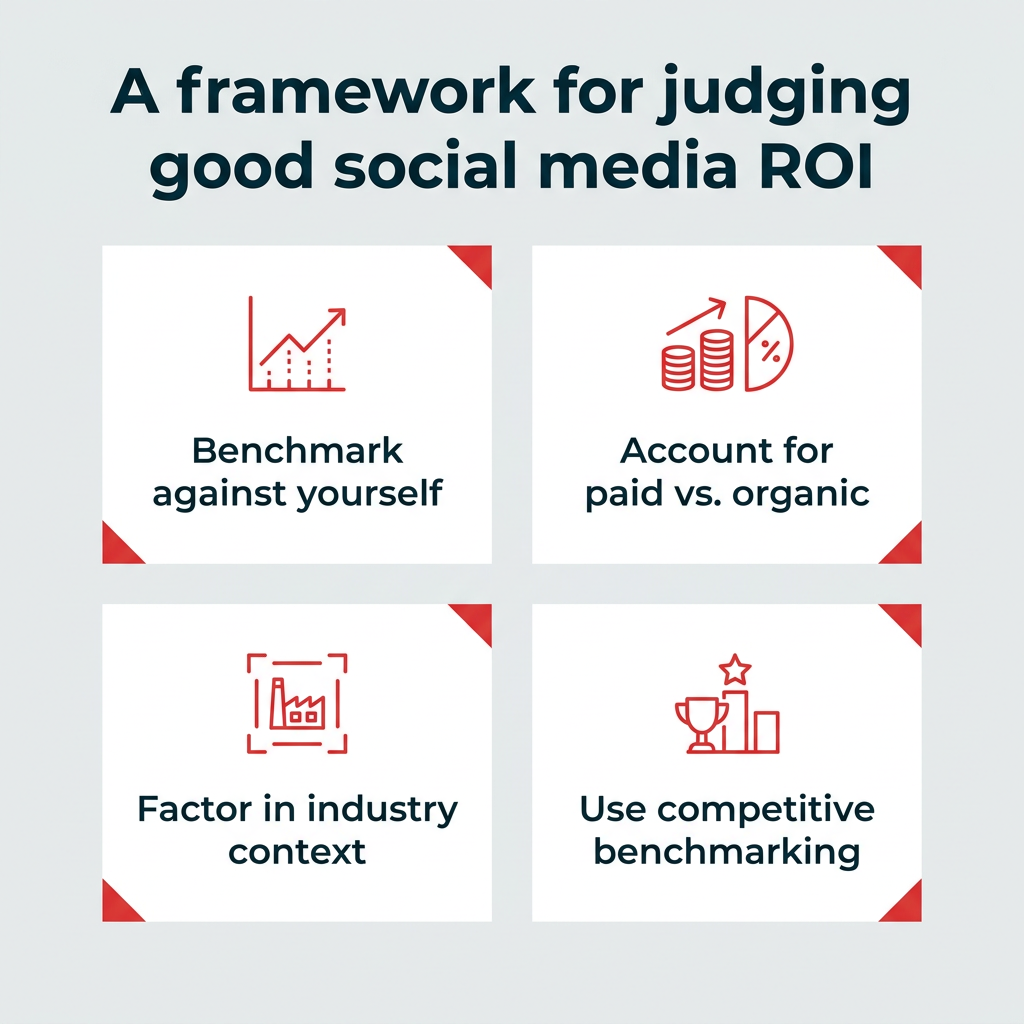
There is no universal benchmark for a "good" social media ROI percentage. What constitutes a favorable return is highly dependent on industry, specific business goals, the maturity of the social strategy, and whether the focus is on paid or organic efforts. Generally, any positive ROI indicates that the investment is generating more value than its cost. A more nuanced framework for evaluating ROI involves:
- Positive ROI: The foundational requirement; social media should not be a net cost center.
- Consistent Improvement: Tracking ROI over time allows for performance benchmarking against past campaigns. An upward trend signifies successful optimization.
- Outperforming Competitors: Comparing ROI against industry peers can highlight competitive advantages or areas for improvement. Tools like Hootsuite Analytics provide competitor benchmarking data.
- Alignment with Business Objectives: The most critical aspect is whether the ROI directly supports broader organizational goals, such as market share growth, customer retention, or brand leadership.
Strategies for Enhancing Social Media ROI

Continuous improvement is key to maximizing social media ROI. This involves a cycle of experimentation, analysis, and refinement:
- A/B Experimentation: Social media platforms are dynamic. Running A/B tests on content formats (e.g., video vs. static images), messaging, call-to-actions, and posting times allows marketers to identify what resonates most effectively with their audience. Hootsuite’s own experiments, like comparing Instagram carousels to Reels, can yield surprising insights into optimal engagement strategies. This iterative testing process directly informs content strategy, leading to higher engagement and conversion rates.
- Competitor Analysis and Benchmarking: Monitoring competitor performance offers invaluable insights. By analyzing their top-performing posts, trending hashtags, and content styles, businesses can identify successful tactics and adapt them for their own strategy. Platforms like Hootsuite Analytics provide tools to track up to 20 competitors, offering a comparative lens to refine one’s approach and pinpoint opportunities for growth.
- Precision Tracking with UTM Parameters: Urchin Tracking Module (UTM) parameters are indispensable for attributing web traffic and conversions directly back to specific social media posts or campaigns. By appending unique tags to URLs shared on social media, marketers can track the exact source, medium, and campaign that drove a user to their website, enabling accurate measurement of clicks, leads, and sales originating from social.
- Leveraging Social Commerce: The integration of shopping functionalities directly within social platforms represents a direct path to revenue. Shoppable posts, in-app checkout, and product tagging turn engagement into immediate sales. The closed-loop nature of social commerce tools offers cleaner attribution, making it easier to measure direct ROI from social selling efforts.
- Optimizing Content Formats: Not all content formats deliver equal returns. Analyzing performance data to identify which formats (e.g., long-form video, short-form Reels, carousels, infographics, live streams) yield the best results on each platform allows for strategic allocation of content creation resources. Doubling down on high-performing formats maximizes engagement and conversion potential.
- Refining Audience Targeting: For paid social campaigns, precise audience targeting is paramount for optimizing ad spend and improving ROAS. Utilizing retargeting to re-engage warm leads, building lookalike audiences based on existing high-value customers, and leveraging detailed demographic and psychographic data to narrow targeting ensures that ad budgets are spent on the most receptive audiences, minimizing wasted impressions.
The Technological Backbone: Tools for Comprehensive ROI Tracking
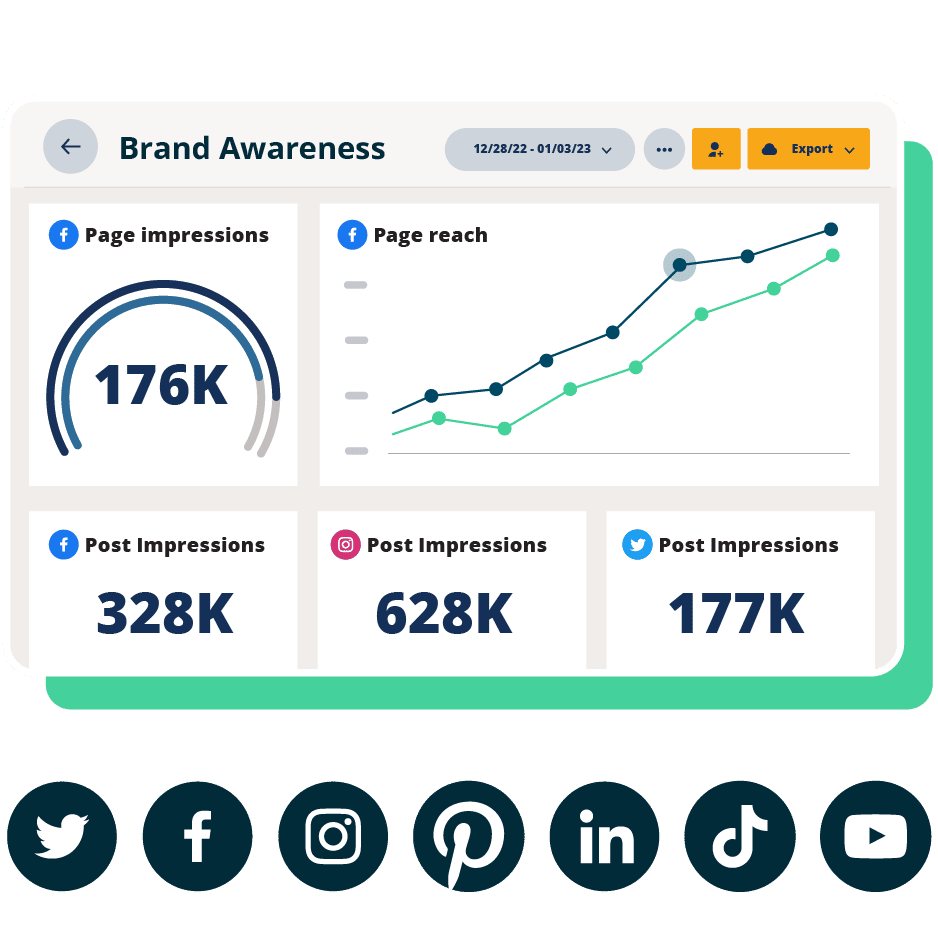
Effective social media ROI measurement relies on a robust tech stack. This typically involves a combination of native platform analytics, web analytics tools (such as Google Analytics or Adobe Analytics), CRM systems, and, crucially, a unified social media analytics platform. The primary challenge lies in integrating these disparate data sources to create a coherent, actionable view.
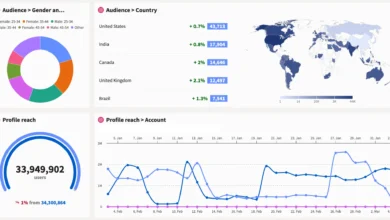
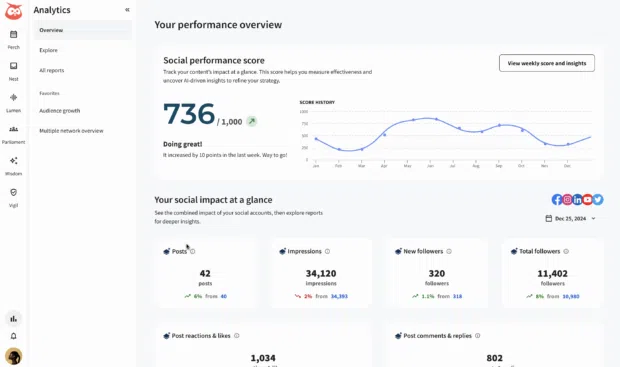
Unified platforms like Hootsuite Analytics play a pivotal role by consolidating data from all social channels into a single dashboard. This eliminates data silos, allowing marketers to connect social activity directly to business outcomes without the laborious manual compilation of reports. Hootsuite’s Advanced Analytics capabilities, for instance, enable users to track sales, sign-ups, and conversions from specific posts, offering granular insights into content performance across various platforms. Furthermore, integrations with web analytics platforms like Google Analytics ensure that social media’s contribution to broader website conversions and business goals is fully captured. Real-time analytics empower marketers to identify emerging trends and optimize campaigns dynamically, rather than waiting for end-of-month reports.

Reporting Social Media ROI to Executive Stakeholders
Effectively communicating social media ROI to executive stakeholders is as crucial as the measurement itself. Reports must be clear, concise, and directly relevant to the business’s overarching strategic objectives. Key best practices include:

- Focus on Business Outcomes: Translate social media metrics into their business impact – revenue generated, leads acquired, cost savings achieved, or improvements in customer satisfaction.
- Tailor the Message: Adapt the report’s detail and focus to the specific interests of the audience. Executives typically prioritize high-level strategic impact and financial returns.
- Use Visualizations: Employ charts, graphs, and infographics to present data clearly and compellingly.
- Highlight Trends Over Time: Demonstrate consistent progress and the long-term value of social media investments.
- Connect to Strategy: Show how social media efforts align with and contribute to broader company goals.
- Provide Actionable Insights: Don’t just present data; offer recommendations based on the findings for future strategy optimization.
As Kwok succinctly puts it, "You don’t know what your ROI is until you’ve laid out the goals you are tracking towards." This foundational principle underscores that without predefined objectives, measuring and reporting ROI becomes an arbitrary exercise.
Broader Implications and Future Outlook
The ability to accurately measure and report social media ROI is no longer a luxury but a strategic imperative. In an environment where digital marketing budgets are constantly under scrutiny, proving the tangible value of social media efforts is essential for securing future investment, scaling successful strategies, and maintaining a competitive edge. As social media platforms continue to evolve, integrating deeper commerce functionalities and advanced analytics, the methods for measuring ROI will also become more sophisticated. The continuous adaptation of measurement strategies, coupled with the strategic use of unified analytics platforms, will enable businesses to not only track but also proactively optimize their social media presence for sustained growth and profitability in the dynamic digital economy.
By Hannah Macready
Hannah Macready is a freelance writer with 12 years of experience in social media and digital marketing. Her work has appeared in publications such as Fast Company and The Globe & Mail, and has been used in global social media campaigns for brands like Grosvenor Americas and Intuit Mailchimp. In her spare time, Hannah likes exploring the outdoors with her two dogs, Soup and Salad.