Bridging the Divide: How Agentic Reasoning Transforms Traditional Machine Learning Systems

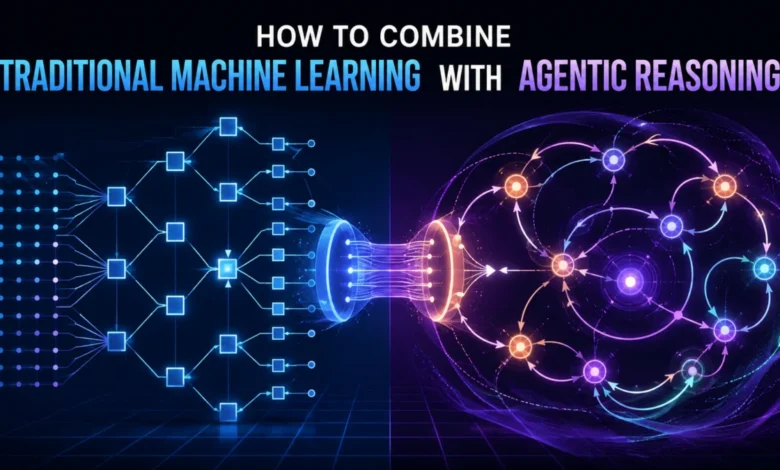
In the evolution of artificial intelligence, a fundamental shift is occurring as organizations transition from static predictive modeling to dynamic, agentic architectures. For over a decade, traditional machine learning (ML) has served as the bedrock of data-driven decision-making, excelling at high-speed pattern recognition. However, as business requirements move beyond simple classification and regression toward complex, multi-step problem solving, the industry is increasingly adopting agentic reasoning to bridge the gap between algorithmic output and real-world execution.
The Foundation of Traditional Machine Learning
The current standard for predictive AI relies on supervised learning, where models are trained on historical data to map specific inputs to defined outputs. According to industry benchmarks from research firms like Gartner and IDC, these models currently power the majority of enterprise AI deployments. Whether calculating the probability of a fraudulent credit card transaction or forecasting retail inventory requirements, these systems are prized for their speed, scalability, and interpretability.
From a technical perspective, traditional ML operates on a closed-loop principle. Once a model is deployed, its "worldview" is effectively frozen in the parameters determined during the training phase. It does not possess the capacity to query external databases, ask clarifying questions when input data is ambiguous, or adjust its logic based on evolving environmental variables. While this rigidity ensures consistent and auditable performance, it creates a "brittleness" that complicates the automation of end-to-end business workflows.
The Limits of Static Models
The limitations of static models become acute when businesses attempt to automate processes that involve ambiguity. Research into AI failure modes suggests that traditional models often struggle in three specific operational domains: multi-stage workflows, dynamic context environments, and action-oriented execution.
In a multi-step scenario, such as loan underwriting, a traditional model might provide a default probability score. However, it cannot independently verify income documents, reconcile discrepancies in a credit report, or draft a compliant rejection letter. These tasks, which require a sequence of dependent actions, have historically required human intervention.
Furthermore, traditional models assume all relevant context is captured at the moment of inference. In real-world security operations, for instance, an investigation might require a technician to look through several logs, pivot to a threat intelligence feed, and then check internal server configurations. A static model, limited to its initial input vector, lacks the agility to perform this investigative discovery. Finally, the "action gap"—where a model predicts a failure but cannot trigger a maintenance ticket—remains a major bottleneck in industrial IoT and logistics.
The Emergence of Agentic Reasoning
The rise of large language models (LLMs) has introduced a new paradigm: agentic reasoning. Unlike static models, an agentic system is designed as a persistent entity capable of perception, decision-making, and action. Industry analysts at Forrester note that the agentic market is expected to grow significantly as companies move from simple chatbots to autonomous "reasoning engines."
Agentic systems utilize LLMs as a central "brain" to orchestrate complex tasks. Instead of performing a single transformation, the agent follows a four-part cycle:
- Planning: The agent decomposes a high-level goal into actionable sub-tasks.
- Tool Use: The agent identifies and executes calls to external APIs, databases, or specialized ML models.
- Adaptation: The agent evaluates the output of its tools and pivots its strategy if the results are insufficient.
- Action: The agent executes final instructions within the business environment.
The Hybrid Architecture
The most sophisticated AI systems being developed today do not replace traditional machine learning; they wrap it in agentic logic. This hybrid architecture treats the traditional ML model as a highly efficient, specialized tool.
Consider the modern insurance claims industry. A 2024 analysis by insurance technology firms suggests that the integration of LLM-based agents with existing fraud-detection models has reduced claim processing times by approximately 40%. In this setup, the "agent" acts as the project manager, gathering policyholder records and incident photos. It then queries a traditional, highly-tuned ML model to assess the statistical likelihood of fraud. Based on the model’s score, the agent decides whether to approve the claim, request further documentation, or escalate to a human claims adjuster.
By separating the "orchestration" (reasoning) from the "calculation" (prediction), organizations gain the benefit of both: the mathematical precision of traditional ML and the adaptive flexibility of agentic AI.
Broader Economic and Operational Implications
The shift toward agentic AI has profound implications for enterprise operations. Historically, "AI-driven" meant the automation of a decision. Today, it means the automation of a process. This change impacts several key areas:
- Workforce Augmentation: By handling the "connective tissue" of business processes—such as data gathering, cross-referencing, and reporting—agents allow human professionals to focus on high-level judgment and strategic oversight rather than manual reconciliation.
- System Resiliency: Agentic systems are inherently more robust to data shifts. Because they can request more information or re-query sources, they are less likely to produce "hallucinated" or incorrect outputs compared to a static model faced with out-of-distribution data.
- Infrastructure Requirements: The adoption of agentic architectures requires a shift in engineering focus. Enterprises must now build robust API ecosystems that allow agents to safely interact with internal data and legacy systems, effectively treating their internal database as a "toolset" for the agent.
Looking Ahead
The chronology of this development suggests that we are currently in the "integration phase." Following the initial excitement surrounding generative AI in 2022 and 2023, 2025 and beyond are characterized by the pragmatic application of agents in production environments.
According to lead engineers in the sector, the focus has shifted from "model performance" (measured in accuracy percentages) to "system performance" (measured in task completion rates). This evolution acknowledges that a 99% accurate model is useless if it cannot be integrated into a functional, actionable workflow.
As organizations continue to refine these systems, the distinction between "software" and "AI" will likely blur further. Future enterprise applications will likely consist of a web of agentic nodes, each managing specific domains of a business, periodically consulting traditional ML models for high-stakes statistical validation. This transition represents the next frontier of digital transformation, where the primary value of AI is no longer just what it can know, but what it can actually accomplish on behalf of the organization.