Multilingual Text Classification with Scikit-LLM and Multilingual Embeddings: A Paradigm Shift for Global Data Operations

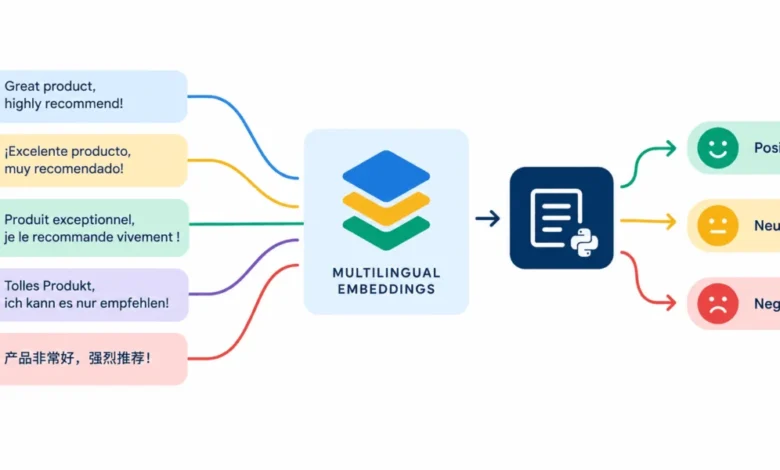
The challenge of deploying machine learning models for a global user base has historically been defined by a fundamental trade-off between architectural complexity and linguistic accuracy. Organizations attempting to perform sentiment analysis or intent classification across multiple languages have long been forced to maintain siloed model architectures, training and deploying separate pipelines for every target language. This approach, while effective, creates significant technical debt, increases maintenance costs, and complicates the scaling of AI-driven customer feedback systems. However, the emergence of multilingual large language model (LLM) embeddings—capable of mapping disparate linguistic inputs into a unified, language-agnostic vector space—has fundamentally transformed this landscape. By leveraging tools such as Scikit-LLM in conjunction with open-source frameworks like Scikit-learn, developers can now build a single, robust classification pipeline that operates seamlessly across over 100 languages.
The Evolution of Multilingual NLP
Historically, the evolution of natural language processing (NLP) for multilingual tasks has progressed through three distinct phases. In the early 2000s, practitioners relied heavily on rule-based systems and bilingual dictionaries, which struggled with the idiomatic nature of global dialects. By the 2010s, the field moved toward machine translation (MT) as a pre-processing step. Companies would translate all incoming data into a "pivot language"—usually English—before running it through a classifier. While this standardized the input, it introduced latency, increased costs, and frequently resulted in the loss of nuanced sentiment or cultural context during the translation process.
The current era, characterized by the rise of transformer-based architectures, utilizes high-dimensional embedding spaces. These models, such as BGE-M3, represent text as numerical vectors. When a model is trained on a massive, diverse corpus, it learns to place similar semantic concepts from different languages—such as the English phrase "The battery life is poor" and the Spanish equivalent "La duración de la batería es mala"—in the same geometric vicinity within the vector space. This effectively removes the language barrier at the input level, allowing a lightweight downstream classifier, such as a logistic regression model or a support vector machine, to interpret the semantic meaning without needing to recognize the specific language of origin.
Technical Implementation and Infrastructure
To implement this architecture in a cost-effective, local environment, the integration of the Ollama framework serves as a critical bridge. Ollama enables the local execution of state-of-the-art LLMs, circumventing the reliance on costly, rate-limited cloud APIs from vendors like OpenAI or Anthropic. By installing the BGE-M3 embedding model—a model designed specifically for multi-functionality, multi-granularity, and multi-lingual capabilities—developers can generate high-quality embeddings locally.
The technical workflow involves a sequence of modular steps. First, the infrastructure must be initialized to support the embedding model. Using Python’s subprocess capabilities, the Ollama server is launched as a background process. Once active, the bge-m3 model is pulled into the local environment. Configuration is then handled via the SKLLMConfig module, which redirects the Scikit-LLM internal client to the local localhost:11434/v1/ endpoint. This configuration allows the developer to utilize a dummy API key, as the local server handles the authentication logic internally.
Data Preparation and Model Training
The efficacy of a multilingual classifier depends heavily on the quality and diversity of the training dataset. The Amazon Multi-language Reviews dataset serves as an ideal benchmark for this task, offering millions of customer reviews labeled on a 5-star scale. For a practical implementation, researchers typically curate a balanced sample of 2,000 reviews—split equally between English and Spanish.
Crucially, the data must be shuffled before the training-test split to ensure that the classifier does not learn to associate specific language structures with specific labels, which could lead to overfitting. Once the data is prepared, the construction of the pipeline follows a standard Scikit-learn pattern:
- Vectorization Stage: The
GPTVectorizerfrom theskllmlibrary processes the raw text, converting it into high-dimensional vectors via the BGE-M3 model. - Classification Stage: A
LogisticRegressionclassifier, configured with a high iteration threshold to ensure convergence, is applied to these embeddings.
During the fit process, the pipeline performs a transformation where every input string is encoded into a vector. Because the BGE-M3 model has been trained on extensive multilingual corpora, the resulting vectors are essentially "language-agnostic." The logistic regression model subsequently learns the relationship between these semantic vectors and the 5-star labels.
Analysis of Model Performance
In practical tests using this architecture, the model demonstrates a distinct performance profile. Observations suggest that the pipeline achieves high precision in identifying extreme sentiments—1-star and 5-star reviews—where the language is typically more polarized and emotionally charged. However, the classification of intermediate ratings (2, 3, or 4 stars) presents more challenges.
There are two primary factors contributing to this performance gap:
- Semantic Overlap: Intermediate reviews often contain mixed sentiments—for example, a product might have a "great design" but a "faulty power cable." This ambiguity makes it difficult for a linear classifier to draw clean boundaries in the vector space compared to the clear-cut, emotionally consistent nature of extreme reviews.
- Sample Distribution: The inherent distribution of consumer sentiment often skews towards extremes, meaning the model receives fewer clear examples of "average" feedback, leading to higher classification error rates for those classes.
Despite these challenges, the macro-average performance indicates that the system is highly capable of identifying the intent of global users without the overhead of language-specific models. The accuracy of 0.57 in a five-class classification task with a limited sample size highlights the potential for this approach to scale significantly with larger, more diverse datasets.
Broader Implications and Industry Impact
The shift toward universal multilingual pipelines has profound implications for global business operations. For multinational corporations, the ability to deploy a single model that understands customer feedback from Japan, Brazil, Germany, and the United States simultaneously allows for real-time sentiment monitoring that was previously impossible. This reduces the need for large, localized data science teams and enables a more unified global product strategy.
Furthermore, this architecture supports the democratization of AI. By moving away from massive, proprietary, language-specific models toward smaller, open-source embeddings, smaller enterprises and startups can now compete with major tech firms in the international market. The ability to "plug and play" different embedding models as they become available—without needing to retrain the entire classifier—offers a level of agility that was unheard of just five years ago.
Future Directions
The current methodology using BGE-M3 and Scikit-learn is likely only the beginning. As research into "adapter-based" learning continues, it is expected that these pipelines will become even more efficient. Future iterations may involve "fine-tuning" the embedding space for specific industry domains, such as medical, legal, or financial terminology, where general-purpose models might occasionally misinterpret technical jargon.
Moreover, as compute efficiency increases, the latency associated with generating embeddings in real-time will decrease, enabling these pipelines to handle streaming data at scale. The integration of such tools into standard CI/CD pipelines will likely become the industry standard for any organization looking to maintain a competitive edge in a globalized, multilingual digital economy. The transition from language-specific model management to a unified, vector-based architecture represents not just a technical upgrade, but a fundamental change in how global enterprises communicate with and understand their customers.