AI Workflows vs Agents: A Practical Guide to Choosing the Right Architecture for Your Application

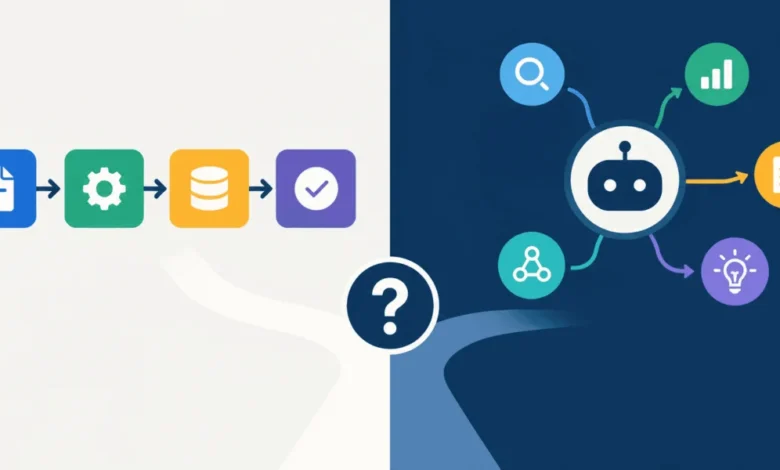
The current landscape of artificial intelligence development is characterized by a significant semantic crisis, particularly regarding the term "agent." As venture capital pours into the AI sector and enterprise adoption accelerates, technical definitions have become increasingly diluted. Developers, product managers, and CTOs are frequently tasked with choosing between two distinct architectural paradigms: AI workflows and AI agents. Understanding the fundamental mechanics of these systems is no longer a theoretical exercise but a critical engineering requirement that dictates the cost, reliability, and maintainability of modern software stacks.
The Evolution of AI Architecture
To understand the current confusion, one must examine the timeline of Large Language Model (LLM) integration. In 2022, following the release of ChatGPT, most organizations implemented basic prompt-response systems. By early 2023, the industry moved toward "chains"—the precursor to modern workflows—where multiple LLM calls were linked sequentially. The term "agent" gained mainstream prominence in late 2023 and 2024, characterized by systems that utilize ReAct (Reasoning and Acting) patterns.
Industry data suggests that the "agentic" buzz has led to a significant misallocation of resources. Recent benchmarks from internal engineering teams at major cloud providers indicate that over 60% of applications currently marketed as "autonomous agents" could be executed more effectively and at 40% lower cost using static, deterministic workflows. The failure to distinguish between these two often leads to "hallucination loops," where autonomous agents fail to reach a terminal state, ballooning token usage and eroding user trust.
Defining the Workflow Paradigm
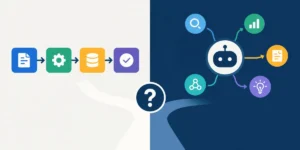
A workflow—frequently described as a pipeline or a directed graph—is an architecture where the control logic is defined at design time. In this model, the developer acts as the architect of the decision-making process. The system operates on a predetermined path: Step A triggers Step B, and conditional branching (if/else logic) dictates the traversal of the graph.
Even when these workflows incorporate LLMs, they remain deterministic regarding the structure of the task. For example, in a customer refund processing system, the LLM may be tasked with analyzing the sentiment of an email, but the path the application takes—validating the transaction ID, checking the policy database, and triggering the payment gateway—is hard-coded.
The primary advantage of the workflow is predictability. In enterprise environments, where auditability and compliance are paramount, workflows provide an immutable log of operations. If a system fails, engineers can trace the exact node in the graph where the logic diverged from expected parameters.
Defining the Agentic Paradigm
Conversely, an agentic system delegates control flow to the model at runtime. The developer provides the agent with a goal, a set of tools, and a defined environment, but the "reasoning engine" (the LLM) determines the sequence of actions. The agent observes the output of a tool, evaluates whether that output satisfies the current sub-goal, and iterates accordingly.
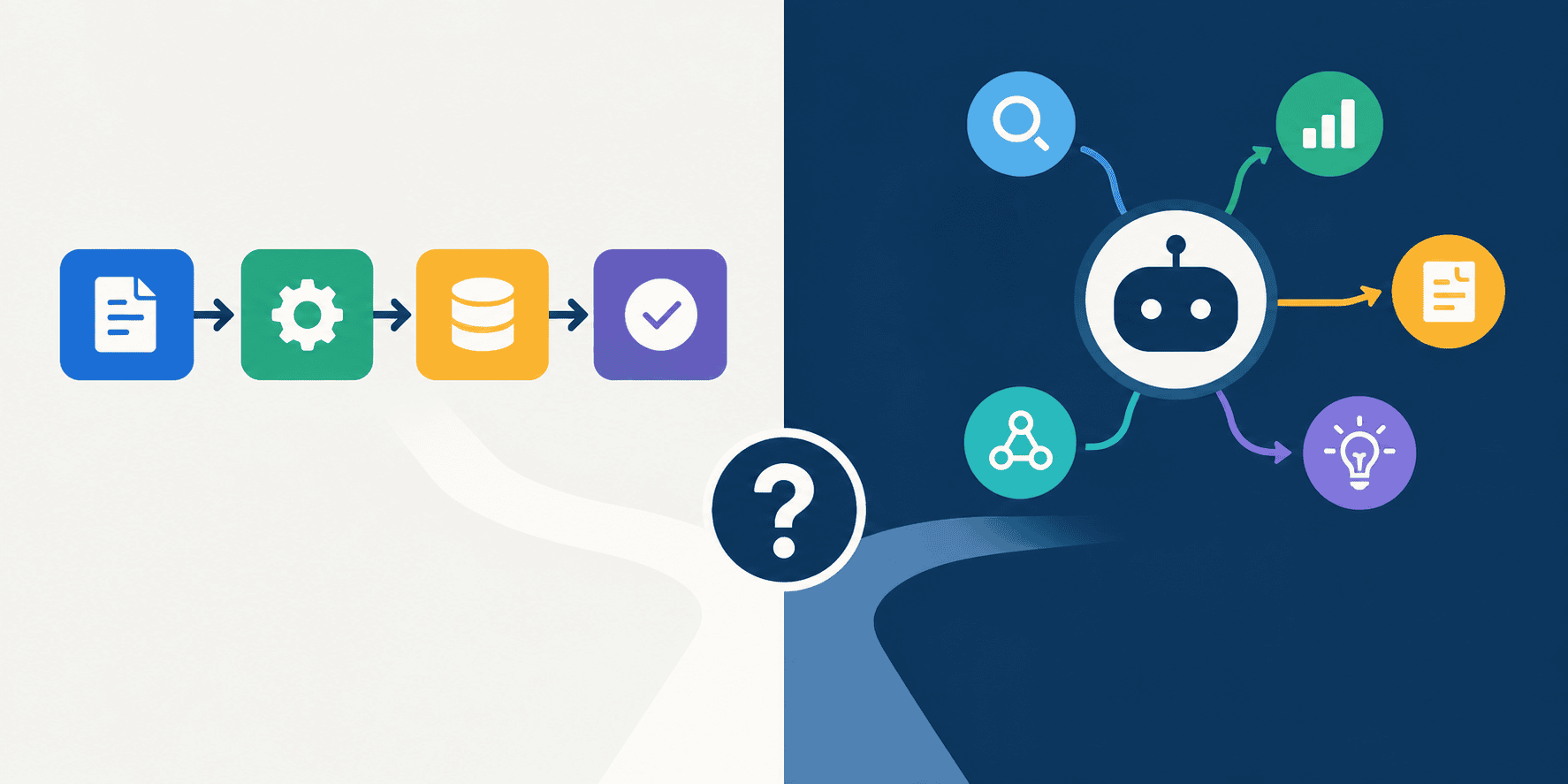
Consider a production outage response system. Unlike a workflow, which would follow a rigid script of "Check Log A, then Log B," an agentic system is designed to respond to the state of the environment. If the agent observes an anomaly in database latency, it may decide to query the infrastructure monitoring tool first. If that yields no results, it might pivot to checking recent CI/CD deployment logs. The sequence is emergent, not pre-scripted. This dynamic capability is the defining feature of agentic systems, enabling them to navigate complex, non-linear problems that defy simple flowcharts.
The Diagnostic Test for Engineering Teams
Before committing to an architecture, engineering leaders often employ a "Flowchart Constraint Test." The test is simple: If a subject matter expert or a senior developer can draw the entire lifecycle of a request on a whiteboard, from input to final output, the system is a workflow.
If the logic requires the system to "discover" the path through iteration and trial-and-error, it is a candidate for an agent. Attempting to force a workflow into an agentic framework often results in "prompt engineering bloat," where developers try to "hard-code" agent behavior through complex system instructions, which is inherently fragile. Conversely, trying to force an open-ended problem into a rigid workflow often leads to "exception hell," where the application crashes because it encounters a scenario the developer failed to map.
Comparative Analysis: Cost, Latency, and Reliability
The implications of choosing one over the other extend far beyond coding style.
- Cost and Resource Consumption: Agents are computationally expensive. Because they operate on a loop of "Think-Act-Observe," they consume significantly more tokens per request than workflows. A standard workflow might involve three LLM calls, whereas an agentic loop could involve dozens, depending on the complexity of the task.
- Latency: Workflows benefit from optimized, parallelized paths. Agents, which rely on the model’s reasoning time for every individual step, typically exhibit higher latency, making them less suitable for real-time, user-facing interfaces.
- Reliability: Deterministic workflows are easier to unit test. Developers can mock the LLM outputs and verify that the workflow handles edge cases correctly. Agents are non-deterministic by design, making them notoriously difficult to test using traditional QA methodologies.
Strategic Recommendations for Implementation
Industry analysts suggest a "Workflow-First" development lifecycle. By starting with a workflow, teams establish a baseline of reliability. If the workflow proves insufficient—for instance, if the classification logic needs to handle an exponentially growing list of categories—developers can then "agentify" specific nodes within that workflow. This hybrid approach, often called "Agentic Workflows," allows for modular autonomy.
For example, a company might use a rigid workflow to handle user authentication and data retrieval, but employ an agentic sub-routine to synthesize a complex, multi-source report. This limits the "blast radius" of potential agentic errors while retaining the flexibility needed for high-level reasoning tasks.
Future Implications and Conclusions
As the AI industry matures, the distinction between these two architectures will likely become the primary differentiator between hobbyist projects and enterprise-grade software. We are witnessing a transition from "toy" agents that perform simple tasks to "orchestrated" systems where workflows and agents coexist in a symbiotic relationship.
The ultimate takeaway for stakeholders is that sophistication is not measured by the autonomy of the system, but by the efficiency with which it solves the problem. A highly effective, deterministic workflow that resolves a customer inquiry in milliseconds is significantly more valuable than a fragile, autonomous agent that struggles to make a decision. By rigorously applying the flowchart test and focusing on the specific constraints of the use case—latency, cost, and auditability—organizations can build resilient AI applications that deliver genuine, measurable business value. The era of blindly labeling every LLM-powered feature as an "agent" is coming to a close, replaced by a more disciplined, engineering-first approach to AI system design.