Fine-Tuning vs. Frozen Embeddings: When to Adapt the LLM vs. the Sklearn Head

The rapid proliferation of Large Language Models (LLMs) has fundamentally altered the landscape of natural language processing (NLP). As businesses and developers look to deploy these models into domain-specific environments, they face a critical architectural decision: whether to undergo the resource-intensive process of fine-tuning the model’s weights or to utilize the model as a static feature extractor, feeding its outputs into a traditional machine learning classifier. This technical crossroads, often framed as the choice between "full-stack adaptation" and "modular integration," represents a significant paradigm shift in how organizations manage compute budgets, latency, and predictive accuracy.
Historically, the machine learning community prioritized fine-tuning, a process that involves updating the internal parameters of a neural network to align it with specific downstream tasks. This approach, while powerful, requires substantial computational overhead and specialized hardware. In contrast, the use of "frozen embeddings"—where the LLM remains static and acts merely as a vector generator for a secondary algorithm like a Scikit-learn Random Forest—offers a compelling, cost-effective alternative. As the demand for energy-efficient AI grows, understanding the trade-offs between these two methodologies has become a primary concern for data engineers and machine learning architects.
The Evolution of Model Adaptation
To understand the current state of model adaptation, one must look back at the development of transfer learning. In the early years of deep learning, researchers relied heavily on feature extraction. Models like BERT were used to generate fixed representations of text, which were then classified by simple linear models. The shift toward end-to-end fine-tuning, spurred by the success of GPT-style architectures, pushed the industry toward updating all model parameters to capture the nuances of a specific dataset.
However, the massive scale of modern LLMs, such as the 1.5 billion parameter Qwen or the 8 billion parameter Llama-3, makes full-weight updates prohibitively expensive for many organizations. This has led to the development of Parameter-Efficient Fine-Tuning (PEFT) techniques, most notably Low-Rank Adaptation (LoRA). LoRA introduces small, trainable adapter matrices into the frozen layers of the model, allowing for a "best of both worlds" scenario where only a tiny fraction of the model’s parameters are updated during training.
Comparative Analysis: The Frozen Embedding Strategy
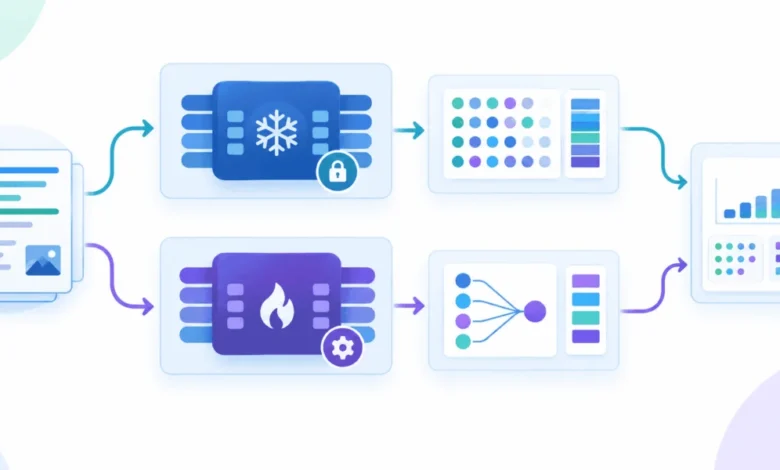
The strategy of using frozen embeddings functions by transforming raw, unstructured text into high-dimensional numerical vectors. By passing a document through a transformer model—without enabling gradient updates—the developer can extract the last hidden state of the model. This vector serves as a rich representation of the text’s semantic meaning.
When these vectors are fed into a Scikit-learn classifier, the training process is remarkably rapid. Because the "heavy lifting" of language understanding is performed by the LLM in a single inference pass, the auxiliary classifier requires only a fraction of the time and memory compared to a full training run. In tests involving the AG News dataset, which categorizes articles into four distinct topics, the frozen embedding method demonstrated an extraction time of approximately 96.5 seconds, with the actual training of a Random Forest classifier completing in less than three seconds. This efficiency makes it an ideal candidate for environments where rapid iteration and minimal GPU utilization are paramount.
The Performance Ceiling of Fine-Tuning
Conversely, LoRA-based fine-tuning involves active parameter optimization. By injecting adapter matrices, the model is physically modified to prioritize the features most relevant to the target domain. In the comparative study, while the frozen embedding approach yielded an 82% accuracy rate, the LoRA-fine-tuned model achieved an 87% accuracy rate.
This five-percentage-point gain represents a significant improvement in classification precision, though it comes at a cost. The fine-tuning process took 300 seconds—more than three times as long as the extraction-based approach. For larger datasets, this ratio could widen, potentially resulting in hours or days of extra compute time. The decision to use LoRA is therefore not merely a technical one but a fiscal one: is the 5% accuracy increase worth the threefold increase in computational expenditure?
Tactical Considerations for Deployment
The implications of this choice extend beyond raw performance metrics. Several factors dictate which path an organization should take:
- Latency Requirements: If the application requires real-time inference, the overhead of running a large LLM as a feature extractor might introduce unacceptable latency. In such cases, knowledge distillation or smaller, specialized models might be necessary, regardless of the adaptation strategy.
- Data Availability: Fine-tuning typically requires larger, high-quality labeled datasets to avoid overfitting. If the target domain is small or data-poor, a frozen embedding strategy is often more robust, as it relies on the model’s pre-existing, generalized knowledge rather than attempting to learn new patterns from a sparse dataset.
- Hardware Constraints: Organizations operating under tight compute budgets or utilizing older hardware will find the frozen embedding strategy significantly more forgiving. It allows the model to be kept in a static state, reducing the risk of memory fragmentation and "out-of-memory" errors that frequently plague fine-tuning runs.
- Task Specificity: For generative tasks, such as writing creative copy or generating code, frozen embeddings are largely insufficient. Fine-tuning is the standard for these applications because the goal is to alter the model’s output distribution, not just its classification boundaries.
Industry Perspectives and Future Trends
Leading researchers at institutions such as Hugging Face have noted that the "one-size-fits-all" approach to LLM adaptation is dying. Instead, the industry is moving toward a modular ecosystem. "The future is not just about choosing between fine-tuning or embeddings," notes one lead engineer in the field, "it is about chaining these methods to create pipelines that optimize for specific business KPIs."
The rise of "model-as-a-service" providers has also complicated this calculation. When an organization utilizes an API-based model, they may not have access to the hidden states required for embedding extraction, forcing them to rely on prompt engineering or, if provided, specific fine-tuning endpoints. This has created a divide between open-source enthusiasts, who favor the flexibility of local deployment, and enterprise users who prefer the convenience of managed APIs.
Broader Implications for AI Infrastructure
The shift toward efficient fine-tuning methods like QLoRA—which combines quantization (4-bit precision) with LoRA—is effectively democratizing AI development. By reducing the memory footprint of fine-tuning, developers can now achieve state-of-the-art results on consumer-grade hardware. This shift is expected to accelerate the development of specialized "small language models" (SLMs) that are hyper-optimized for specific verticals like legal, medical, or financial analysis.
Ultimately, the choice between frozen embeddings and LoRA fine-tuning represents the maturity of the AI sector. The initial "gold rush" phase, characterized by brute-forcing solutions with massive compute, is giving way to a more disciplined, engineering-focused approach. By carefully weighing the costs of computation against the marginal gains in accuracy, developers can build more resilient, scalable, and cost-effective AI systems. As the tooling for both methods continues to improve, the gap between the performance of these two strategies will likely narrow, placing even more importance on the specific business requirements of the application at hand. For now, the verdict remains clear: use frozen embeddings for rapid prototyping and compute-constrained environments, and reserve LoRA fine-tuning for high-stakes, performance-critical domains where every percentage point of accuracy translates into tangible business value.