Google Launches Playground: An Experimental Platform Enabling Users to Create and Play Custom Games Without Coding Experience

Video games have long stood as one of the most dynamic and immersive forms of human expression, combining narrative, visual art, music, and interactive mechanics. Yet, despite the massive growth of the global gaming community—which now encompasses billions of players across mobile, console, and personal computer platforms—the actual creation of digital games has remained largely restricted. Historically, developing even a simple playable concept required specialized technical expertise, a mastery of complex game engines like Unity or Unreal, and familiarity with programming languages such as C++ or C#. These barriers effectively sidelined millions of creative minds who possessed vivid ideas for interactive experiences but lacked the coding proficiency to build them.
Seeking to democratize game development and unlock new avenues for everyday creativity, Google has officially introduced Playground, an experimental gaming platform designed to let users create, play, and share custom video games simply by describing them. Developed by the company’s AI Innovation and Research division—with key contributions from software engineers like Maryam Karimzadehgan—Playground aims to lower the traditional barriers to entry in software development. By leveraging conversational artificial intelligence, the platform allows anyone with a web browser to turn conceptual prompts into fully functioning games in a matter of moments, fundamentally shifting the paradigm of who can become a game creator.
The Mechanics of Conversational Game Creation
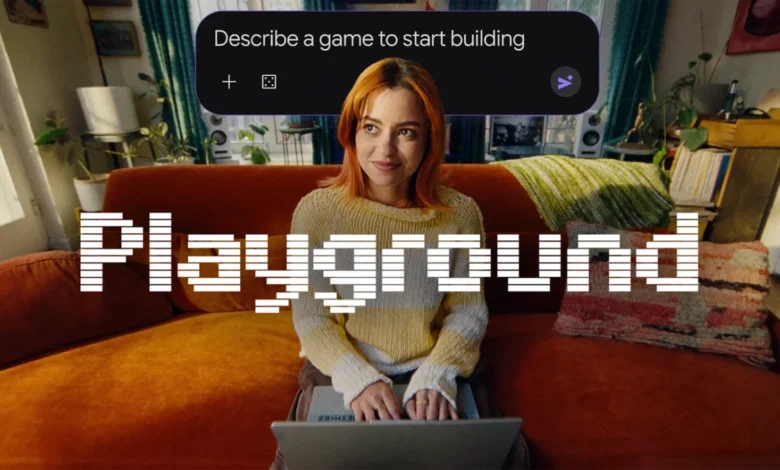
At the core of Playground is an intuitive, conversational interface that redefines the workflow of game design. Rather than manipulating complex scene graphs, writing scripts, or configuring physics assets manually, users can direct the game development process through natural language text prompts. A creator might begin with a blank canvas, selecting from a series of starter prompts to inspire their project, or utilize guided support tools to flesh out an abstract concept.
Once a foundational idea is established, the user can test the game immediately within the browser interface. If a character moves too fast, if the gravity feels unnatural, or if the visual environment needs a complete aesthetic overhaul, the creator does not need to dig through source code. Instead, they simply type a corrective instruction, such as adjusting the physics parameters, rewriting the core rules, or swapping out graphic themes. This conversational loop keeps the user in complete creative control throughout the entire lifecycle of the project, from a rough, unpolished sketch to a finished, shareable product.
As demonstrated in early platform previews, a user might enter a prompt describing a cozy, food-themed arcade experience—such as an "ube latte game"—and watch as the system generates a functional 2D platformer complete with custom sprites, distinct mechanics, and responsive controls. This streamlined approach bridges the gap between imagination and execution, enabling rapid prototyping that previously would have taken professional development teams days or weeks to accomplish.
Multiplayer Features, Cross-Device Accessibility, and the Community Gallery
Playground extends far beyond a solitary creation tool, functioning as a vibrant, browser-based ecosystem for discovering and sharing user-generated content. Because the platform operates entirely within standard web browsers, both creators and players can access the catalog seamlessly across a wide variety of devices, whether they are using a high-end desktop workstation or a mobile smartphone on the go.
Once a game is finalized, creators are given flexible deployment options. They can keep their projects private for personal enjoyment, generate a direct shareable link to challenge friends and family members, or publish their work publicly to the Playground Explore gallery. To foster community engagement, the platform supports in-game leaderboards and multiplayer functionality across select game genres. Users can link a Play Games profile to establish a custom handle, favorite specific titles, compete for top positions on global scoreboards, and follow their favorite creators to receive notifications about new releases.
To maintain a high standard of quality and ensure a secure environment for all users, the platform incorporates a multifaceted curation and moderation system. The Explore gallery prominently features fresh, creative, and engaging titles by analyzing player ratings and active engagement metrics. Simultaneously, every published game must undergo automated and manual safety screenings that align strictly with Google’s published Community Guidelines, bolstered by user-reporting mechanisms to quickly flag and remove inappropriate content.
Strategic Integration with Unity Spark for Advanced Creators
While Playground is intentionally designed to be accessible to absolute beginners, Google has also laid the groundwork for creators who wish to scale their ambitions beyond simple text-prompt mechanics. To achieve this, the company has announced a forthcoming integration with Unity Spark, a specialized suite of tools from the industry-standard game engine developer Unity.
Unity Spark is engineered to unlock robust, professional-level gameplay mechanics, high-fidelity three-dimensional rendering capabilities, and the deep flexibility inherent in the Unity runtime environment. By combining the conversational accessibility of Playground with the technical depth and world-class engine architecture of Unity, Google is establishing a developmental pipeline. In this ecosystem, a creator can conceive their very first project using a basic text prompt and gradually transition into building deeply immersive, complex 3D experiences as their skills and ambitions grow. Furthermore, these advanced titles will remain fully accessible to the broader Playground community to play and enjoy.
Unity Spark is currently undergoing rigorous internal testing, with a closed beta rollout scheduled for the near future. In the interim, enthusiasts can explore early proof-of-concept demo games directly on the official Playground web portal.
Rollout Strategy, Availability, and Industry Implications
Playground officially launches today as an early-stage technological experiment aimed at redefining digital interaction and expanding the boundaries of casual entertainment. Initially, access to the platform is rolling out to users aged 18 and older residing in the United States. To manage computational resources and server loads associated with generative artificial intelligence, creation access is tiered based on the user’s Google AI subscription status.
The release of Playground arrives at a pivotal juncture in the technology and entertainment sectors. For decades, the software industry has sought to lower the friction of creation, moving from assembly language to high-level programming, and subsequently from manual code-writing to low-code and no-code development environments. Generative AI represents the next logical leap in this evolution, replacing syntax with semantic intent.
By enabling non-technical users to build interactive media, platforms like Playground could dramatically expand the cultural footprint of video games. Just as the democratization of desktop publishing transformed millions of readers into writers, and smartphone cameras turned everyday consumers into videographers, conversational game engines threaten to unlock a massive wave of grassroots digital authorship. Creators, educators, and hobbyists alike will now have the power to turn lesson plans, personal narratives, and spontaneous jokes into playable digital realities.
As Google continues to gather user feedback and refine the platform’s underlying models, Playground is expected to evolve rapidly alongside its community. The success of this experiment will likely serve as a bellwether for how generative AI can be responsibly integrated into creative software suites, balancing infinite creative freedom with robust safety moderation and seamless cross-platform performance. Users interested in experiencing the platform firsthand or reviewing the foundational community guidelines can visit the official portal to begin exploring the next generation of interactive storytelling.
Related posts: