Sandboxing AI Agent Code Execution in Python: Containers, MicroVMs and Beyond

In the rapidly evolving landscape of artificial intelligence, the rise of autonomous agents capable of generating and executing arbitrary code has necessitated a fundamental shift in cybersecurity infrastructure. As developers integrate these agents into production environments, the challenge of isolating potentially malicious or error-prone code has become a top-tier security priority. This guide examines the tiered approach to securing AI agent code execution, exploring the technical implementation of limited subprocesses, hardened Docker containers, and Firecracker microVMs, while evaluating the trade-offs between security depth and operational latency.
The Security Challenge of Autonomous Agents
AI agents function by interpreting natural language instructions and converting them into executable Python scripts to solve complex data analysis or automation tasks. However, an agent is only as secure as its execution environment. Without proper boundaries, a model hallucinating a harmful command—or being prompted by an adversarial user—could theoretically access sensitive environment variables, manipulate the host file system, or initiate unauthorized network requests.
The industry standard for mitigating these risks is sandboxing. By establishing a "chroot-like" environment or a hardware-level partition, developers can constrain the reach of an untrusted process. The security boundary chosen determines what a malicious program can access; the goal is to implement the "principle of least privilege," ensuring the agent has only the resources required to complete its assigned task.
Tiered Isolation: From Subprocesses to MicroVMs
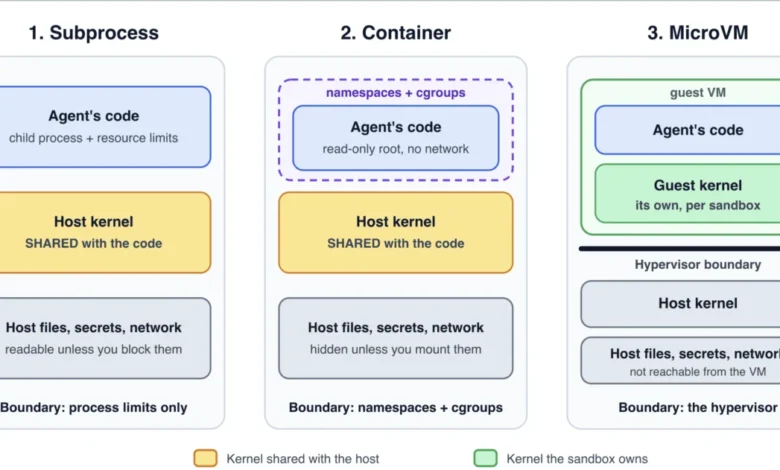
The architecture of code execution can be categorized into three distinct tiers, each offering varying levels of isolation and resource overhead.
1. The Subprocess Tier: Lightweight and Shared
The subprocess approach is the most efficient in terms of latency, as it essentially spawns a child process on the host system. By utilizing Linux-native features like resource limits and unshare, developers can restrict CPU time, memory, and file access. However, this tier remains fundamentally limited because it shares the host’s kernel and file system. While effective for simple, non-sensitive tasks, it is susceptible to "breakout" scenarios if the kernel itself has vulnerabilities. It is generally recommended only for internal, trusted scripts.
2. The Container Tier: Namespace and Cgroup Isolation
Docker containers offer a more robust solution by utilizing Linux namespaces and control groups (cgroups) to partition the operating system. By applying flags such as --network none and --read-only, developers can significantly harden the environment. Despite this, the shared kernel remains a point of concern. Technical post-mortems from recent years—such as the November 2025 runc vulnerabilities—highlight that container escapes remain a viable threat vector. Security teams must ensure that infrastructure policies, rather than the agent itself, dictate file access and network connectivity.
3. The MicroVM Tier: Hardware-Level Separation
The current gold standard for high-stakes AI execution is the Firecracker microVM. Unlike traditional containers, a microVM provides each sandbox with its own kernel, effectively creating a hardware-level boundary. Systems like AWS Lambda and specialized services like E2B leverage this technology to ensure that no kernel state is shared between execution sessions. This provides near-perfect isolation, as an attack targeting the guest kernel cannot impact the host machine.
Comparative Latency and Performance Metrics
Security often introduces latency. In performance benchmarking, the subprocess model remains the fastest, typically executing in the low-millisecond range. Containers add a marginal overhead due to image loading and environment orchestration. MicroVMs, while historically slower, have seen significant optimization. Recent benchmarks suggest that modern microVMs can boot in approximately 150 milliseconds, a negligible latency for most asynchronous agentic workflows.
The following table summarizes the trade-offs:
| Isolation Level | Security Strength | Latency | Kernel Sharing |
|---|---|---|---|
| Subprocess | Low | Ultra-Low | Yes (Host) |
| Container | Medium | Low | Yes (Host) |
| MicroVM | High | Medium | No (Isolated) |
Implementation and Defensive Coding
To implement these layers, developers should use a modular interface where the agent’s logic is decoupled from the execution backend. The agent should be provided with a standard run_python tool. By implementing an abstraction layer—such as a get_backend() function—developers can swap between SubprocessSandbox, DockerSandbox, and E2BSandbox without altering the core agentic code.
A critical defensive strategy is to ensure that the environment is "fail-closed." For instance, if a network-restricted sandbox cannot be successfully initialized, the system must raise a runtime error rather than defaulting to an open network connection. Similarly, API keys and sensitive environment variables must be stripped from the execution context, ensuring that even if the code is fully compromised, there are no credentials to exfiltrate.
Industry Trends and Future Outlook
The industry is clearly trending toward hardware-level isolation. In April 2026, Docker announced the integration of microVMs into their sandbox ecosystem, acknowledging that the shared-kernel model is insufficient for the demands of modern AI agents. Furthermore, cloud providers are increasingly offering serverless environments that persist state for up to eight hours while remaining in a suspended state when idle, effectively solving the "startup latency" problem that once plagued VM-based execution.
The broader implication is that infrastructure-as-code (IaC) will become the primary mechanism for agent security. Rather than relying on the model to "behave," developers will define the sandbox policy at the infrastructure level. This transition ensures that even if a model is compromised by an injection attack, the underlying execution environment remains a fortified vault.
Conclusion
For organizations deploying AI agents, the choice of sandbox is not merely a technical decision but a risk management strategy. For development environments and low-stakes tasks, a hardened container is often sufficient. However, for agents processing proprietary data, handling financial transactions, or interacting with external APIs, the microVM approach is becoming the mandatory baseline. By adopting a tiered security architecture and continuously testing against known adversarial patterns—such as fork bombs, memory exhaustion, and unauthorized file access—developers can harness the full potential of AI agents without compromising the integrity of their production systems.