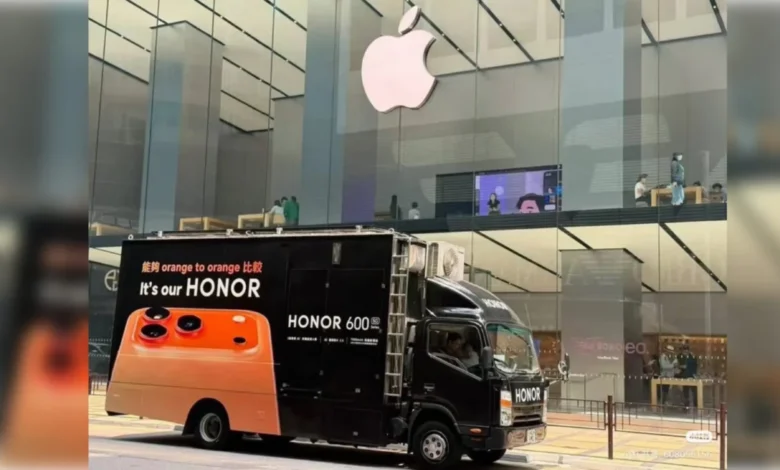
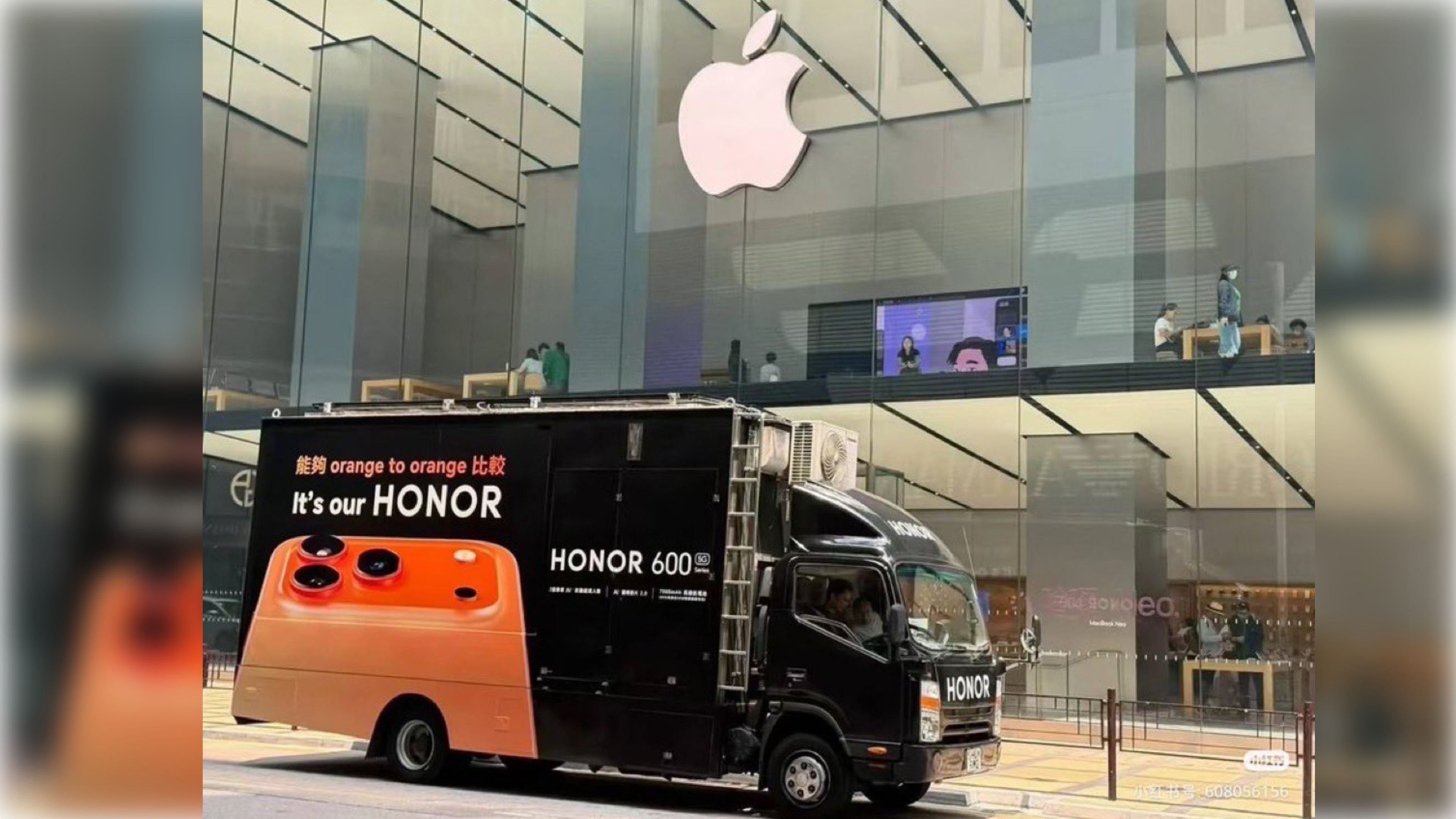
On Friday, April 17, 2026, the bustling commercial district surrounding Apple’s flagship Canton Road store in Hong Kong became the unlikely backdrop for a provocative marketing display orchestrated by Chinese smartphone manufacturer Honor. Photos widely circulated across Chinese social media platforms captured an Honor-branded advertising truck strategically parked directly in front of the iconic Apple retail outlet, prominently promoting the company’s new Honor 600 series smartphone. The audacious move immediately ignited discussions among tech enthusiasts and industry observers, highlighting the intensifying competitive dynamics within the global smartphone market, particularly in the premium segment.
The mobile advertisement featured the slogan "It’s our HONOR," a clear double entendre leveraging the brand’s name while simultaneously asserting a claim of superiority or achievement. Below this, the phrase "orange to orange" appeared, a clever linguistic play on the well-known English idiom "apples to apples," which refers to a comparison between two like entities. This verbal juxtaposition was paired with a striking visual: an image of the Honor 600 series phone, presented in a finish that bore an unmistakable resemblance to the rumored "Cosmic Orange" colorway of Apple’s latest premium device, the iPhone 17 Pro. The directness of the comparison, both linguistic and visual, left little doubt about Honor’s intent to position its new offering as a direct competitor to Apple’s top-tier smartphone.
The Unveiling of a Bold Marketing Gambit
The choice of location for this marketing stunt was anything but coincidental. Apple’s Canton Road store is not merely a retail space; it is a landmark, situated in one of Hong Kong’s most prestigious shopping districts, frequented by both affluent locals and international tourists. The store’s prominent glass facade and high foot traffic provide unparalleled visibility, making it a prime target for a high-impact, if unconventional, advertising campaign. By placing its mobile billboard directly in Apple’s line of sight, Honor ensured maximum exposure to a demographic already predisposed to high-end electronics and, crucially, to potential Apple customers.
The imagery on the truck was meticulously designed to draw comparisons. The "orange to orange" slogan, rather than merely suggesting a comparison, actively invited it, framing the Honor 600 Pro as a legitimate alternative in the premium smartphone category. The specific shade of orange on the Honor device, mirroring what is believed to be a signature color for the iPhone 17 Pro, escalated the direct challenge. This visual mimicry, combined with the wordplay, crafted a narrative of direct competition, forcing consumers to consider Honor’s offering in the same breath as Apple’s. Such a tactic, often termed "guerrilla marketing," aims to generate significant buzz and media attention with a relatively low investment, relying on shock value and direct confrontation to cut through the advertising noise.
Honor’s Strategic Evolution and Market Position
To fully appreciate the significance of Honor’s audacious stunt, it is crucial to understand the company’s unique trajectory. Honor was originally established in 2013 as a sub-brand of Huawei, conceived to target a younger, more budget-conscious demographic with aggressively priced, feature-rich smartphones. For years, it operated successfully under Huawei’s umbrella, leveraging its parent company’s robust R&D, supply chain, and marketing prowess to carve out a significant share of the mid-range smartphone market, particularly in China.
However, Honor’s fate took a dramatic turn in 2020. Facing crippling U.S. sanctions that severely restricted Huawei’s access to critical American technology, including essential semiconductors and Google’s Android services, Huawei made the strategic decision to divest Honor. In November 2020, a consortium of over 30 agents and dealers, along with the Shenzhen Smart City Development Group, acquired Honor. This spin-off was a calculated move designed to allow Honor to bypass the U.S. restrictions that continued to plague Huawei. Freed from the direct association with its sanctioned former parent, Honor regained the ability to procure components from suppliers like Qualcomm and access Google Mobile Services (GMS), which are vital for international market competitiveness.
Since its independence, Honor has been on a determined path to rebuild its brand and reclaim lost market share. Initially, the separation led to a dip in sales as the brand navigated its new autonomy and re-established supply chains. However, with renewed access to critical technologies, Honor has aggressively pursued a strategy of innovation and market expansion, increasingly moving into the premium segment where it directly competes with established giants like Apple and Samsung. In its home market of China, Honor has demonstrated remarkable resilience, often fluctuating in the top three or four smartphone vendors, frequently surpassing its former parent company, Huawei, in shipments. This growth is a testament to its successful pivot and its ambition to challenge the status quo, making the Canton Road stunt a logical, albeit aggressive, extension of its broader competitive strategy.
The Art of "Guerrilla Marketing" in Tech
Guerrilla marketing, characterized by its unconventional, often low-cost, and high-impact tactics, has a long history in competitive industries. In the technology sector, where product cycles are rapid and consumer attention is fleeting, such strategies are employed to generate immediate buzz and differentiate brands in a crowded marketplace. Historically, brands like Samsung have famously engaged in advertising campaigns that directly, and often humorously, lampooned Apple’s products or loyal user base, effectively positioning themselves as the rebellious challenger.
Honor’s Canton Road stunt fits squarely within this tradition. It is not about a massive ad spend but about strategic placement and provocative messaging. By parking its truck at the doorstep of a competitor, Honor directly targeted Apple’s customer base, inviting them to consider an alternative right at the point of purchase. This method aims to leverage the competitor’s established brand equity and prime retail location to elevate its own visibility. The goal is to create a viral moment, generate social media chatter, and earn free media coverage, all of which contribute to brand awareness and perception. The "shameless copy" accusation, while potentially negative, also serves to place Honor’s product in the same conversation as Apple’s, suggesting a comparable level of design and aspiration. For a brand still cementing its independent identity in the premium space, being mentioned in the same breath as Apple, even controversially, can be seen as a victory.
Design Homage or Direct Imitation?
The visual resemblance between the Honor 600 series phone and the iPhone 17 Pro’s "Cosmic Orange" finish is a central element of the controversy. In the highly competitive smartphone industry, design trends often converge, and it is common for manufacturers to draw inspiration from successful aesthetic choices. However, there is a fine line between inspiration and direct imitation, and Honor’s stunt arguably treads very close to the latter.
Apple, known for its meticulous design language and proprietary aesthetic, has historically faced numerous instances of other companies adopting similar design cues. While patents protect specific design elements, general color schemes or overall form factors can be difficult to litigate. The term "Cosmic Orange" itself, while an industry rumor for the iPhone 17 Pro, indicates Apple’s continued exploration of distinctive colorways to differentiate its premium offerings. For Honor to launch a device in a remarkably similar shade, especially when accompanied by a slogan explicitly inviting comparison to "apples," raises questions about originality and brand identity.
Industry analysts suggest that such a move by Honor is a calculated risk. On one hand, it allows Honor to associate its brand with the perceived premium quality and desirability of Apple’s design, potentially attracting consumers who are drawn to that aesthetic but might be open to a more competitively priced alternative. On the other hand, it risks branding Honor as unoriginal or a mere imitator, potentially eroding its own distinct brand narrative. For a company striving to establish its independent identity post-Huawei, striking this balance between leveraging market trends and forging its own path is critical. The "orange to orange" slogan cleverly acknowledges the perceived similarity while attempting to turn it into a point of pride, suggesting Honor can offer an equally compelling product.
Apple’s Likely Response and Industry Dynamics
Given the nature of such guerrilla marketing tactics, Apple is highly unlikely to issue an official statement or engage publicly with Honor’s stunt. As the original article astutely notes, any public reaction from Apple would inadvertently amplify Honor’s message, granting it further legitimacy and media mileage. Apple’s strategy in such situations typically involves maintaining a dignified silence, relying on its strong brand loyalty, established ecosystem, and perceived innovation leadership to speak for itself. For Apple, engaging in a tit-for-tat marketing battle with a challenger brand would be seen as beneath its stature and counterproductive to its premium image.
From a legal perspective, while the stunt is provocative, direct legal action by Apple would be challenging. The use of an advertising truck and a clever slogan, even one directly referencing Apple’s products, typically falls within the bounds of comparative advertising and free speech, rather than trademark infringement or unfair competition, unless there is clear deception or misuse of protected intellectual property. The design similarities, while evident, would also require a strong case of patent or design infringement, which is often difficult to prove in the rapidly evolving tech product landscape. Therefore, Apple’s response is expected to be an internal acknowledgment of the competitive landscape, perhaps prompting a review of its own marketing strategies, but not a public confrontation. The old adage, "imitation is the sincerest form of flattery," often resonates in these situations, implicitly acknowledging the influence and market leadership of the imitated brand.
Broader Implications for the Smartphone Market
Honor’s brazen marketing stunt in Hong Kong is indicative of several broader trends shaping the global smartphone market. Firstly, it underscores the intensifying competition, particularly in the premium segment and in key Asian markets like Hong Kong and mainland China. These markets are critical battlegrounds where brand perception, design aesthetics, and perceived value play a significant role in consumer purchasing decisions. Chinese brands, including Honor, Xiaomi, and Vivo, are increasingly challenging the dominance of Apple and Samsung by offering sophisticated devices with competitive features and aggressive pricing.
Secondly, the event highlights the evolving nature of marketing in the digital age. With consumers inundated with traditional advertising, companies are constantly seeking novel and memorable ways to capture attention. Guerrilla marketing, social media virality, and direct, confrontational campaigns are becoming more prevalent as brands fight for mindshare. This trend is likely to continue, pushing the boundaries of what is considered acceptable in competitive advertising.
Finally, the incident reflects the ongoing narrative of innovation versus imitation. While Apple has long been seen as a design and innovation leader, the rapid advancement of Chinese manufacturers means that features, designs, and even specific colorways can be replicated or closely paralleled in increasingly shorter timeframes. This puts pressure on all brands to continually innovate and differentiate, not just in terms of hardware and software, but also in terms of brand experience and customer loyalty. The Honor 600 series stunt serves as a stark reminder that the battle for smartphone supremacy is far from over, and challenger brands are prepared to go to extraordinary lengths to stake their claim.
In conclusion, Honor’s advertising truck outside Apple’s Canton Road store was more than just a promotional activity; it was a deliberate statement of intent. It showcased Honor’s post-divestment ambition, its willingness to engage in aggressive marketing tactics, and its direct challenge to Apple’s premium market dominance. While Apple is expected to remain silent, the incident has undoubtedly generated considerable discussion, affirming the fierce competition that defines the contemporary smartphone industry and hinting at an exciting, and perhaps even more confrontational, future for tech marketing.