OWC Upgrades Flagship ThunderBay 4 RAID Enclosure with Thunderbolt 5 Technology and Massive 128 TB Capacity

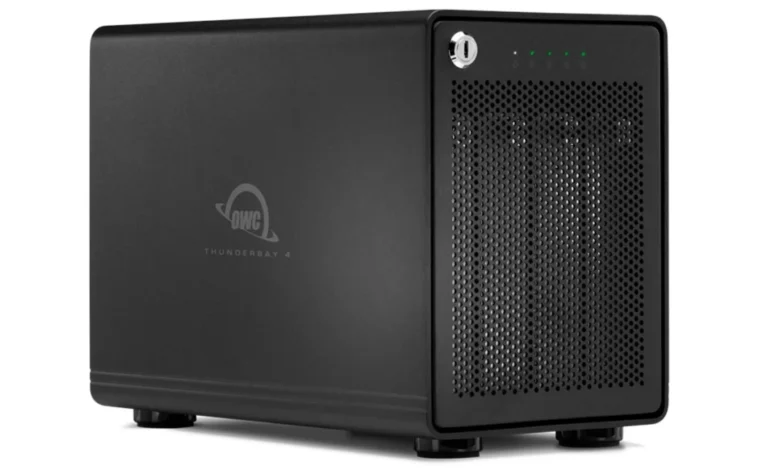
The storage landscape for high-end digital cinematography and post-production workflows has officially shifted as OWC announces the latest iteration of its flagship ThunderBay 4 RAID enclosure. By integrating the groundbreaking Thunderbolt 5 standard, this storage solution represents a generational leap in bandwidth, addressing the bottleneck issues often faced by professional editors working with 6K, 8K, and high-bitrate RAW video files. This update marks a significant milestone in the evolution of direct-attached storage (DAS), transitioning from the long-standing 40 Gb/s limitations of Thunderbolt 3 and 4 to the massive 80 Gb/s bi-directional throughput offered by the latest Intel-backed standard.
The Evolution of Thunderbolt: A Historical Context
To understand the magnitude of this upgrade, one must consider the historical trajectory of the Thunderbolt interface. Introduced in 2011 as a joint venture between Intel and Apple, Thunderbolt was designed to replace a fragmented ecosystem of ports with a single, high-speed conduit. Thunderbolt 2 doubled the original 10 Gb/s speed to 20 Gb/s in 2013, followed by the ubiquitous Thunderbolt 3 in 2015, which unified the connector to the USB-C form factor and stabilized the industry at 40 Gb/s.
For nearly a decade, 40 Gb/s remained the ceiling for professional creative workflows. While sufficient for many, the rise of 8K resolution, high-frame-rate HDR content, and complex multi-stream multicam editing has pushed these limits to their breaking point. Thunderbolt 5, announced by Intel in late 2023 and now finding its way into premium hardware like the new ThunderBay 4, effectively doubles the primary data bandwidth to 80 Gb/s. Furthermore, the protocol introduces "Bandwidth Boost," a feature that allows the connection to dynamically reallocate throughput to up to 120 Gb/s for display-intensive applications, providing a significant safety margin for workstations tethered to multiple high-resolution reference monitors.
Engineering for Performance and Reliability
Beyond the raw throughput, the physical construction of the ThunderBay 4 remains anchored in OWC’s commitment to thermal management and structural integrity. The enclosure utilizes a rugged, all-aluminum chassis that serves as a passive heatsink, dissipating the significant thermal energy generated by high-performance drives during intensive data-scrubbing sessions.
The enclosure is cooled by a sophisticated 92 mm fan assembly designed specifically to prioritize low-decibel operation. In a quiet studio environment, the acoustics of storage equipment are paramount; the unit’s vibration-absorbing feet ensure that high-RPM mechanical drives do not induce harmonic resonance on desk surfaces, which could otherwise lead to performance degradation or premature drive failure.
Throughput Metrics and Workflow Realities
The transition to Thunderbolt 5 is not merely a theoretical gain in speed; it manifests in tangible improvements to the editing pipeline. OWC reports real-world transfer speeds reaching 1,268 MB/s with traditional high-capacity hard drives and up to 1,703 MB/s when populated with enterprise-grade SSDs, both measured in a RAID 0 configuration.
For the modern editor, these metrics are transformative. Previously, the need to transfer high-resolution footage from an external array to an internal NVMe drive before commencing the edit was a mandatory time-sink. With the sustained throughput offered by the Thunderbolt 5-equipped ThunderBay 4, professionals can now edit multi-stream 4K ProRes 422 HQ footage directly from the enclosure. This eliminates the "copy-and-wait" cycle, significantly reducing turnaround times on large-scale projects.
Scaling Storage: The Move to 128 TB
The capacity ceiling of the ThunderBay 4 has been lifted in tandem with its speed. By supporting the latest generation of 32 TB high-density hard drives, the enclosure now reaches a total raw capacity of 128 TB. This capacity is critical as digital formats continue to evolve; a single hour of 8K RAW footage can easily consume hundreds of gigabytes, and modern feature-length productions—or even high-end commercial spots—can quickly overwhelm smaller storage volumes.
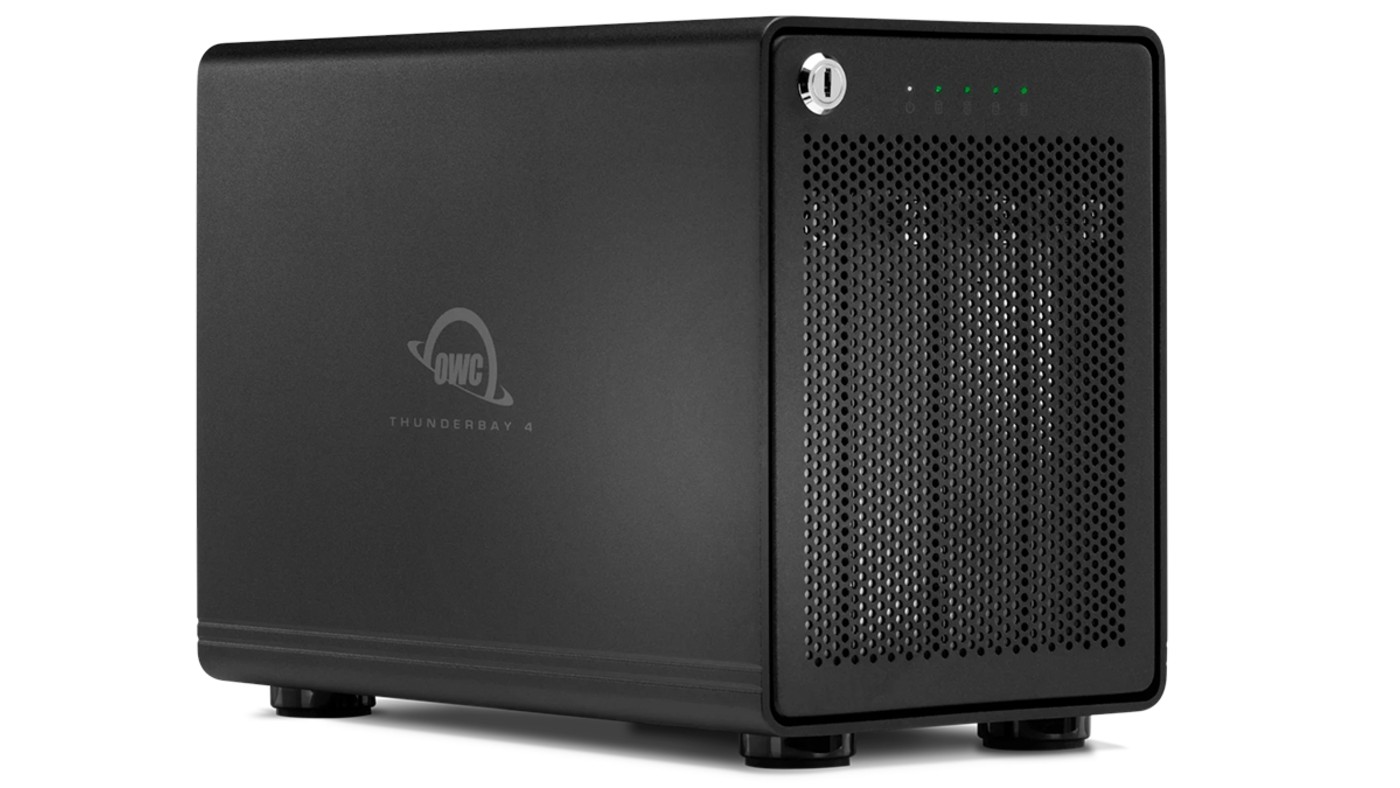
This 128 TB threshold allows creative firms to keep active projects, proxies, and render caches centralized in one location. For those who require redundancy, the RAID 5 configuration provides an optimal balance, yielding 96 TB of usable, fault-tolerant space. In the event of a single drive failure, the RAID 5 parity allows the array to remain operational while the technician replaces the failed unit, ensuring zero downtime during critical project delivery windows.
Software Integration and Data Protection
The intelligence of the ThunderBay 4 is managed by OWC’s SoftRAID software, an enterprise-class RAID management platform. SoftRAID provides the user with granular control over the array’s logic, supporting a diverse range of configurations including RAID 0, 1, 4, 5, 6, 6+, 10, and JBOD.
Perhaps more importantly, SoftRAID performs continuous, background health monitoring of every drive in the enclosure. By analyzing S.M.A.R.T. data and tracking potential failure indicators, the software provides early warnings, allowing editors to replace degrading drives before catastrophic data loss occurs. The inclusion of optional Strada software further extends these capabilities, enabling remote access to the array, which is an increasingly vital feature for distributed production teams working in remote or hybrid environments.
The Economic Implications of High-Performance Storage
While the performance gains are undeniable, the cost of entry for Thunderbolt 5 hardware remains a consideration for independent creators. The base enclosure, retailing for $550, represents a professional-grade investment. When scaled to the 128 TB configuration, the price tag rises to $1,500, a reflection of the current market volatility and high manufacturing costs for high-density magnetic storage.
Industry analysts suggest that while these costs are significant, they must be viewed through the lens of risk management. The cost of data recovery or the loss of a client’s master assets far outweighs the capital expenditure of a robust, RAID-protected storage array. For a professional editor, the enclosure serves as an insurance policy. By providing a stable, high-bandwidth environment that protects against drive failure, the ThunderBay 4 safeguards the most valuable asset in the production chain: the footage itself.
Broader Impact on the Post-Production Ecosystem
The release of this enclosure signals a broader trend in the industry: the commoditization of extreme bandwidth. As Thunderbolt 5 becomes the new standard for high-end workstations and creative peripherals, the infrastructure of the edit suite is finally catching up to the resolution demands of modern cameras.
We are seeing a convergence where the limitations of the "storage pipe" are no longer the primary hurdle in creative workflows. Instead, the focus is shifting toward data management, archival strategies, and cloud-hybrid synchronization. OWC’s move to update the ThunderBay 4 reflects an awareness that professional users are no longer satisfied with incremental performance gains; they require future-proof solutions that can accommodate the next three to five years of technological advancement in sensor resolution and codec complexity.
Conclusion and Availability
The OWC ThunderBay 4 with Thunderbolt 5 is currently available for purchase, targeting a professional demographic that requires reliable, high-speed, and large-capacity storage. With its combination of an aluminum thermal-management design, the massive throughput of Thunderbolt 5, and the robust data protection of SoftRAID, it stands as a significant upgrade for any studio or independent professional.
As production workflows continue to demand faster access to larger datasets, the importance of reliable, high-speed storage cannot be overstated. By successfully bridging the gap between legacy connectivity and next-generation speed, OWC has ensured that the ThunderBay 4 remains a fixture in the post-production industry, providing the necessary foundation for the next generation of visual storytelling. Whether for a small creative agency or a large-scale editorial facility, the transition to Thunderbolt 5 represents a logical and necessary step forward in the pursuit of seamless, high-performance video editing.