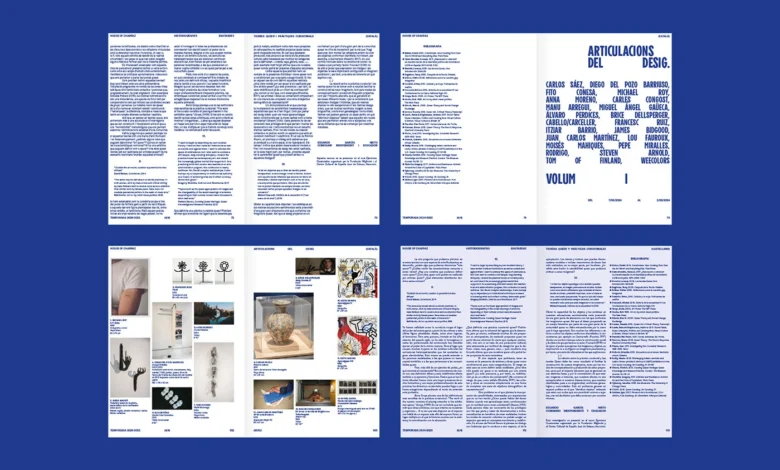
House of Chappaz, a leading contemporary art gallery with a significant presence in Barcelona and Valencia, has announced the launch of a highly specialized editorial system designed to document and elevate its 2024–2025 exhibition season. Developed in collaboration with the renowned design agency Toormix, the project represents a departure from traditional art cataloging, opting instead for a "living" publication model that evolves in real-time alongside the gallery’s programming. This initiative aims to provide a comprehensive archive of the gallery’s activities while simultaneously serving as a limited-edition collector’s object, reinforcing the institution’s commitment to high-concept aesthetic standards and artistic rigor.

The new editorial system is structured as a sequential series of four individual booklets, released throughout the academic and artistic year. Each booklet corresponds to a specific exhibition, numbered 1/4 through 4/4, and features continuous pagination to ensure that, when gathered, they form a cohesive single volume. This modular approach allows the gallery to maintain a consistent dialogue with its audience, providing timely documentation for each show while building toward a finalized seasonal archive. By the end of the 2024–2025 cycle, these components, along with supplementary materials, are housed in a bespoke, limited-edition box, of which only 200 numbered copies have been produced.
A Strategic Shift in Gallery Documentation
The commissioning of Toormix follows a long-standing relationship between the design studio and House of Chappaz. Previously responsible for the gallery’s visual identity, Toormix was tasked with expanding this brand language into a physical format that could capture the ephemeral nature of contemporary art exhibitions. The goal was to move beyond the static nature of a year-end retrospective and create a system that grows organically.
Industry analysts note that such high-investment physical publications are becoming increasingly rare in an era dominated by digital archives. However, for contemporary art galleries, the physical catalog remains a vital tool for "legitimizing" the work of emerging and established artists. By producing a meticulous, high-production-value object, House of Chappaz effectively raises the profile of its roster, offering artists a permanent, tactile record of their contributions to the 2024–2025 season.
The project also addresses the needs of the gallery’s target audience—collectors, curators, and art historians—who value the archival quality of print. The decision to limit the final boxed set to 200 copies introduces an element of scarcity, positioning the publication itself as an extension of the art sold within the gallery walls.

Technical Execution and the Rivelino Technique
The production of the House of Chappaz publications is characterized by its technical complexity and intentional use of artisanal printing methods. Central to the visual identity of the 2024–2025 series is the "rivelino" technique, also known as Split Fountain Printing. This process is conducted on an offset press and involves placing two different inks at opposite ends of the same ink duct. As the printing run progresses, the colors gradually merge in the center, creating an unpredictable and unique gradient on every sheet.
Because the colors blend dynamically during the press run, no two pages in the entire edition are identical. This mirrors the uniqueness of the artworks being documented. Toormix utilized a "living chromatic system" where the colors used in one booklet transition into the next. For example, the publication for the exhibition "W.O.R.M" utilized a palette of pink and lilac. In the subsequent publication, the lilac was retained while the pink was replaced by a Klein blue, creating a visual thread that connects the disparate exhibitions into a singular seasonal narrative.

The material selection further emphasizes the project’s archival ambitions. Each exhibition booklet utilizes a combination of two paper types:
- Bible Paper: Used for text-heavy sections, this thin, durable paper allows for a high page count without excessive bulk and responds well to the single-ink rivelino technique.
- Coated Calendered Paper: Used for the installation photograph booklet, this paper features a high-gloss mass varnish to ensure that the color reproduction of the artworks is as accurate and vibrant as possible.
The final component is a folded broadsheet featuring the gallery’s seasonal statement, providing a theoretical framework for the year’s programming. The entire collection is enclosed in a box printed on heavy black cardstock using a silver Pantone ink, which provides a sharp, professional contrast to the colorful interior booklets.

Chronology of the 2024–2025 Editorial Cycle
The rollout of the House of Chappaz editorial system follows a strict timeline aligned with the gallery’s exhibition calendar:
- Exhibition 1/4 Launch: The first booklet is released, establishing the initial color palette and the baseline for the continuous pagination.
- Sequential Releases (2/4 and 3/4): Subsequent booklets are published at the opening of each new exhibition. The "living chromatic system" evolves, dropping one color from the previous run and introducing a new one, ensuring a visual transition that reflects the changing themes of the gallery.
- Exhibition 4/4 and Documentation Phase: The final exhibition booklet is produced. Simultaneously, Joval Arderiu Studio completes the photography of all four installations.
- The Installation Booklet: A dedicated fifth booklet is produced at the end of the year, focusing exclusively on the spatial reality of the exhibitions, providing a "walkthrough" experience for the reader.
- Final Assembly and Distribution: The four exhibition booklets, the installation booklet, and the broadsheet are compiled into the bespoke silver-inked box. The 200 limited-edition copies are numbered and distributed to key stakeholders and collectors.
Supporting Data and Production Details
The sheer scale of the production involves a variety of specialized contributors and technical specifications that highlight the project’s premium nature.

- Total Papers Used: 5 distinct varieties, selected for texture, weight, and ink absorption.
- Total Inks: 9 specific inks, including various Pantone shades and the silver ink used for the exterior casing.
- Print Partnership: The printing was handled by Grafiko, a firm known for its expertise in complex offset projects and artisanal techniques like Split Fountain Printing.
- Photography: All installation views were captured by Joval Arderiu Studio, ensuring a consistent aesthetic style across the different exhibitions.
- Pagination: A continuous numbering system that spans all four booklets, emphasizing the unity of the season.
The use of 9 inks and 5 papers in a single seasonal project is significantly higher than the industry standard for art catalogs, which typically rely on standard four-color (CMYK) printing on a single paper stock. This investment underscores the gallery’s strategy of using design as a primary tool for brand differentiation.
Broader Implications for the Art and Design Industry
The House of Chappaz project serves as a case study for the "objectification" of information. In a landscape where exhibition details are readily available on websites and social media, the physical publication must offer something the digital realm cannot: a unique, tactile, and unrepeatable experience.

From a design perspective, Toormix’s use of the rivelino technique is a deliberate embrace of "controlled chance." In an era of digital perfection, the slight variations in color and the unpredictable gradients of the offset press provide a human touch that resonates with the handmade nature of fine art. This approach aligns with a broader trend in high-end editorial design where the process of making is as important as the content itself.
Furthermore, the project highlights the importance of the "seasonal archive" for contemporary galleries. By treating a year’s worth of exhibitions as a single, interconnected narrative, House of Chappaz is able to present a more cohesive vision to the public. It moves the conversation away from individual sales and toward the long-term legacy of the gallery as a cultural institution.

Official Responses and Strategic Vision
While official statements from the gallery emphasize the "legitimizing" power of the archive, the design team at Toormix has focused on the "attitude" of the piece. According to project documentation, the goal was to combine "rigor and attitude in every detail," creating a piece that would resonate with a "kindred audience"—namely, those who appreciate the intersection of avant-garde art and sophisticated graphic design.
The collaboration between House of Chappaz, Toormix, Grafiko, and Joval Arderiu Studio represents a holistic approach to gallery branding. It suggests that for a gallery to be successful in the current market, it must curate its own identity as carefully as it curates the art on its walls. The 2024–2025 editorial system is not merely a record of what happened; it is a statement of intent for what the gallery represents in the contemporary art ecosystem.

As the 2024–2025 season concludes, the release of the final 200 boxed sets will mark the completion of a year-long artistic and technical journey. These publications will likely serve as a benchmark for how art institutions can use print media to create lasting value in a digital-first world, ensuring that the ephemeral experience of a gallery visit is transformed into a permanent and collectible legacy.