The Two-Phase Performance Paradigm
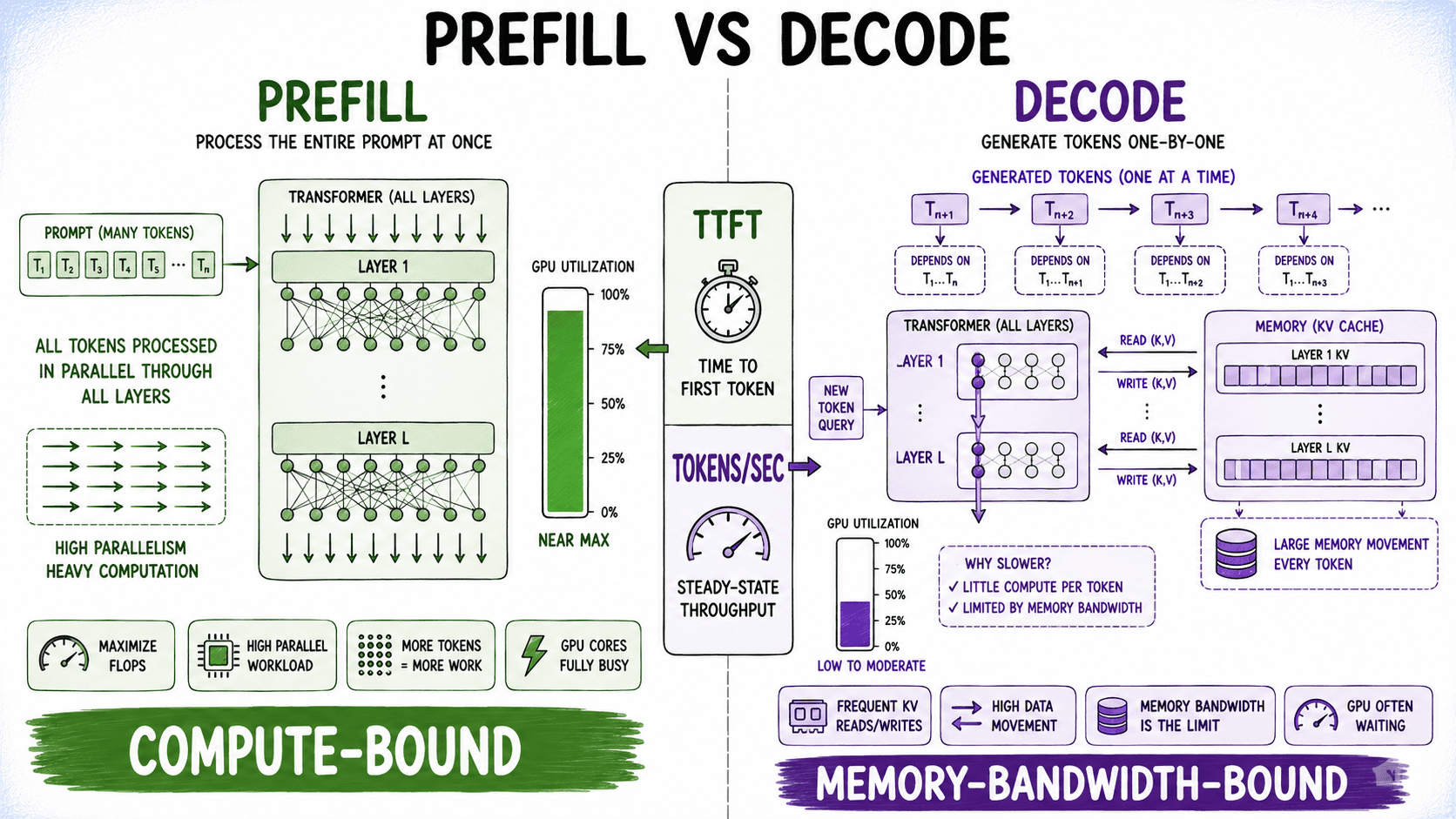
To optimize LLM inference, one must first recognize the fundamental split in the computational lifecycle of a model: the prefill phase and the decode phase. The prefill phase occurs when a model processes an entire input prompt. Because the system has access to the full input sequence simultaneously, it can maximize parallel computation across GPU cores. This phase is characteristically compute-bound, meaning the limiting factor is the raw mathematical throughput of the graphics processing unit.
Conversely, the decode phase—which generates output tokens one by one in an autoregressive fashion—is memory-bandwidth-bound. Each new token requires the model to read the entire set of parameters and the key-value (KV) states from memory. Because the GPU must wait for data to traverse the memory bus before it can perform the next operation, the bottleneck shifts from compute capacity to memory throughput. Consequently, benchmarks that focus solely on "Tokens Per Second" (TPS) often mask critical failures in "Time-to-First-Token" (TTFT), which is governed by the efficiency of the prefill stage. Understanding this distinction is the cornerstone of any high-performance architecture.
Managing the KV Cache: From Fragmentation to Efficiency
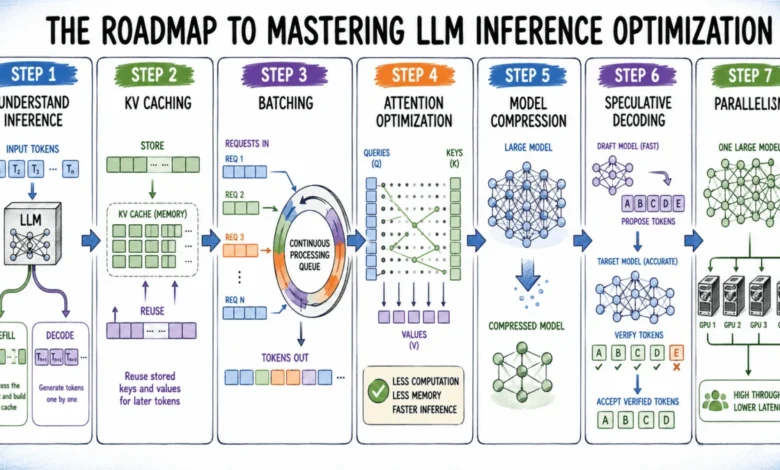
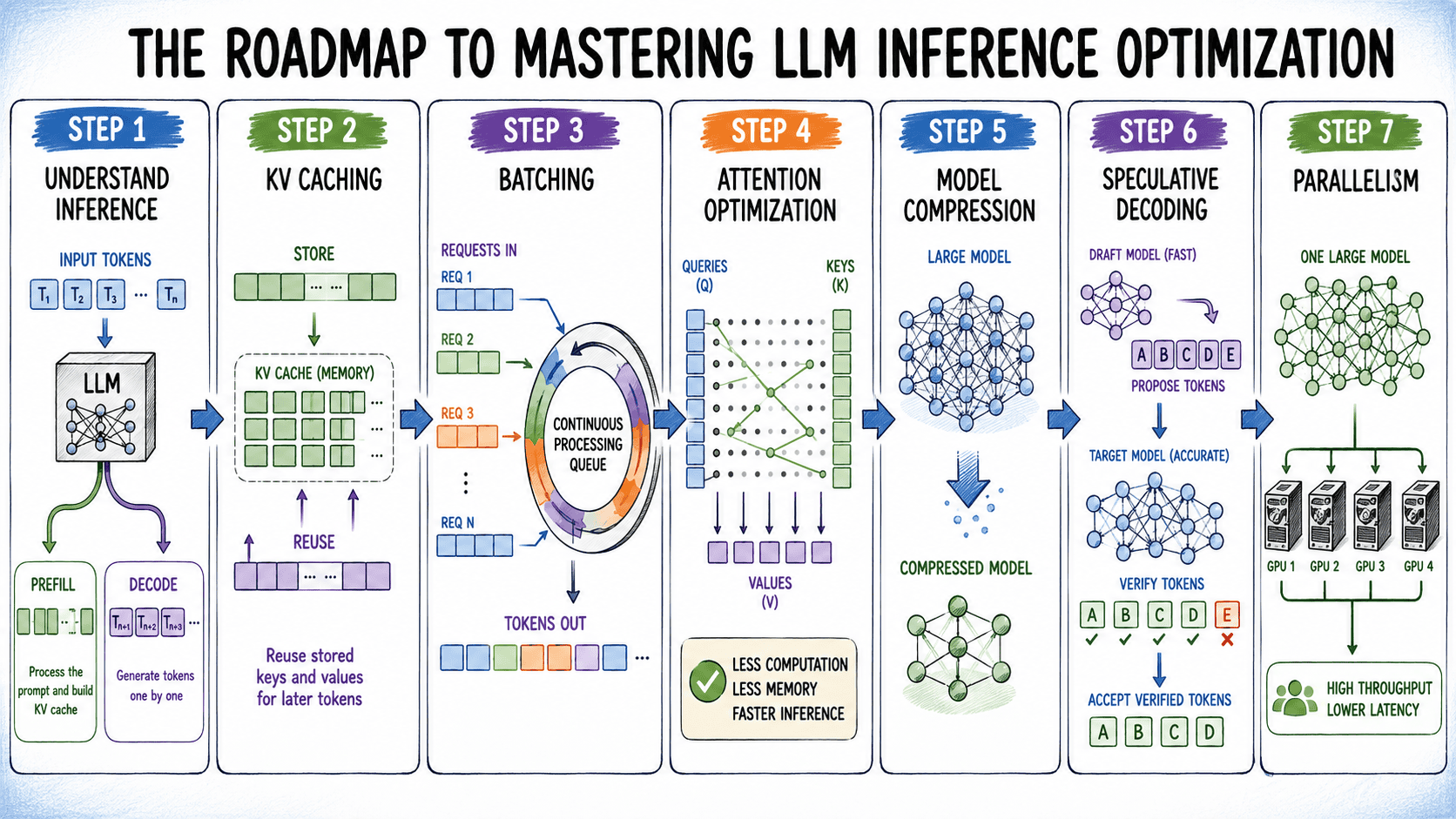
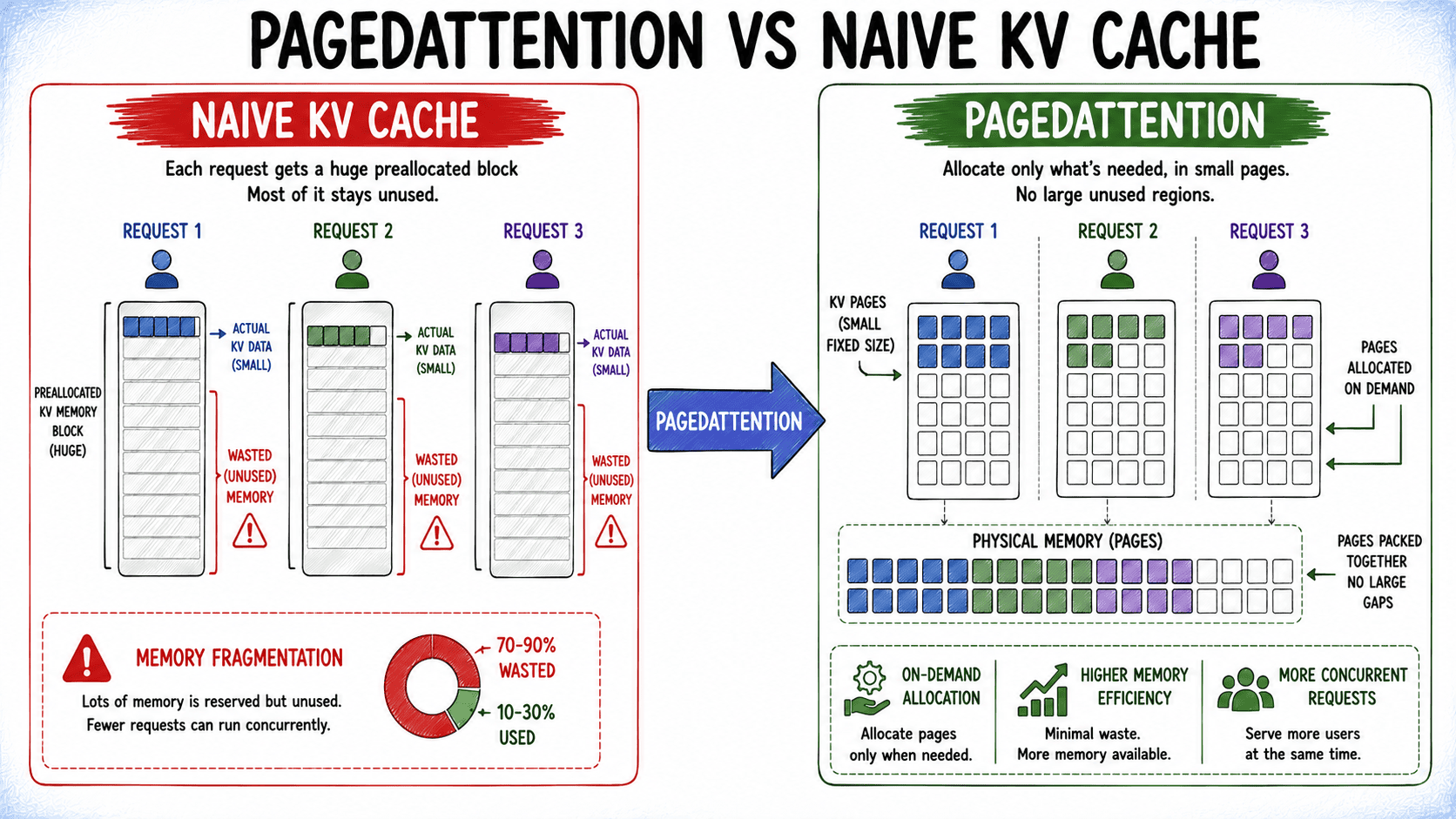
The KV cache is an essential memory-saving strategy that avoids the redundant recomputation of intermediate states during token generation. By storing the key and value tensors of previously generated tokens in VRAM, the model avoids recalculating the entire history for every new token. However, this convenience comes at a significant cost. As batch sizes increase and sequences grow to include thousands of tokens, the memory footprint of the KV cache can consume the majority of a GPU’s available VRAM.
Traditional approaches to memory management often resulted in severe fragmentation, as developers would pre-allocate memory for the maximum possible sequence length to avoid runtime failures. This "over-provisioning" leads to massive wastage. Modern runtimes have pivoted toward PagedAttention, a mechanism inspired by virtual memory systems in operating systems. By partitioning the KV cache into fixed-size blocks, PagedAttention allows for non-contiguous allocation on demand. This granular control dramatically improves memory utilization, enabling developers to increase batch sizes without proportionally increasing hardware requirements. Furthermore, prefix caching—a technique that reuses KV cache states for common system prompts or long-context documents—further reduces redundant computation, a vital optimization for Retrieval-Augmented Generation (RAG) pipelines.
The Evolution of Batching: Towards Continuous Throughput
Optimizing GPU utilization is synonymous with effective batching. If a GPU processes requests one by one, the vast majority of its massive parallel-processing capacity sits idle. While static batching—the practice of grouping requests into fixed sets—is an intuitive starting point, it is notoriously inefficient. Because LLMs generate responses of varying lengths, static batches are held hostage by the slowest request in the group. If one request takes 500 tokens to complete while others take 50, the entire batch remains locked until the longest sequence concludes.
Continuous batching, or in-flight batching, has emerged as the industry standard to solve this latency imbalance. By allowing the engine to "top off" the batch as soon as an individual sequence completes, the system maintains consistent GPU saturation. This architecture ensures that shorter requests are not stalled by long-running generation tasks, resulting in significantly higher throughput and reduced average latency for the end user. Leading inference runtimes, including vLLM and TensorRT-LLM, now implement continuous batching as a core feature, signaling a shift toward more dynamic, interrupt-driven request management.
Architecture-Level Attention Variants
Attention is the engine of the transformer architecture, yet it remains computationally expensive. Standard Multi-Head Attention (MHA) creates significant memory pressure during the decode phase due to the sheer volume of key and value heads that must be stored and accessed. Multi-Query Attention (MQA) and Grouped-Query Attention (GQA) represent significant architectural evolutions by allowing multiple query heads to share a smaller subset of key and value heads. These techniques dramatically reduce the memory traffic required during each step of generation.
Furthermore, FlashAttention has revolutionized performance by optimizing the physical movement of data within the GPU. Rather than writing intermediate attention matrices to slower global memory, FlashAttention uses tiling to perform operations within the faster on-chip SRAM. This mathematical restructuring provides a substantial speedup without changing the model’s weights or output, making it an essential, low-risk optimization for any production deployment.
Model Compression and the Future of Deployment
As models grow in size, the hardware requirements to serve them often exceed the budget of smaller teams. Model compression—specifically through quantization, sparsity, and knowledge distillation—is essential for democratization. Quantization, which reduces the numerical precision of weights from 16-bit to 8-bit or 4-bit, allows models to fit into significantly smaller memory footprints with negligible loss in accuracy. Techniques like GPTQ and AWQ have made 4-bit quantization highly robust for production environments.
In addition to quantization, hardware-level support for structured sparsity (such as the 2:4 sparsity pattern in NVIDIA’s Ampere architecture) provides a path to doubling throughput for compatible layers. Meanwhile, knowledge distillation remains a critical path for high-latency requirements. By training smaller "student" models to emulate the decision-making of massive "teacher" models, organizations can achieve high-performance outputs while running on hardware that is significantly more affordable and easier to scale.
Speculative Decoding and Parallel Scaling
For applications where latency is the ultimate metric, speculative decoding provides an elegant solution. By utilizing a small, lightweight draft model to predict the next few tokens, and a larger model to verify those tokens in a single parallel pass, developers can achieve multi-token generation per cycle. If the draft model is accurate, the latency savings are substantial. This method is particularly effective for interactive chat applications where the sequence is generated sequentially and the benefits of traditional batching are limited.
Finally, for the most demanding workloads, horizontal and vertical scaling through tensor and pipeline parallelism remains the standard. Tensor parallelism splits the weight matrices across multiple GPUs, while pipeline parallelism distributes layers across devices. The emerging pattern of "prefill-decode disaggregation" takes this further by routing requests to separate hardware clusters based on whether they are in the compute-heavy prefill stage or the memory-heavy decode stage.
Implications for the Industry
The shift toward these advanced inference techniques represents a maturation of the AI industry. We are moving away from the "bigger is better" era toward an era of engineering efficiency. The implications are clear: the winners in the generative AI space will not necessarily be those with the largest models, but those with the most efficient inference stacks. Organizations that master these optimizations—from KV cache management to speculative decoding—will be able to deliver AI services that are not only faster and more reliable but fundamentally more cost-effective. As context windows continue to expand and demand for real-time interaction grows, these technical optimizations will remain the defining differentiator between sustainable AI products and those that collapse under the weight of their own scale.