Ulanzi Launches D200X Creative Deck Command Pad to Streamline Professional Video and Livestream Workflows

The landscape of digital content creation has undergone a significant transformation, moving from simple webcam setups to complex, multi-device studio environments. In response to this evolution, Ulanzi has officially announced the release of the D200X Creative Deck, a multi-functional control hub designed to serve as the central nervous system for videographers, editors, and broadcasters. Retailing at an introductory price of $95.99, the D200X represents a strategic expansion for Ulanzi, a company traditionally known for its camera accessories and lighting solutions, as it moves deeper into the hardware-software integration market. This new device aims to address the common bottlenecks in post-production and live production by combining tactile macro controls with a high-density 8-in-1 docking station.
The D200X Creative Deck is positioned as a successor to the earlier D200 model, reflecting a significant leap in both ergonomic design and technical capability. At its core, the device is built to facilitate faster interaction with complex software suites, such as Adobe Premiere Pro, DaVinci Resolve, and OBS Studio. By moving frequently used commands from keyboard shortcuts to a dedicated physical interface, the D200X seeks to reduce cognitive load and physical strain during long editing sessions. The introduction of this device comes at a time when the "Creator Economy" is projected to grow into a multi-billion dollar industry, driving demand for affordable yet professional-grade tools that can bridge the gap between amateur setups and high-end broadcast consoles.
Technical Architecture and Tactile Interface
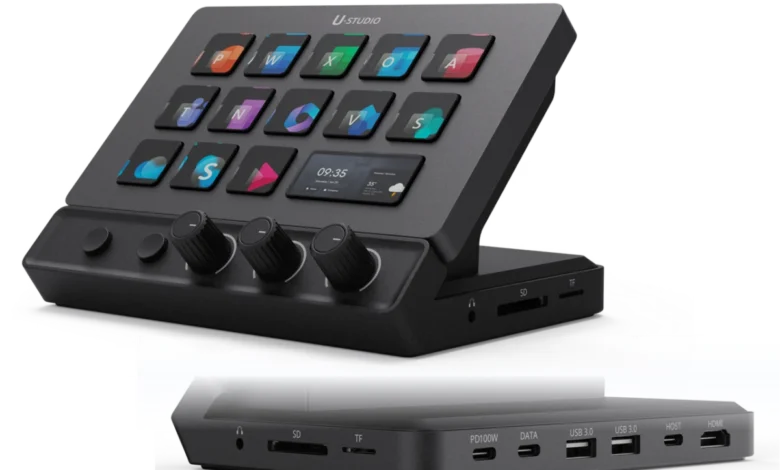
The physical layout of the Ulanzi D200X is engineered for high-frequency use. It features 14 customizable LCD keys, which provide visual feedback for assigned macros. Unlike traditional static buttons, these LCD keys allow users to upload custom icons, enabling immediate recognition of functions regardless of the software being used. Flanking these keys are three programmable rotary knobs and two paging buttons. The inclusion of rotary encoders is a critical update from previous iterations, as they provide the precision required for granular adjustments in audio mixing, color grading, and timeline scrubbing.
In professional video editing, the ability to "feel" a parameter change—such as shifting a color wheel or adjusting a volume fader—is often cited as a major factor in productivity. The D200X’s knobs allow for these fine-tuned interactions, which are typically difficult to achieve with a standard mouse and keyboard. The paging buttons further extend the device’s utility, allowing users to cycle through different "layers" of commands. For instance, a user could have one page dedicated to video cutting, another for color correction, and a third for managing livestream overlays, effectively providing dozens of shortcuts within a compact desktop footprint.
The 8-in-1 Docking Station: Peripheral Consolidation
One of the most distinct features of the D200X, which sets it apart from competitors like the Elgato Stream Deck or Loupedeck, is its integrated 8-in-1 I/O matrix. Modern laptops, particularly those favored by mobile creators, often suffer from a lack of connectivity ports. The D200X addresses this by functioning as a high-speed docking station. The integrated hardware includes a Power Delivery (PD) charging port, high-speed data transfer ports (USB-C and USB-A), and a 4K-capable HDMI output.
This integration serves a dual purpose: it declutters the workspace by replacing multiple dongles and provides a stable power source for the creator’s primary machine. The 4K HDMI output is particularly significant for editors who require a secondary monitor for previewing timelines or managing assets. By routing the display through the D200X, users can maintain a streamlined cable management system. Furthermore, the inclusion of audio monitoring capabilities ensures that creators can manage their sound levels directly from the hub, consolidating audio and video management into a single hardware interface.
Software Ecosystem and Ulanzi Studio 3.0
The hardware capabilities of the D200X are supported by the Ulanzi Studio 3.0 software ecosystem. This platform is designed as an open control system, moving away from the restrictive "walled garden" approach often seen in proprietary hardware. Ulanzi Studio 3.0 facilitates the mapping of hardware buttons to software actions, supporting a wide range of creative workflows, including image processing, automation, and livestream management.
A key differentiator for the Ulanzi ecosystem is its accessibility. The software removes common usage barriers, such as mandatory account registrations or subscription-based features. This "plug-and-play" philosophy is intended to appeal to professionals who require reliable tools without the friction of ongoing administrative requirements. To ensure long-term viability, Ulanzi has committed to a roadmap of regular updates, which will include new plugins and presets. This allows the device to adapt as new creative software enters the market or as existing programs update their API protocols.
The Dial Editing Assistant and Studio Integration
To further enhance the precision of the D200X, Ulanzi has introduced a companion accessory: the Dial Editing Assistant. This wireless rotary controller is specifically optimized for timeline navigation and parameter fine-tuning. The Dial connects via Bluetooth and can support up to three devices simultaneously, providing a flexible interface that can be moved around the desk independently of the main deck.
The synergy between the D200X and the Dial Editing Assistant highlights Ulanzi’s broader ambition to create a unified studio environment. The D200X is capable of controlling not just software, but also physical hardware within the Ulanzi catalog. This includes the brand’s extensive line of LED lighting systems. Furthermore, the device integrates with third-party smart home platforms, including Philips Hue, Home Assistant, Govee, Nanoleaf, and Yeelight. This allows a creator to trigger a "Recording" macro that simultaneously opens their streaming software, dims the room lights, turns on the studio key lights, and sets their status to "Do Not Disturb" across their devices.
Chronology of Development and Market Context
The release of the D200X is the culmination of several years of iterative development by Ulanzi. Founded in 2015, Ulanzi initially focused on mobile photography accessories, such as smartphone cages and compact tripods. As the definition of "content creator" expanded to include professional-level YouTubers and Twitch streamers, the company began diversifying into more complex electronic hardware.
The original D200 served as a proof-of-concept for a tactile control deck, but user feedback indicated a need for more robust I/O options and more precise rotary controls. The D200X is the direct result of that feedback. By pricing the unit at under $100, Ulanzi is positioning itself as a high-value alternative to established market leaders. For comparison, professional editing consoles from brands like Blackmagic Design or specialized control surfaces from Loupedeck often retail for two to five times the price of the D200X.
Broader Impact and Industry Implications
The introduction of the D200X may signal a shift in the democratization of professional editing workflows. Historically, tactile control surfaces were the exclusive domain of high-end post-production houses and television studios. As hardware costs decrease and software integration becomes more seamless, these tools are becoming accessible to independent creators and small production teams.
Industry analysts suggest that the integration of docking stations with control surfaces represents a logical evolution in desktop ergonomics. By combining power, data, and control into one unit, manufacturers are catering to the "minimalist" aesthetic currently popular in the workstation market while simultaneously increasing functional density. The D200X’s ability to interface with smart home lighting further suggests that the boundaries between "home" and "studio" are continuing to blur, requiring devices that can manage both environmental and digital variables.
Availability and Future Outlook
The Ulanzi D200X is currently available for purchase through the company’s official website and authorized global retailers. As the device reaches the hands of the first wave of users, the focus will shift toward the developer ecosystem hosted at Ulanzi’s dedicated portal. This developer-centric approach is intended to foster a community-driven library of plugins, potentially allowing the D200X to support niche software or custom automation scripts that go beyond the factory presets.
In the coming months, the D200X is expected to undergo rigorous field testing by independent reviewers and industry professionals. These evaluations will likely focus on the durability of the rotary knobs, the latency of the LCD keys, and the stability of the Ulanzi Studio 3.0 software under heavy multi-tasking loads. If the D200X performs as advertised, it could establish Ulanzi as a formidable player in the creative hardware market, challenging the dominance of more expensive, specialized brands and providing creators with a versatile tool to optimize their digital production pipelines.