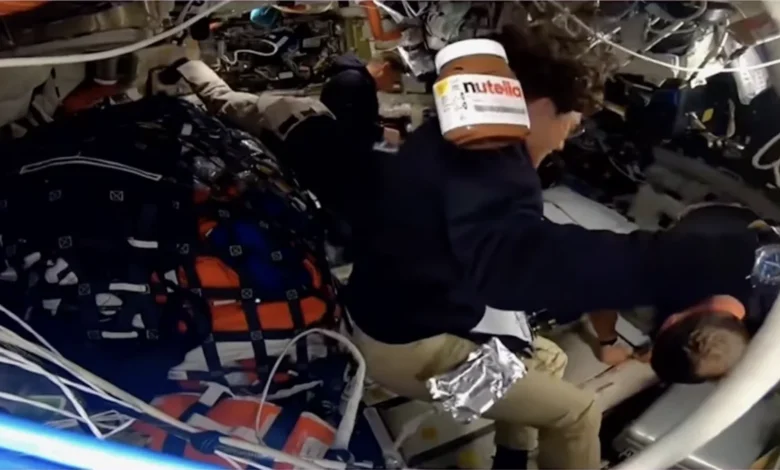
As NASA’s Artemis II mission etched its name into the annals of space exploration, carrying four astronauts farther from Earth than any humans have ever journeyed, an unexpected, yet utterly familiar, item captured global attention: a jar of Nutella. This iconic hazelnut spread was observed drifting serenely within the microgravity environment of the Orion spacecraft cabin, a peculiar companion to the pioneering crew moments before they surpassed the half-century-old distance record set by Apollo 13 in 1970. The sighting, broadcast live during NASA’s official mission coverage, swiftly transformed a routine aspect of astronaut life into an internet sensation, sparking widespread amusement, viral memes, and an intriguing discussion about product placement in the final frontier.
The Artemis II Mission: A New Chapter in Lunar Exploration
The Artemis II mission represents a pivotal step in NASA’s ambitious Artemis program, designed to return humanity to the Moon, establish a sustainable lunar presence, and ultimately pave the way for human missions to Mars. Launched on April 6, 2026, the mission marked the first crewed flight test of the Orion spacecraft and the Space Launch System (SLS) rocket, a super heavy-lift launch vehicle representing the pinnacle of modern rocketry. Unlike its uncrewed predecessor, Artemis I, which successfully completed a test flight around the Moon in late 2022, Artemis II carries a crew of four highly experienced astronauts: Commander Reid Wiseman, Pilot Victor Glover, and Mission Specialist Christina Koch, all from NASA, alongside Mission Specialist Jeremy Hansen of the Canadian Space Agency (CSA). This international collaboration underscores the global effort behind humanity’s renewed push into deep space.
The primary objective of Artemis II is to perform a lunar flyby, testing Orion’s critical systems with humans aboard in the deep space environment. This includes verifying life support systems, communications, and navigation capabilities beyond low-Earth orbit. The mission profile involves a trans-lunar injection maneuver, propelling Orion towards the Moon, where it will execute a free-return trajectory before heading back to Earth. The journey is designed to push the boundaries of human spaceflight, reaching a maximum distance of approximately 400,171 kilometers (248,655 miles) from Earth, a point farther than any human has ever ventured. This record was officially broken minutes after the Nutella jar made its cinematic debut.
A Sweet Moment in Microgravity: The Nutella Phenomenon
The viral moment unfolded during a live broadcast from inside the Orion capsule. As viewers around the world tuned in to witness this historic voyage, the camera panned across the interior of the spacecraft, revealing the crew at work. Amidst the high-tech equipment and scientific instruments, a small, familiar glass jar with its distinctive red-and-white label was seen gently floating, untethered, in the cabin’s microgravity. The sight of the Nutella jar, a staple in countless pantries worldwide, juxtaposed against the backdrop of humanity’s furthest journey into space, immediately resonated with the online community.
Social media platforms erupted with reactions. Users shared screenshots and video clips of the floating jar, often accompanied by humorous captions. Jokes quickly circulated about Nutella having now traveled farther from Earth than any human in history, playfully sidestepping the fact that it was merely a passive observer to the astronauts’ record-breaking journey. The hashtag #NutellaInSpace began trending, transforming a minor, almost incidental detail into a major talking point. Many users also speculated, half-jokingly, that this was the "most valuable product placement imaginable," a "free ad from space" for Ferrero, the Italian confectionery giant behind the spread. This sentiment was echoed in discussions comparing it to other unexpected brand appearances in space, such as the Apple iPhone 17 Pro Max, which was also reportedly used to capture images during the mission.

NASA’s Official Stance: No Brand Deals in Orbit
Amidst the online frenzy and speculation about a potential commercial endorsement, NASA was quick to clarify the situation. In a statement provided to Futurism by agency press secretary Bethany Stevens, NASA explicitly stated that it "does not select crew meals or food in association with brand partnerships." Stevens further clarified that the Nutella appearance "was not a product placement." This official denial aimed to quash any suggestions of commercial bias or promotional deals influencing the provisions carried aboard a scientific mission.
NASA’s policy strictly adheres to principles of objectivity and scientific integrity. While astronauts are permitted to bring a limited number of personal items and select certain comfort foods to help with morale during long-duration missions, these choices are not dictated by external commercial interests. The agency maintains a rigorous selection process for all provisions, prioritizing nutritional value, shelf stability, and suitability for the microgravity environment, rather than brand visibility. The Nutella jar, therefore, was simply an item chosen by one of the crew members, likely for personal consumption, and its appearance in the live feed was purely coincidental, albeit highly photogenic.
The Evolution of Space Cuisine and Astronaut Morale
The presence of a seemingly ordinary food item like Nutella aboard a cutting-edge spacecraft highlights the significant evolution of space food and the increasing emphasis on astronaut well-being. Early space missions, particularly during the Mercury and Apollo eras, featured highly functional but often unappetizing meals consisting of purees, dehydrated cubes, and squeeze-tube foods. The primary concerns were nutritional sustenance, minimal weight, and ease of consumption in zero-G. Taste and variety often took a backseat.
However, as missions grew longer, extending from days to months and even years on the International Space Station (ISS), the psychological impact of monotonous food became a critical consideration. Astronauts reported a diminished sense of taste in microgravity, often preferring strong, spicy, or flavorful foods. Modern space cuisine has adapted dramatically to address these challenges. Today, astronauts on missions like Artemis II enjoy a far more diverse and palatable menu, designed not only for nutrition but also for comfort and morale.
The Artemis II crew’s reported menu is indeed "stacked," featuring a diverse array of dishes that aim to provide both sustenance and a taste of home. Items such as barbecue beef brisket, macaroni and cheese, cauliflower and broccoli au gratin, tortillas, hot sauce, and coffee demonstrate a conscious effort to include familiar, flavorful options. Tortillas, for instance, are highly favored in space as a bread substitute because they don’t produce crumbs that could float and interfere with equipment. Hot sauce is a perennial favorite, helping to overcome the blunted sense of taste. The Nutella, in this context, fits perfectly as a "mid-flight snack" – a small, sweet indulgence that can provide a momentary sense of normalcy and comfort amidst the extraordinary rigors of deep space travel. It serves as a reminder that even record-breaking astronauts, pushing the boundaries of human endeavor, still crave the simple pleasures of a familiar treat.
Broader Implications: Public Engagement and Unintended Marketing

While NASA denied any intentional product placement, the viral spread of the Nutella image undeniably provided Ferrero with an unprecedented level of global brand exposure. The value of such "earned media" – publicity gained through promotional efforts other than paid advertising – is immense. To have a product associated, even inadvertently, with a historic NASA mission and beamed across the internet to millions of viewers is an advertising coup that money simply cannot buy. It underscores how easily everyday objects can capture public imagination when placed in extraordinary contexts.
Beyond the commercial aspect, the Nutella moment also serves as a powerful example of how relatable, human elements can significantly enhance public engagement with complex scientific endeavors. For many, the intricacies of orbital mechanics, propulsion systems, or life support technologies can be abstract and daunting. However, seeing a jar of Nutella floating in space instantly humanizes the mission. It connects the vast, unfathomable expanse of space with the mundane realities of daily life, making the astronauts’ journey feel more tangible and accessible. This kind of viral moment helps to bridge the gap between cutting-edge science and the general public, fostering interest and excitement in space exploration. It reminds people that behind the helmets and sophisticated machinery are human beings with human needs and desires, including a craving for a sweet treat.
The incident also highlights the evolving landscape of science communication in the digital age. In an era dominated by social media, unexpected visuals and human-interest stories often cut through the noise more effectively than traditional press releases. NASA, despite its official denial of product placement, tacitly benefits from these moments of organic virality, as they draw new audiences to its mission and inspire a new generation to look to the stars.
The Chronology of Humanity’s Lunar Aspirations
To fully appreciate the significance of Artemis II and its incidental Nutella passenger, it’s essential to place it within the broader timeline of lunar exploration:
- 1961-1972: The Apollo Program. NASA’s seminal program that first landed humans on the Moon.
- 1969: Apollo 11. Neil Armstrong and Buzz Aldrin become the first humans to walk on the Moon.
- 1970: Apollo 13. Despite a critical in-flight emergency, the crew successfully returned to Earth, setting the record for the farthest human travel from Earth at 400,171 kilometers (248,655 miles). This record stood for over half a century.
- 2017: Establishment of the Artemis Program. NASA announces its new lunar exploration initiative.
- 2022: Artemis I. The uncrewed test flight of the Orion spacecraft and SLS rocket successfully orbits the Moon and returns, paving the way for crewed missions.
- April 6, 2026: Artemis II. The first crewed test flight, carrying Commander Reid Wiseman, Pilot Victor Glover, Mission Specialist Christina Koch, and Mission Specialist Jeremy Hansen, breaks Apollo 13’s distance record during its lunar flyby. The Nutella jar makes its unexpected appearance.
- Future (Targeted 2027/2028): Artemis III. Planned to be the first mission to land humans on the lunar south pole, including the first woman and person of color on the Moon.
- Beyond: Artemis IV and subsequent missions. Aim to establish a sustained human presence on and around the Moon, utilizing the Gateway lunar orbital outpost, and developing technologies for future missions to Mars.
The journey of the Nutella jar, from an Italian factory to the farthest reaches of human space travel, is a quirky footnote in this grand narrative. It reminds us that while the objectives of space exploration are profound and scientific, the human element – with its simple comforts and occasional viral moments – remains at its heart. As humanity continues its audacious push beyond Earth, it seems even our favorite snacks are along for the ride, making history one sweet, hazelnut-infused moment at a time. The Artemis II mission is a testament to human ingenuity and collaboration, and the floating Nutella jar, a testament to the enduring power of relatable imagery in a world captivated by the cosmos.